Chesta Teachers, Training College

About Chesta Teachers Training College

About Us

Chesta Teachers college is a prime institution in the country .

The College is committed to continuous improvement and quality in research and Teaching activities

We pride our selves in offering Quality and Market oriented Education in in various fields.

Administrative Structure

Discipline

Professionalism

Quality and relevance

Excellence

Integrity

To Train disciplined resource that meets the country’s needs; Disseminate knowledge and skills in education.

A leading teacher training college in academic excellence and social welfare

Chesta Teacher Training College is a public teacher training college in west pokot county.

We are located in pokot central sub-county in Lomut ward.

Increase access to teachers training education.

Train to produce well educated, skilled and competent manpower

P1 teachers – Both regular and schoolbased

Diploma teachers

Certificate and Diploma ECD teacher

ICT Courses

To established and maintained learning infrastructure

About Chesta Teachers Training College

Vision:
A leading teacher training college in academic excellence and social welfare

Mission:
To Train disciplined resource that meets the country’s needs; Disseminate knowledge and skills in education.

Motto:
Discipline for Excellence.

Chesta Teachers Training College details

  •  Address: P.O. Box: 5 – 30603 Wei wei,
    West Pokot, Kenya.
  •  Location: West Pokot, Kenya
  •  Telephone Number: +254 722 272 884
  •  Email Address: [email protected]
  •  Website: http://chestattc.ac.ke/
A LIST OF PUBLIC TEACHERS’ COLLEGES ; 12, Kaimosi Teachers‘ Training College, Vihiga ; 13, Kamwenja Teachers Training College, Nyeri ; 14, Read more Kenya Science Teachers …
A LIST OF PUBLIC TEACHERS’ COLLEGES ; 12, Kaimosi Teachers‘ Training College, Vihiga ; 13, Kamwenja Teachers Training College, Nyeri ; 14, Kenya Science Teachers …Read more

Related: Kuccps list of all Colleges in Kenya, Their Codes and Courses

Best Teachers Training Colleges (TTC) In Kenya (Public & Private) 

If you are looking for a good college to pursue your teaching career, below is a list of the best Teachers Training Colleges in Kenya that…

List of Best, Top Teachers Training Colleges TTC in Kenya Today

Latest List of registered Public Teachers Training Colleges per county in Kenya Teachers’ Training College-TTC County 1.       Asumbi Teachers College, ATC Homa Bay 2.       Baringo Teachers Training College, BTTC Baringo 3.       Bondo Teachers Training…

Latest List of best Public and Private Teachers Training Colleges-TTC in Kenya

Full List of registered public Teachers training colleges per county Teachers’ Training College-TTC County 1.       Asumbi Teachers College, ATC Homa Bay 2.       Baringo Teachers Training College, BTTC Baringo 3.       Bondo Teachers Training College Siaya 4.       Bomet Teachers’…
List of all public and private Teacher Training Colleges, TTCs, in Kenya.

Full list of all best top performing Teacher Training Colleges (TTC) in Kenya

There are quite a number of Teacher Training Colleges in Kenya. These Colleges are either Public (Government owned) or private. Admissions to the Public…
Langata High School- one of the Covid19 isolation centres in Nairobi County.

List of teachers who have completed the Diploma in Education (CBC upgrade)

List of teachers who have completed the Diploma in Education (CBC upgrade). Here is a list of teachers who have attained the Diploma in Education,…

Eight Teachers colleges selected to offer Education Diploma Upgrading programme

Eight Teachers colleges selected to offer Education Diploma Upgrading programme Primary school teachers are set to start their Diploma Upgrading programme in various Teacher Training…

Kuccps list of all Colleges in Kenya, Their Codes and Courses

Kuccps list of all Colleges in Kenya, Their Codes and Courses KEY NAME CATEGORY S. TYPE ABERDARE TTC ABERDARE TEACHERS TRAINING COLLEGE College Public ASM TTI AHMED SHAHAME MWIDANI TECHNICAL TRAINING INSTITUTE College Public ALDAITTI ALDAI TECHNICAL TRAINING…

List of all best Colleges in Kenya and their Courses

List of all best Colleges in Kenya and their Courses S/No KEY NAME CATEGORY S. TYPE 1 ABERDARE TTC ABERDARE TEACHERS TRAINING COLLEGE College Public 4 ASM TTI AHMED SHAHAME MWIDANI TECHNICAL TRAINING INSTITUTE College Public 5 ALDAITTI ALDAI TECHNICAL TRAINING INSTITUTE College Public 7 ALUPE…

Latest list of all Colleges in Kenya – KUCCPS List

Here is a list of all public and private Colleges accredited by KUCCPS in Kenya: KEY NAME CATEGORY S. TYPE ABERDARE TTC ABERDARE TEACHERS TRAINING COLLEGE College Public ASM TTI AHMED SHAHAME MWIDANI TECHNICAL…

KUCCPS accredited Public Colleges in Kenya

Here is the complete and latest list of Public Colleges accredited by KUCCPS in Kenya: KEY NAME CATEGORY S. TYPE ABERDARE TTC ABERDARE TEACHERS TRAINING COLLEGE College Public ASM TTI AHMED SHAHAME MWIDANI TECHNICAL…

Latest Ongoing Teachers Service Commission (TSC) News- TSC News Today

The Teachers Service Commission (TSC) Kenya is a body in charge of the employment of Primary and Secondary School Teachers in Kenya. This body…

Kuccps latest list of Public Colleges; Plus their Codes, Courses

Kuccps latest list of Public Colleges; Plus their Codes, Courses # KEY NAME CATEGORY INSTITUTION TYPE PARENT MINISTRY 3 ASM TTI AHMED SHAHAME MWIDANI TECHNICAL TRAINING INSTITUTE College Public Ministry of Education 4 ALDAITTI ALDAI TECHNICAL TRAINING INSTITUTE College Public Ministry of…
Eregi Teachers' College guide.

Diploma Teachers Training Colleges 2023 Revised Term Dates

The Ministry of education has released the 2023 term dates for all Teachers Training Colleges (TTCs). Secondary school trainee teachers will report for their…

Top ten best teachers training colleges in Kenya 2022-2023

Here is a list of the best 10 Teacher Training Colleges in Kenya, today: 1. Asumbi Teachers Training College Located in Homa Bay County, this college…
narok teachers training college fee structure
narok teachers training college contacts
narok ttc admission letter
narok teachers training college graduation
narok ttc application form pdf
how to apply for teachers training college?
teachers training college requirements
eldoret teachers training college online application
teachers training colleges in nairobi
teachers training college intake 2023 in kenya
teachers training college requirements
best teachers training colleges in nairobi
kenya teachers training college courses
thika teachers training college
p1 teachers training colleges in nairobi
machakos teachers training college

Moi Girls High School Eldoret KCSE 2025 Joint Exam Papers & Answers

Moi Girls High School Eldoret KCSE 2025 Joint Exam Papers & Answers

MOI GIRLS PHYC PP3 CONF.pdf
MOI GIRLS PHYC PP3 CONF.docx
MOI GIRLS PHYC PP3 2025 PREDICTIONS.pdf
MOI GIRLS CHEM PP3 CONF.pdf
MOI GIRLS CHEM PP3 2025 PREDICTIONS.pdf
MOI GIRLS CHEM PP3 2025 PREDICTIONS.docx
MOI GIRLS BIO PP3 CONF.pdf
MOI GIRLS BIO PP3 CONF.docx
MOI GIRLS BIO PP3 2025 PREDICTIONS.pdf
MOI GIRLS CRE PP1 2025 PREDICTIONS.pdf
MOI GIRLS CRE PP1 2025 PREDICTIONS.docx
MOI GIRLS HOME SCI PP3 2025 PREDICTIONS.pdf
MOI GIRLS HOME SCI PP3 2025 PREDICTIONS.docx
MOI GIRLS HOME SCI PP2 2025 PREDICTIONS.pdf
MOI GIRLS HOME SCI PP2 2025 PREDICTIONS.docx
MOI GIRLS HOME SCI PP1 2025 PREDICTIONS.pdf
MOI GIRLS HOME SCI PP1 2025 PREDICTIONS.docx
MOI GIRLS COMP PP2 2025 PREDICTIONS.pdf
MOI GIRLS COMP PP1 2025 PREDICTIONS.pdf
MOI GIRLS COMP PP1 2025 PREDICTIONS.docx
MOI GIRLS MATH PP2 2025 PREDICTIONS.pdf
MOI GIRLS MATH PP2 2025 PREDICTIONS.docx
MOI GIRLS MATH PP1 2025 PREDICTIONS.pdf
MOI GIRLS BIO PP2 2025 PREDICTIONS.pdf
MOI GIRLS BIO PP1 2025 PREDICTIONS.pdf
MOI GIRLS PHYC PP2 2025 PREDICTIONS.pdf
MOI GIRLS PHYC PP2 2025 PREDICTIONS.docx
MOI GIRLS PHYC PP1 2025 PREDICTIONS.pdf
MOI GIRLS CHEM PP2 2025 PREDICTIONS.pdf
MOI GIRLS CHEM PP2 2025 PREDICTIONS.docx
MOI GIRLS CHEM PP1 2025 PREDICTIONS.pdf
MOI GIRLS BST PP2 2025 PREDICTIONS.pdf
MOI GIRLS BST PP2 2025 PREDICTIONS.docx
MOI GIRLS BST PP1 2025 PREDICTIONS.pdf
MOI GIRLS AGRI PP2 2025 PREDICTIONS.pdf
MOI GIRLS AGRI PP2 2025 PREDICTIONS.docx
MOI GIRLS AGRI PP1 2025 PREDICTIONS.pdf
MOI GIRLS AGRI PP1 2025 PREDICTIONS.docx
MOI GIRLS KISW PP3 2025 PREDICTIONS.pdf
MOI GIRLS KISW PP3 2025 PREDICTIONS.docx
MOI GIRLS KISW PP2 2025 PREDICTIONS.pdf
MOI GIRLS KISW PP1 2025 PREDICTIONS.pdf
MOI GIRLS KISW PP1 2025 PREDICTIONS.docx
MOI GIRLS ENG PP3 2025 PREDICTIONS.pdf
MOI GIRLS ENG PP3 2025 PREDICTIONS.docx
MOI GIRLS ENG PP2 2025 PREDICTIONS.pdf
MOI GIRLS ENG PP1 2025 PREDICTIONS.pdf
MOI GIRLS ENG PP1 2025 PREDICTIONS.docx
MOI GIRLS GEO PP2 2025 PREDICTIONS.pdf
MOI GIRLS GEO PP1 2025 PREDICTIONS.pdf

FORM 4 AGRICULTURE SCHEMES OF WORK

SCHEME  OF  WORK           AGRICULTURE  FORM  FOUR             TERM  ONE  

WK/NO

L/

NO

TOPIC   /

SUBTOPIC

LESSON / SPECIFIC
OBJECTIVES
TEACHING / LEARNING
ACTIVITIES
MATERIALS

/

RESOURCES

REF. REM.

1

1

POULTRY PRODUCTION

Composition of an egg.

By the end of the lesson, the learner should be able to:

Identify parts of an egg.

Describe the parts of an egg.

Drawing and labeling an egg.

Breaking an egg to examine its internal structure.

Eggs,


Chart – parts of an egg.

KLB BK IV

Pg 1-2


Longhorn Bk IV

Pg 1-2


2

Incubation of  eggs.

Define the term incubation of eggs.

State characteristics of eggs for incubation.

Q/A and discussion.   KLB BK IV

Pg 3-4

Longhorn Bk IV

Pg 2


3

Egg candling.

Describe candling of eggs. Practical activity. Observing internal structure of an egg.

Make deductions from the observations.


Cardboard boxes,

Torch, eggs.


KLB BK IV

Pg 4


Longhorn Bk IV

Pg 3


4

Natural incubation.


State merits & demerits of natural incubation.

Identify management practices of an incubator.


Q/A & discussion.

Exposition, discussion & oral questions.

Nesting box. KLB BK IV

Pg 5-6


Longhorn Bk IV

Pg 3-4


2

1

Artificial incubation.

Outline conditions necessary for artificial incubation.


    KLB BK IV

Pg 7-8

Longhorn Bk IV

Pg 5-6


2

Management of an incubator.


Merits & demerits of artificial incubation.


Highlight management practices of an incubator.


State merits & demerits of artificial incubation.


Brain storming;

Probing questions;

Brief discussion.

  KLB BK IV

Pg 8-9


Longhorn Bk IV

Pg 5-6


3

Artificial brooding.

Identify requirements for an artificial brooder. Exposition;

Probing questions;

Brief discussion.

  KLB BK IV

Pg 10-11

Longhorn Bk IV

Pg 8-9


4

Brooder & brooder management.

Outline management practices of a brooder. Exposition;

Explanations;


Artificial brooder. KLB BK IV

Pg 11-13

Longhorn Bk IV

Pg 8-9


3

1

Rearing of growers, layers and broilers.

Discuss rearing of growers, layers and broilers. Exposition;

Probing questions;

Brief discussion.

  KLB BK IV

Pg 14

Longhorn Bk IV

Pg 12-13


2

Chicken rearing systems.


  -Free range rearing

   system.

State factors considered when choosing a rearing system.

Identify requirements for free-range system.

State merits & demerits of free rage system.


Q/A & discussion.   KLB BK IV

Pg 15-17


Longhorn Bk IV

Pg 13-15


3

– Fold system.

Describe fold system.

State merits & demerits of fold systems.

Q/A & discussion. Chicken folds. KLB BK IV

Pg 17-18

Longhorn Bk IV

Pg 15-16


4

– Deep liter system.

Describe the requirements for deep liter system of rearing chicks.

State merits & demerits of deep liter systems.


Q/A & brief discussion.   KLB BK IV

Pg 18-20


Longhorn Bk IV

Pg 16-18


4

1

– Battery cage system.

Describe the requirements for battery cage system of rearing chicks.


Q/A & discussion. Battery cages. KLB BK IV

Pg 20-21


2

Factors affecting egg production.

Vices.

Identify causes of vices such as egg eating and cannibalism and measures taken for the vices. Discussion: causes and control of vices.   KLB BK IV

Pg 23-24

Longhorn Bk IV

Pg 20-21


3

Stress.

State causes of stress in birds.

Outline stress management practices.


Q/A & discussion.   KLB BK IV

Pg 22-23

Longhorn Bk IV

Pg 20-21


4

Culling birds.

Define the term culling.

Give reasons for culling of birds.

Brain storming;

Observing characteristics of a good / bad layer.

Discussion.


  Longhorn Bk IV

Pg 20-21


5

1

Marketing eggs and chicken meat.

State factors considered in sorting and grading eggs for fresh markets.

Outline methods of killing a bird.

Describe dressing of a bird’s carcass.

Teacher’s demonstrations &  discussion.


Topic review questions.


  KLB BK IV

Pg 24-27


Longhorn Bk IV

Pg 22-23


2

LIVESTOCK PRODUCTION (CATTLE)


Raising of the young stock.


Explain the importance of feeding calves on colostrum.

Prepare artificial colostrum.


Q/A: qualities of colostrum.

Teacher’s demonstration: colostrum preparation.


Artificial colostrums.


KLB BK IV

Pg 28-29


Longhorn Bk IV

Pg 25-26


3

Methods of calf rearing.

State merits & demerits of natural and artificial methods of calf rearing. Q/A & discussion.   KLB BK IV

Pg 29-30

Longhorn Bk IV

Pg 26-29


4

Weaning of calves.

Describe early & late weaning of calves. Q/A, exposition & discussion. Chart –

weaning guide.

KLB BK IV

Pg 30-32

Longhorn Bk IV

Pg 29-30


6

1

Rearing replacement stock.

Describe routine management practices for rearing replacement stock.

Give reasons for carrying out varying routine practices.

Q/A: review common management routine practices.


Discussion & Q/A. parasite control, castration, disease control, identification, dehorning.

  KLB BK IV

Pg 32-3


Longhorn Bk IV

Pg 30


2

TEST        

3

Calf housing.

Identify types of calf pens.

Outline requirements for calf pens.

Exposition of new concepts.

Q/A & explanations.


Calf houses. KLB BK IV

Pg 33-34

Longhorn Bk IV

Pg 31


4

Routine management practices in poultry.

Analyze routine management practices in poultry. Q/A: review routine management practices in livestock.

Brief discussion.

  KLB BK IV

Pg 34-36

Longhorn Bk IV

Pg 31


7

1

MILK AND MILKING

Factors affecting milk composition.


Highlight factors affecting milk composition.

Brain storming;

Probing questions;

Discussion.

  KLB BK IV

Pg 36-38

Longhorn Bk IV

Pg 32


2

Milk secretion and let-down.

Describe the structure of the mammary gland.

Describe the flow of milk from the alveoli to the teat canal.


Drawing  and labeling diagram of  the udder.

Exposition of new concepts.

Chart-

Structure of the udder.

KLB BK IV

Pg 38-40


Longhorn Bk IV

Pg 33-34


3

Clean milk.

State characteristics of clean milk.

Outline essentials of clean milk production.


Oral questions & brief discussion.   KLB BK IV

Pg 40-42

Longhorn Bk IV

Pg 34-35


4

Milking materials and equipment.

List down necessary milking materials and equipment.

State the purpose of the milking materials and equipment.


Brain storming;

Probing questions;

Discussion.

Strip cup. KLB BK IV

Pg 42-44


Longhorn Bk IV

Pg 35-37


8

1

Milking procedure and technique.

Carry out milking using the correct milking procedure and technique.

Outline rules observed when milking.


Practical activity: milking by hand.


Probing questions on milking rules.


Lactating cow, basic milking equipment. KLB BK IV

Pg 44-46


Longhorn Bk IV

Pg 37


2

Dry cow therapy.


Milk products.


Marketing of milk and beef.

Explain the concept of dry cow therapy.


Name various milk products.

Describe marketing of milk, beef & their by-products in Kenya.


Explanations & brief discussion.   KLB BK IV

Pg 46-47


Longhorn Bk IV

Pg 38-40


3

FARM POWER & MACHINERY.


Sources of power in the farm.


Describe various sources of power in the farm.

State merits & demerits of each source of power.


Q/A & discussion: animal power, wind power, waterpower, biogas, solar radiation, and fossil fuel.


KLB BK IV

Pg 50-56


Longhorn Bk IV

Pg 42-53


4

The tractor:


Petrol & diesel engines.

Identify major parts of the tractor petrol & diesel engines.


Exposition of new concepts, drawing illustrative diagrams. Chart- petrol engine & diesel engine. KLB BK IV

Pg 57-58

Longhorn Bk IV

Pg 53-54


9

1

The four-stroke cycle engine. Describe the four strokes in an engine

State merits & demerits of the four-stroke cycle engine.


Exposition of new concepts, drawing illustrative diagrams. Diagrams – The four-stroke cycle. KLB BK IV

Pg 58-61


Longhorn Bk IV

Pg 54-55


9

2

The two- stroke cycle engine.


Structural and functional differences between petrol and diesel engines.

Describe the two strokes in a cycle.

State merits & demerits of two-stroke cycle engine.


State structural and functional differences between petrol and diesel engines.


Exposition of new concepts,

drawing; illustrative diagrams;


Discussion.

  KLB BK IV

Pg 61-63


Longhorn Bk IV

Pg 56-57


3

Petrol fuel system of a tractor.

Describe the petrol fuel system of a tractor.

State maintenance practices of a petrol fuel system of a tractor.

Block diagram: petrol engine fuel system.

Discussion.

  KLB BK IV

Pg 63-64

Longhorn Bk IV

Pg 60-61


4

Diesel fuel system of a tractor.

Describe the diesel fuel system of a tractor.

State maintenance practices of a diesel fuel system of a tractor.

Block diagram: petrol engine fuel system.

Discussion.

  KLB BK IV

Pg 64-65

Longhorn Bk IV

Pg 60-61


10

1

Electrical system of a tractor.

Name the components in the electrical system of a tractor.

Highlight methods of maintaining a tractor battery.

Refer to diagram for electrical system of a tractor;

Brief discussion.

Chart – electrical system. KLB BK IV

Pg 65-67


Longhorn Bk IV

Pg 61


2

Tractor ignition system.

Name the components of tractor ignition system.

Correct some common faults of ignition system.

Discuss maintenance practices of the ignition system.


Refer to a diagram for ignition system of a tractor;

Brief discussion.

Chart – ignition system. KLB BK IV

Pg 67-69


Longhorn Bk IV

Pg 62-63


3

Tractor cooling system.

Briefly describe air-cooled and water-cooled systems.

Discuss proper maintenance of cooling system.


Brief discussion. Chart- water cooling system. KLB BK IV

Pg 69-71


Longhorn Bk IV

Pg 63-64


4

Lubrication system of an engine.

Describe the lubrication system of an engine.

Outline importance of maintaining the lubrication system.

Exposition;

Brief discussion.

  KLB BK IV

Pg 71-72

Longhorn Bk IV

Pg 64-5


11

1

Power transmission system of an engine.

Explain the function of power transmission system.

State the function of the clutch, gearbox and the differential.

Teacher exposes the parts of power transmission system.

Refer to diagrams to identify parts of a power transmission system;

Brief discussion.


Chart- power transmission

system.

KLB BK IV

Pg 72-76


Longhorn Bk IV

Pg 64-65


2

Tractor servicing.

Describe tractor servicing and maintenance practices.


Brief discussion.   KLB BK IV

Pg 776-77

Longhorn Bk IV

Pg 65-6


3

Tractor drawn implements.

Classify tractor drawn implements on basis of attachment to the tractor.

List down maintenance practices for a trailer.


Teacher’s explanations.


Q/A: maintenance practices.

Charts-

Tractor drawn implements.

KLB BK IV

Pg 77-80


Longhorn Bk IV

Pg 66-7


4

Disc plough. Label parts of a disc plough

List down maintenance practices for a disc plough.


Q/A: review primary and secondary cultivation.


Drawing labeled diagrams.


Q/A & discussion.

Chart- Disc plough


KLB BK IV

Pg 79-80


Longhorn Bk IV

Pg 68-9


12

1

Mould board plough. State operational differences between the disc plough and  mould board plough.


  Chart- Mould board plough


KLB BK IV

Pg 80-82

Longhorn Bk IV

Pg 70-1


2

Harrows.

Identify types of harrows and their uses.

List down maintenance practices for harrows.


Drawing diagrams, Q/A & discussion.   KLB BK IV

Pg 82-84

Longhorn Bk IV

Pg 72-77


12

3

Other farm implements.

Explain the functional features of subsoilers, ridgers, rotary tillers & mowers.

List down maintenance practices for the

implements.


Exposition & brief discussion.

Excursion & exhibitions.

  KLB BK IV

Pg 85-91


Longhorn Bk IV

Pg 78-82


4

Animal drawn implements.

Identify parts of animal drawn implements and state their functions.

List down maintenance practices for an ox-plough, an ox-plough, and an ox-cart.

State merits & demerits of using animal-drawn implements compared to tractor power.


Drawing and labeling an ox-plough;

Probing questions;

Discussion.

Chart:

An ox-plough.

KLB BK IV

Pg 91-94


Longhorn Bk IV

Pg 82-83


END  OF  TERM  ONE  EXAMINATION    


SCHEME  OF  WORK               AGRICULTURE  FORM  FOUR                 TERM  ONE  2011    

1

1

AGRIC. ECONOMICS III

(PRODUCTION ECONOMICS)


Household firm relationship.


Define a household and a firm as business terms.

Describe a household and a firm as producers and consumers and their role in a country’s economic growth.

Q/A: review definition of economics, production economics.

Exposition & explanations.

Q/A & discussion.


  KLB BK IV

Pg 96-97


Longhorn Bk 4

Pg 20-21


2

Gross domestic product (GDP) and Gross National product (GNP).

 Per Capita Income.

Define the terms GDP & GNP.

Define the term gross national income (GNI).


Define the term per capita income.


Exposition & explanations.


Calculations.


  KLB BK IV

Pg 97-98


Longhorn Bk 4

Pg 87-88


3

Contribution of Agriculture to national development. Explain contribution of Agriculture to development.


Brain storming;

Discussion.

  KLB BK IV

Pg 98-9

Longhorn Bk 4

Pg 90-91


4

Land as a factor of production.

Describe the economic value of production of crops and livestock and space for construction of farm buildings, agro-industries & infrastructure.

List down methods of land acquisition.

Exposition of new concepts;

Probing questions to elicit responses;

Brief discussion.

  KLB BK IV

Pg 99-100


Longhorn Bk 4

Pg 92-3


2

1

Labour as a factor of production.

Define the term labour as used in production.

Explain ways of improving labour productivity.

Identify types of labour.

Oral questions & discussion.   KLB BK IV

Pg  100-2


Longhorn Bk 4

Pg 93-4


2

Capital.

Define the term capital.

Identify types of capital.

List sources of capital.

Oral questions, exposition & discussion.   KLB BK IV

Pg 102-3

Longhorn Bk 4

Pg 94-95


3

Management as a production factor.

State functions of a manager in a farm.

Identify good qualities of a manager.

Q/A & discussion.   KLB BK IV

Pg 103-4


4

TEST     KLB BK IV

Pg  104-


3

1

Production function.

Define production function.

State characteristics of variable and fixed inputs.

Q/A: examples of inputs & outputs; variable and fixed inputs;

Brief discussion.


  KLB BK IV

Pg 104-6

Longhorn Bk 4

Pg 96-7


2

Production function curves.

Illustrate and interpret input-output relationship graphically. Worked examples: supervised practice. Graph papers. KLB BK IV

Pg 106-7

Longhorn Bk 4

Pg 98


3

Increasing returns production functions.

Illustrate and interpret Increasing returns production functions.

Give empirical examples where increasing returns production functions are experienced.

Tabulate inputs and outputs.

Graphical representation of increasing returns production functions.

Graph papers. KLB BK IV

Pg 107-8

Longhorn Bk 4

Pg 99


4

Constant returns production functions.

Constant returns production functions.

Give empirical examples where Increasing returns production functions are experienced.

Tabulate inputs and outputs.

Graphical representation of constant returns production functions.

  KLB BK IV

Pg 108-9


Longhorn Bk 4

Pg 99


4

1

Decreasing returns production functions.

Decreasing returns production functions.

Give empirical examples where decreasing returns production functions are experienced.

Tabulate inputs and outputs.

Graphical representation of decreasing returns production functions.

  KLB BK IV

Pg 109-10


2

Law of diminishing returns.

State the law oh diminishing returns. Refer to illustrative tables.

Plot graphs from the tables;

Discuss shape of the curve.

  KLB BK IV

Pg 112


Longhorn Bk 4

Pg 100-1


3

Zones of a PF curve.

Divide a production function into three zones.

Identify rational zones of production.

Q/A: review AP, MP.

Guided discovery of the three zones.

Chart –

Curve showing 3 zones of PF.

KLB BK IV

Pg 113-5

Longhorn Bk 4

Pg 101-2


4

The principles of substitution.


Input-input relationship.

State the principles of substitution.

Give examples illustrating principles of substitution.

Identify ways of combining inputs.

Exposition.


Illustrative examples, brief discussion.

  KLB BK IV

Pg 115-6


Longhorn Bk 4

Pg 102


5

1

Product-product relationship.


Supplementary and complementary products.


Give examples of product-product relationship.


Give illustrative examples depicting supplementary and complementary products.

Oral questions: joint products, competitive products.


Discussion.

  KLB BK IV

Pg 116-7


Longhorn Bk 4

Pg 103


2

The principle of equi-marginal returns.


The concept of cost.

State the principle of equi-marginal returns.


Determine the cost of production.

Identify the role of cost in production.

List types of costs.

Discussion.


Exposition;

Worked examples.

  KLB BK IV

Pg 117-9


Longhorn Bk 4

Pg 104-5,6


3

Types of revenue.

Compute total revenue, net revenue and marginal revenue given the relevant information. Worked examples;

Explanations.

  KLB BK IV

Pg 119-120

Longhorn Bk 4

Pg 107


4

Farm planning.

State factors to consider when drawing a farm plan. Exposition, Q/A & discussion.   KLB BK IV

Pg 121-2

Longhorn Bk 4

Pg 108


6

1

Making a farm plan.

Outline steps followed in making a farm plan. Exposition, probing questions & discussion.   KLB BK IV

Pg 122-3

Longhorn Bk 4

Pg 109


2

Farm budgeting.

Define a farm budget.

Analyse importance of farm budgeting.

Exposition & discussion.   KLB BK IV

Pg 123

Longhorn Bk 4

Pg 110


3

Types of farm budgets.

Describe types of farm budgets.

Give examples of contexts where certain types of budgets are used.

Draw a partial budget.

Draw a complete budget.


Exposition & discussion,

Worked examples;

Supervised practice;

Written exercises.

  KLB BK IV

Pg 124-7


Longhorn Bk 4

Pg 110-1


4

Farmer’s support services

Extension, training & banking.


Describe extension, training & banking as support services to the farmers.


Exposition & explanations.   KLB BK IV

Pg 127-8


Longhorn Bk 4

Pg 112-3


7

1

Credit.


Sources of credit.


Define the term credit.

Identify types of credit.

Differentiate between hard & soft credit.

List down sources of credit.

Identify problems associated with credits.


Detailed discussion

& exposition of new concepts.

  KLB BK IV

Pg 128-130


Longhorn Bk 4

Pg 113-5


2

Artificial insemination

&

Agricultural research.

Describe A.I. services provided to farmers.

Identify objectives of Agricultural research.

Give examples of Agricultural research centers in Kenya.


Detailed discussion

& exposition of new concepts.

  KLB BK IV

Pg 130-2


Longhorn Bk 4

Pg 115-6


3

Marketing.


Farm input suppliers

Tractor hire service

Cite examples of organizations that help farmers in marketing their produce.

Cite organizations where farmers can obtain farm inputs.

State merits & demerits of tractor hire service.

Cite points of tractor hire service.

Writing initials in full e.g. KPCU.


Brief discussion

  KLB BK IV

Pg 132-4


Longhorn Bk 4

Pg 112-3


4

Risks and uncertainties in farming.

Define the terms risk and uncertainty.

List types of risk and uncertainties.


Brain storming;

Detailed discussion.

  KLB BK IV

Pg 134-5


Longhorn Bk 4

Pg 116-7


8

1

Adjusting to uncertainties and risks. Outline ways of adjusting to risks and uncertainties.


Brain storming;

Detailed discussion.

  KLB BK IV

Pg 135-6


Longhorn Bk 4

Pg 118-9


2

AGRICULTURE ECONOMIC IV (FARM ACCOUNTS)


Financial documents.


Outline details contained in an invoice, receipt, delivery note and a purchase order.


Oral questions & brief discussion.


Invoice, receipt, delivery note and a purchase order.


KLB BK IV

Pg 139-145


Longhorn Bk 4

121


3

Books of accounts.

Describe features of the ledger and the inventory. Oral questions & brief discussion.

Illustrative tables.

  KLB BK IV

Pg 146-150

Longhorn Bk 4

Pg 124


4

Cash book.

Describe features of the cash book.

Balance cash book.

Oral questions & brief discussion.

Illustrative examples.


Cash book. KLB BK IV

Pg 150

Longhorn Bk 4

Pg 125


9

1

Journal

&

Subsidiary books of the Journal.

Describe features of the journal & subsidiary books of the journal. Oral questions & brief discussion.

Illustrative tables.

  KLB BK IV

Pg 151-3


2


Financial statements.

Balance sheet.

Describe features of balance sheets.

Prepare a balance sheet.


Make entries in a balance sheet.

Prepare a balance sheet.

Supervised practice.

Balance sheet. KLB BK IV

Pg 154-7

Longhorn Bk 4

Pg 129-130


3

Solvency of a business.

Determine whether a business is solvent or insolvent.


    KLB BK IV

Pg 154-7

Longhorn Bk 4

Pg 130


4

Profit and loss account.

Define a profit and loss account.

Draw a profit and loss A/C.

Compute net profit.


Teacher gives format of profit and loss A/C.

Worked examples.

Supervised practice.

  KLB BK IV

Pg 157-9

Longhorn Bk 4

Pg 132-3


10

1,2

Cash analysis.

Define the term cash analysis.

Draw a cash analysis.

Compute total receipt and total expenditure for a given accounting period.

Worked examples.

Supervised practice.

Written exercise.

  KLB BK IV

Pg 159-162


Longhorn Bk 4

Pg 133-4


3

AGRICULTURAL MARKETING & ORGANIZATIONS


Market and marketing.


Define the term market as an institution.

Distinguish between a perfect and imperfect market.


Q/A: definition.

Teacher’s explanations.


KLB BK IV

Pg 164


Longhorn Bk 4

Pg 137


4

Types of markets.


Monopoly.

Oligopoly

     &

Monopsony.


Identify features of a monopolistic competition in a market, oligopolistic and monopsonistic markets.


Brain storming;

Exposition;

Discussion.

  KLB BK IV

Pg 165-6


Longhorn Bk 4

Pg 137-8


11

1

Price theory and demand.

Define the terms price & demand.

Sketch the demand curve.

Explain the term demand schedule.

Exposition;

Curve sketching & explanations.

  KLB BK IV

Pg 166-8

Longhorn Bk 4

Pg 139-140


2

Factors affecting demand for a commodity.

Outline factors affecting demand for a commodity. Q/A, discussion & explanations.   KLB BK IV

Pg 168-9

Longhorn Bk 4

Pg 140-2


3

Elasticity of demand.

Explain the concept of elasticity of demand.

Illustrate demand for a commodity.

Calculate elasticity of demand.

Identify types of elasticity of demand.

Illustrate elastic, inelastic  & unitary demand graphically.

Teacher’s explanations.

Graphical illustration.


Worked examples. Supervised practice.


Graphical representation of demand.

  KLB BK IV

Pg 170-3


Longhorn Bk 4

Pg 142-4


4

Factors affecting elasticity of demand.

State factors affecting elasticity of demand. Exposition;

Explanations.

  KLB BK IV

Pg 173-4


12,

13

END  OF  TERM TWO EXAMINATIONS    


FORM             FOUR            AGRICULTURE      TERM            THREE    2011  

1

1

Supply

&

Supply-price relationship.

Define the term supply.

Illustrate supply-price relationship.

Sketching supply-price curves.

Refer to supply schedules.

Discussion.

  KLB BK IV

Pg 174-5

Longhorn Bk 4

Pg 144-5


2

Factors affecting supply of a commodity.

State & explain factors affecting supply of a commodity. Q/A & detailed discussion.   KLB BK IV

Pg 175-7

Longhorn Bk 4

Pg 145-6


3

Elasticity of supply (Es).

Define elasticity of supply (Es).

Calculate (Es)

Q/A: review Ed hence defines Es.

Worked examples.

Supervised activity.

  KLB BK IV

Pg 177-8

Longhorn Bk 4

Pg 147


4

Determination of market prices.

Explain how market prices are determined.

Determine the equilibrium or market prices of a commodity in a free market.


Teacher’s explanation.


Q/A : review demand and supply curves.

Plot both curves.

Interpret the graphs.

  KLB BK IV

Pg 178-9


Longhorn Bk 4

Pg 149


2

1


Price control.


Marketing and marketing function.

Explain the role of government in price control.


Define marketing and marketing function.describe tingfunction. a market.

Brain storming;

Exposition;

Discussion.

  KLB BK IV

Pg 179-183


Longhorn Bk 4

Pg 151


2

Marketing organizations and agencies.


Wholesalers & retailers.


Explain the arbitrage role of a wholesaler.

Identify services provided by retailers.


Brain storming;

Exposition;

Discussion.


KLB BK IV

Pg 183-4


Longhorn Bk 4

Pg 151


3

Itinerant traders, broker agents & commission agents.

Outline the functions of Itinerant traders, broker agents & commission agents in a market. Exposition & explanation.   KLB BK IV

Pg 184-5


4

Packers and processors, marketing boards & auctioneers.

Outline functions of packers and processors, marketing boards & auctioneers in a market. Q/A & detailed discussion.   KLB BK IV

Pg 185-6


3

1

Special characteristics of Agricultural products.

Describe bulkiness, weight, volume, seasonality and perishability of Agricultural products. Oral questions & detailed discussion   KLB BK IV

Pg 186-8


2

Agricultural organizations.

Kenya sugar authority, Horticultural crops Development Authority, AFC, ADC, and KMC.


Outline the functions of Kenya sugar authority, Horticultural crops Development Authority, AFC, ADC, and KMC. Probing questions,

Brief discussion

  KLB BK IV

Pg 189-192


Longhorn Bk 4

Pg 163-4


3

Other Farmers’ Associations:

 KNFU, ASK, 4K-club, YF club.

Outline the functions of other Farmers’ Associations such as KNFU, ASK, 4K-club, YF club. Probing questions,

Brief discussion

Assignment.

  KLB BK IV

Pg 195-7


4

Co-operative societies.

Outline the principles of co-operatives.

Highlight functions of co-operatives.


Probing questions, brief discussion, & teacher’s explanations.   KLB BK IV

Pg 161-2


4

1

AGROFORESTRY

Definition of

agroforestry.


Forms of agroforestry.


Define the term agroforestry.


Describe forms of agroforestry.


Probing questions & explanations.

  KLB BK IV

Pg 200-1


Longhorn Bk 4

Pg 166-7


2

Importance of agroforestry.

Explain the importance of agroforestry.     KLB BK IV

Pg 201-2

Longhorn Bk 4

Pg 167-8


3

Tree nursery.

State factors considered when selecting the nursery site.

Describe treatment of nursery seeds.


Q/A & discussions. Tree nurseries. KLB BK IV

Pg 203-5


Longhorn Bk 4

Pg 169-173


4

Nursery management practices

    &

Care and management of trees.

Identify practices carried out on the nursery in order to produce healthy tree seedlings.

Describe the care and management of trees.

Brain storming;

Discussion;

Practical activities – transplanting seedlings.

Tree nurseries. KLB BK IV

Pg 205-8


Longhorn Bk 4

Pg 173-177


SUMMATIVE ASSESSMENT TEST


KCSE top ranking secondary schools in Elgeyo Marakwet County

KCSE Best and Top Ranking Secondary Schools in Kenya- Are you looking for the list of the best and top performing secondary schools in Elgeyo Marakwet County? Below is a list of all the best Secondary Schools in Elgeyo Marakwet County. The list features the best schools plus their Knec codes.

Extra County High schools form the second level of secondary schools in Kenya; after National Schools.

For complete information on all schools in the country, visit the Schools’ Portal. Here you will find contact details, location, KCSE performance analysis and fees details for all schools in Kenya.

BEST SECONDARY SCHOOLS IN ELGEYO MARAKWET COUNTY

See also; List of all County secondary schools in Kenya

School  Code School Name Category Type Cluster
34518102 SING’ORE GIRLS SECONDARY SCHOOL Extra County Girls C1
34518104 KIPSOEN SECONDARY SCHOOL Extra County Boys C2
34518401 TAMBACH BOYS HIGH SCHOOL Extra County Boys C1
34518402 AIC GIRLS SECONDARY SCHOOL KESSUP Extra County Girls C2
34520101 CHEBARA SECONDARY SCHOOL Extra County Boys C1
34520102 ST. PETER’S MARAKWET BOYS SECONDARY SCHOOL Extra County Boys C2
34520103 YEMIT BOYS HIGH SCHOOL Extra County Boys C2
34520104 SANTA MARIA GIRLS SECONDARY SCHOOL Extra County Girls C2
34520109 YEMIT GIRLS’ SECONDARY SCHOOL Extra County Girls C3
34520202 KAPSOWAR BOYS’ SECONDARY SCHOOL Extra County Boys C3
34559201 KAPKENDA GIRLS’ HIGH SCHOOL Extra County Girls C1
34559204 MOKWO GIRLS SECONDARY SCHOOL Extra County Girls C3
34559208 OUR LADY OF GLORY-KAPTAGAT GIRLS HIGH SCHOOL Extra County Girls C1
34559501 SIMOTWO SECONDARY SCHOOL Extra County Boys C2
34559502 METKEI SECONDARY SCHOOL Extra County Girls C1
34559503 KIPSAOS SECONDARY SCHOOL Extra County Boys C3
34561301 SAMBIRIR GIRLS SECONDARY SCHOOL Extra County Girls C2

Maranda High KCSE Exam Papers Plus Marking Schemes (All Subjects)

Maranda High KCSE Exam Papers Plus Marking Schemes (All Subjects)

2023 Maranda Pre-Mock AGRIC PP2 MS.pdf
2023 Maranda Pre-Mock AGRIC PP2 MS (2).pdf
2023 Maranda Pre-Mock AGRIC PP2 QNS (2).pdf
2023 Maranda Pre-Mock AGRIC PP2 QNS.pdf
2023 Maranda Pre-Mock BIOPP1MS (2).pdf
2023 Maranda Pre-Mock BIOPP1MS.pdf
2023 Maranda Pre-Mock BIOPP1QNS (2).pdf
2023 Maranda Pre-Mock BIOPP1QNS.pdf
2023 Maranda Pre-Mock BIOPP2MS (2).pdf
2023 Maranda Pre-Mock BIOPP2MS.pdf
2023 Maranda Pre-Mock BIOPP2QNS (2).pdf
2023 Maranda Pre-Mock BIOPP2QNS.pdf
2023 Maranda Pre-Mock BIOPP3MS (2).pdf
2023 Maranda Pre-Mock BIOPP3MS.pdf
2023 Maranda Pre-Mock BIOPP3QNS (2).pdf
2023 Maranda Pre-Mock BIOPP3QNS.pdf
2023 Maranda Pre-Mock BUSS PP2 MS (2).pdf
2023 Maranda Pre-Mock BUSS PP2 MS.pdf
2023 Maranda Pre-Mock BUSS PP2 QNS (2).pdf
2023 Maranda Pre-Mock BUSS PP2 QNS.pdf
2023 Maranda Pre-Mock CHEM PP1 MS (2).pdf
2023 Maranda Pre-Mock CHEM PP1 MS.pdf
2023 Maranda Pre-Mock CHEM PP1 QNS (2).pdf
2023 Maranda Pre-Mock CHEM PP1 QNS.pdf
2023 Maranda Pre-Mock CHEM PP2 MS (2).pdf
2023 Maranda Pre-Mock CHEM PP2 MS.pdf
2023 Maranda Pre-Mock CHEM PP2 QNS (2).pdf
2023 Maranda Pre-Mock CHEM PP2 QNS.pdf
2023 Maranda Pre-Mock CHEM PP3 MS (2).pdf
2023 Maranda Pre-Mock CHEM PP3 MS.pdf
2023 Maranda Pre-Mock CHEM PP3 QNS (2).pdf
2023 Maranda Pre-Mock CHEM PP3 QNS.pdf
2023 Maranda Pre-Mock CHEMISTRY PP3 CONFIDENTIAL (2).pdf
2023 Maranda Pre-Mock CHEMISTRY PP3 CONFIDENTIAL.pdf
2023 Maranda Pre-Mock CHEMPP3MS (2).pdf
2023 Maranda Pre-Mock CHEMPP3MS.pdf
2023 Maranda Pre-Mock COMPPP1QNS (2).pdf
2023 Maranda Pre-Mock COMPPP1QNS.pdf
2023 Maranda Pre-Mock COMPPP2QNS (2).pdf
2023 Maranda Pre-Mock COMPPP2QNS.pdf
2023 Maranda Pre-Mock CREPP2QNS (2).pdf
2023 Maranda Pre-Mock CREPP2QNS.pdf
2023 Maranda Pre-Mock ENG PP3MS (2).pdf
2023 Maranda Pre-Mock ENG PP3MS.pdf
2023 Maranda Pre-Mock ENGPP1MS (2).pdf
2023 Maranda Pre-Mock ENGPP1MS.pdf
2023 Maranda Pre-Mock ENGPP1QNS (2).pdf
2023 Maranda Pre-Mock ENGPP1QNS.pdf
2023 Maranda Pre-Mock ENGPP2MS (2).pdf
2023 Maranda Pre-Mock ENGPP2MS.pdf

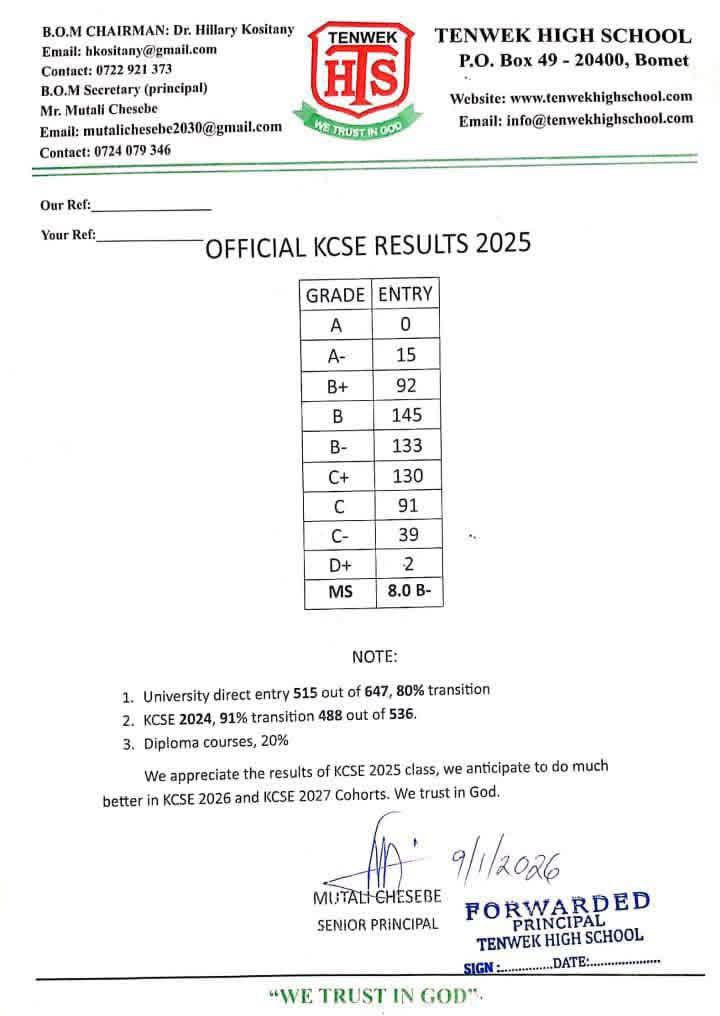
Tenwek Boys High School KCSE 2025 Results Analysis & Grade Count

Tenwek Boys High School recorded impressive results in the 2025 Kenya Certificate of Secondary Education, KCSE. Here is  the school’s official results as released by the Kenya National Examinations Council, Knec, on January Thursday 9th, 2025 at AIC Chebisas High School in Eldoret; Uasin Gishu County.

GRADE CANDIDATES’ COUNT
A (PLAIN) 0
A- (MINUS) 15
B+ (PLUS) 92
B (PLAIN) 145
B- (MINUS) 133
C+ (PLUS) 130
C  (PLAIN) 91
C- (MINUS) 39
D+ (PLUS) 2
D (PLAIN) 0
D- (MINUS) 0
E 0
X 0
Y 0
U 0
P 0
W 0
TOTAL/ ENTRY 647
MEAN POINTS 8.0
SCHOOL MEAN B- (minus)
CANDIDATES WITH C+ & ABOVE 515
UNIVERSITY PASS % 80%
Tenwek Boys High School KCSE 2025 Results Analysis & Grade Count

Check more details at  How to check KCSE 2025 Results {Ultimate Guide}.

Download Form 1 to 4 Free End Term 3, End Year Exams

Form 1 to 4 Free End Term 3, End Year Exams

BUS F2.pdf
F1 AGRIC END TERM 3 EXAMS.pdf
F1 BIO END TERM 3 EXAMS.pdf
F1 BUSS END TERM 3 EXAMS.pdf
F1 CHEM END TERM 3 EXAMS.pdf
F1 CRE END TERM 3 EXAMS.pdf
F1 ENG END TERM 3 EXAMS.pdf
F1 GEO END TERM 3 EXAMS.pdf
F1 HIST END TERM 3 EXAMS.pdf
F1 KIS END TERM 3 EXAMS.pdf
F1 MATHS END TERM 3 EXAMS.pdf
F1 PHY END TERM 3 EXAMS.pdf
F2 AGRIC END TERM 3 EXAMS.pdf
F2 BIO END TERM 3 EXAMS.pdf
F2 CHEM END TERM 3 EXAMS.pdf
F2 CRE END TERM 3 EXAMS.pdf
F2 ENG END TERM 3 EXAMS.pdf
F2 GEO END TERM 3 EXAMS.pdf
F2 HIST END TERM 3 EXAMS.pdf
F2 KISW END TERM 3 EXAMS.pdf
F2 MATH END TERM 3 EXAMS.pdf
F2 PHY END TERM 3 EXAMS.pdf
F3 AGRIC END TERM 3 EXAMS.pdf
F3 BIO END TERM 3 EXAMS.pdf
F3 BUSS END TERM 3 EXAMS.pdf
F3 CHEM END TERM 3 EXAMS.pdf
F3 CRE END TERM 3 EXAMS.pdf
F3 ENG END TERM 3 EXAMS.pdf
F3 GEO END TERM 3 EXAMS.pdf
F3 HIST END TERM 3 EXAMS.pdf
F3 KISW END TERM 3 EXAMS .pdf
F3 MATHS END TERM 3 EXAMS.pdf
F3 PHY END TERM 3 EXAMS.pdf

KPSEA 2024 results released by Knec- How to check results online

The Kenya National Examination Council (KNEC) has now officially released the 2024 Kenya Primary School Education Assessment (KPSEA) results.

In a statement via its official Facebook Page, on Tuesday, KNEC announced that the results of the exams, are now available on its Competency-Based Assessment (CBA) portal, asking schools to log in to access learner-specific results.

Continue reading: How to check KNEC KPSEA (GRADE 6) Results

“The 2024 Kenya Primary School Education Assessment reports are ready and have been uploaded on the CBA portal, cba.kec.ac.ke,” the KNEC statement reads.

“Schools that presented candidates for the assessment are advised to log into the portal and access the learner-specific reports. Congratulations to all the 2024 KPSEA candidates.”

The KPSEA assessment took place from October 28 to October 30, 2024, with over 1.2 million Grade 6 learners across the country sitting for the exams.

According to KNEC, the assessment seeks to establish the learning outcomes at upper primary school level and assess pupils’ levels of acquisition of core competencies and values.

“It also gives the classroom teachers relevant information about learning gaps noted at the end of the primary tier. Further, it informs stakeholders in education of possible interventions that can improve learning outcomes at the primary school level,” KNEC said in the 2023 KPSEA National Report.

NEWTON’S LAWS OF MOTION PHYSICS NOTES

Chapter Three

NEWTON’S LAWS OF MOTION

Newton’s First Law

Newton’s first law, which states that a body remains in its state of rest or uniform motion in a straight line unless acted upon by an external force

Inertia

The property of bodies to resist change in state of motion is called inertia and it explains why cars have seat belts

Newton’s first law of motion suggests that matter has an in-built reluctance to change its state of motion or rest.

When a moving bus comes to an abrupt stop, the passengers lurch forward, i.e., tends to keep on moving. Likewise, when a bus surges forward, the passengers are jerked backwards, i.e., tend to resist motion. This property of bodies to resist change in state Of motion is called inertia and it explains why cars have seat belts

The mass of a body is a measure of its inertia. A larger mass requires a larger force to produce
a given acceleration or deceleration on it than a smaller mass. The larger mass therefore has a
greater inertia.

Newton’s first law of motion is also referred to as the law of inertia.

Momentum’

A heavy-commercial vehicle requires a greater tractive force to start it moving when loaded than when empty. Likewise, a greater braking force is needed to bring to rest a heavy commercial vehicle than a small passenger car travelling at the same velocity. The vehicles each have a quantity called momentum which depends on the mass and the velocity of the vehicle. In the foregoing illustration, the heavy commercial vehicle has a greater momentum than the small car.

The momentum of a body is defined as the product of its mass and velocity. If m is the mass of a body in kg and v Its velocity in ms”, then;

momentum = mass (kg) x velocity (ms-1)

= mv

The SI unit of momentum is therefore kgms-1. Momentum is a vector quantity, having both magnitude and direction. The direction of momentum is same as that of velocity of the body.

Example 1

A van of mass 3 metric tonnes is travelling at a velocity of 72 kmh-1. Calculate the momentum of the vehicle.


Example 2

A car is moving at 36 kmh-1. What velocities will double its momentum?


Newton’s Second Law

Newton’s second law of motion states that the rate of change of momentum of a body is’ directly proportional to the resultant external force producing the change, and takes place in the direction of the force. Thus; resultant force acting  rate of change of momentum.

If the forces acting on the body are in equilibrium (balanced), then the resultant force acting on the body is zero, hence no change in momentum. This implies that the body under this condition will continue in its state of rest or uniform motion in a straight line (Newton’s first law).

Relation between Force, Mass and Acceleration

Consider a force F acting on a body of mass m for a time t. If its velocity changes from u to v, then;


change in momentum = final momentum – initial momentum
= mv-mu


:. Rate of change of momentum=

But acceleration a=

Hence, F mass x acceleration
So, F = krna, where k is a constant.

The Newton is that force which produces an acceleration of 1 ms-2 when it acts on a mass of 1 kg.
This definition gives; F = 1 N, a = 1 ms-2 and m = 1 kg.

Hence, substitution in F = kma leaves k = 1.

:. F=ma

Newton’s second law of motion can be verified by measuring the acceleration produced when various forces are applied to a frictionless trolley running on a friction-compensated runway. The trolley is taken to be of unit mass and the applied force is measured using identical elastic cords by taking the tension of the cord as a unit force when stretched by a certain
length.

Example 3

What is the mass of an object which is accelerated at 3 ms-2 by a force of 125 N

Example 4

A truck weighs 1.0 x 10⁵N and is free to move. What force will give it an acceleration of 1.5 ms-2? (Take g = 10 Nkg-l)

Example5

A trolley of mass 1.5 kg is pulled along by an elastic cord and given an acceleration of2 ms-2. Find the frictional force acting on the trolley if the tension in the cord is 5 N.

Example 6

A car of mass 1 200 kg travelling at 45 ms-1 is brought to rest in 9 seconds. Calculate the average retardation of the car and the average force applied by the brakes.


Impulse

When a force acts on a body for a very short time, the force is referred to as an impulsive force.
The result produced is known as the impulse of the force. Impulsive forces occur when two moving bodies collide, e.g., when two cars collide head-on or when a hammer strikes a stationary metal plate.

If a force F acts on a body of mass m for a time t, then the impulse of the force or impulse is given by force x time.

That is, impulse = force x time
= Ft

From Newton’s second law;

F=

This can be rewritten as; Ft = mv – mu

Since mv – mu is the change in momentum produced in the body during the time t, the impulse of a force acting on a body during a given time interval is equal to the change in momentum produced in the body in that time.

The SI unit of impulse is Newton second (Ns).

Therefore, another unit of momentum is the Newton-second (Ns). Since the rate of change of momentum is equal to impulse, i.e., Ft = p,
F = /t. Thus, force can be defined as rate of change of momentum.

A plot of force F against time is as in figure 3.9. The area under the curve is Ft or change in momentum during collision.


Large impulsive force are produced when momentums of bodies change within a very short time.

For example, when the velocity of a car is suddenly brought down to zero in a collision, the impulsive force on the passengers is so great that it could be fatal.

Seat-belts and airbags help in safeguarding against severe injuries occasioned by inertial forward surge.

The same applies to collapsible bumpers and steering which also helps during head on collisions by cushioning impulsive forces during head-on collisions through collapsing.

Example 7

The graph in figure 3.10 shows the force on a tennis ball when served during a game. Find the mass of the racket with a velocity of 40 ms-1 (Assume the ball is stationary before it is struck)


Example 8

(a) Determine the change in momentum produced when a force of3.5 x 103 N acts on a body which is at rest for 0.02 seconds.


(b) What velocity will be given to the body if it has a mass of 20 kg?

Example 9


The valve of a gas cylinder containing 15 kg of compressed gas is opened and the cylinder empties in 1 hour and 20 minutes. If the gas issues from the exit nozzle with an average velocity of 30 ms -1, find the force exerted on the cylinder.

Example 10

A truck of mass 2 000 kg starts from rest on horizontal rails. Find the speed 3 seconds after starting if the tractive force by the engine is 1 000 N.


Example 11

A ball of mass 35 g travelling horizontally at 20 ms-1 strikes a wall at right angles and rebounds with a speed of 16 ms-1. Find the impulse exerted on the ball.


Newton’s Third Law


Newton’s third law of motion states action and reaction are equal and opposite.

The law tells us that forces do not occur singly but due to action and reaction, they occur in pairs.

As the floor is part of a large mass (earth), the acceleration produced on it is not noticeable.

The force due to gravity W is the action force while that acting normally upwards is the reaction
force R. Since there is no resultant motion;

R=W=mg

Note:

The action force is produced by the block of wood when its weight is exerted on the table. The reaction is the equal force exerted by the table top on the block of wood. Hence. ‘action always begs for a reaction!’


Weight of a Body in a Lift


A passenger in a lift (elevator) experience forces against the feet, depending on the direction of motion and the acceleration of the lift. Consider a body of mass m on a weighing machine in a lift.

LAW OF CONSERVATION OF LINEAR MOMENTUM

The law of conservation of linear- momentum, which states that for a system of colliding bodies, the total linear momentum remains constant, provided no external forces act

Example 14


A body A of mass 5 kg moving with a velocity of 3 ms-1 collides head-on with another body B of mass 4 kg moving in the opposite direction at 6ms-1. If after the collision the bodies move together (coalesce), calculate the-common velocity v.

Example 15

A bullet of mass 0.005 kg is fired from a gun of mass 0.5 kg. If the muzzle velocity bullet is 350 ms-1, determine the recoil velocity of the gun.


Collisions


One common property of any system of colliding bodies that the total momentum is conserved.
After collision, bodies may:


(i) fuse and move together in one direction, .
(ii) separate and move in different directions, or,
(iii) separate and move in the same direction.

Elastic Collisions

An elastic collision is one in which both kinetic energy and momentums are conserved.


Inelastic Collisions


An inelastic collision is one in which momentum is conserved but kinetic energy is not. The collision of lumps of plasticine or a bullet fired from a gun getting embedded into a block is cases of perfectly inelastic collisions. The characteristic of this type of collision is that after the collision:

(i) the total mass is the sum of the masses of the individual bodies.
(ii) the bodies end up with a common velocity.

In inelastic collisions, kinetic energy is lost because the bodies undergo some deformation.
Also, some of the energy is transformed to heat, sound or light.

Example 16


A bullet of mass 10 g travelling horizontally at a speed of 100 ms -1 embeds itself in a block of wood of mass 990 g suspended from a light inextensible string so that it can swing freely.
Find:

(i) the velocity of the bullet and block immediately after collision.
(ii) the height through which the block rises.

Example 17

A minibus of mass 1 500 kg travelling at a constant velocity of  72 kmh-1 collides with a stationary car of mass 900 kg. The impact takes 2 seconds before the two move together at a constant velocity for 20 seconds. Calculate:

(a) the common velocity.

(b) the distance moved after the impact.
(c) the impulsive force.

(d) the change in kinetic energy.


Some Applications of the Law of Conservation of Momentum
Rocket and Jet Propulsion

A rocket propels itself forward by forcing out its exhaust gases. The hot exhaust gases are pushed out of the exhaust nozzle at high velocity and gain momentum in one direction. The rocket thus gains an equal momentum in the opposite direction. The rate at which the momentum changes provides the forward thrust on the rocket.

Note:

The rocket engine uses liquid hydrogen as its fuel and ‘liquid oxygen for combustion. It moves faster in the outer space, where there is no air resistance, than in the earth’s atmosphere.

A jet engine works on the same principle as the rocket engine but requires air which provides oxygen for combustion. The jet engine also requires a large mass of air to push out of  its exhaust nozzles, so as to provide greater thrust.

The Garden Sprinkler

The garden sprinkler operates on the same principle as the engine discussed above. The pressure ;’ of the water in the pipe causes the water to be ejected through the nozzles at high velocity. The ejected water gains momentum and causes the sprinkler to rotate as in figure 3.24.


FRICTION

Friction is the resistance a body experience when it tend to move over another body

Static/ limiting friction is the maximum force between the surfaces before a body start moving

Sliding/ dynamic friction is the maximum force between the surfaces when the body is in motion

Molecular Explanation of Friction

smooth surfaces would look very rough when viewed under a powerful microscope.
This is due to some molecules on the surface lying on top of one another forming ‘tiny hills’.
The pressure at these points is quite enormous and the molecules making the ‘tiny hills’ which are in contact tend to stick together

For the bodies to move over each other work has to be done to overcome the interlocking between the ‘bumps’ and the ‘troughs’. The force opposing the work being done constitutes friction.


Laws of Friction

Experimental results on friction between solids are summed up under the following laws:
(i) Frictional force between two surfaces oppose their relative motion.

(ii) Frictional force is independent of the area of contact of the given surfaces when the normal reaction is constant.

(iii) . Frictional friction is directly proportional to the normal reaction R.
(iv) Kinetic friction is independent of relative velocity.

(v) Frictional force is dependent on the nature of the surfaces in contact.

From the third law above,

F

F=

Where  is the coefficient of friction

NB RESULTANT FORCE = FORCE APPLIED – FRICTION

Resultant force causes the body to accelerate

Example 18

A wooden box of mass 30 kg rests on a rough floor. The co-efficient of friction between the floor and the box is 0.6.

(a) Calculate the force required to just move the box.

(b) If a force of200 N is applied to the box, with what acceleration will it move? (Take g = 10 ms-2)


Example 19

A block of metal with a mass of 20 kg requires a horizontal force of 50 N to pull it with uniform velocity along a horizontal surface. Calculate the co-efficient of friction between the surface and the block. (Take g = 10 ms-2)

Methods of Minimising Friction


It may not be possible to achieve a completely frictionless surface, but friction can be greatly minimized using the following:

Rollers


Rollers are placed between two rough surfaces so that when one body is to slide, friction is reduced. Rollers may be placed between the floor and heavy crates to enable the crates to slide,

Rollers may also be used when a marine vessel is being launched. They work on the principle that rolling friction is less than sliding friction.

Ball Bearings

Ball bearings reduce the friction for rotating axles. They are used extensively in machinery and are made of hard steel to prevent wear

Grease must be used together with ball bearings to lubricate the rolling action.


Lubrication

This is the application of oil or grease between moving parts.

Air Cushion


Air cushioning is done by blowing air into the space between surfaces. This prevents the surface coming into contact. The hovercraft uses air cushion to move with greatly reduced frictional force. Also air cushion is used in air tracks to produce a frictionless runway

Applications of Friction
Walking

Walking is made easier by friction. Pavements are made rough and tyres treaded to increase friction.

Motor Vehicles

Rotating tyres push backwards against the road surface. Friction opposes this force and the resultant force enables the vehicle to move.

Brakes

Friction between the brake drum and the brake lining halts the vehicle.

Matchstick

Friction between the matchstick head and the rough surface develops heat, igniting the stick head.

Friction can also be a nuisance. It causes wear, tear and noise between moving parts of a system, hence the need for lubrication in machines. Friction also, causes energy loss since work has to be done against it.

VISCOSITY

It is more difficult to wade through water than to move the same distance in open air space.
A steel ball dropped in a cylinder full of glycerine takes longer to reach the bottom than when dropped into the cylinder full of water.

This frictional resistance to motion in fluids is called viscosity. It is defined as the force which opposes the relative motion between the layers of the fluid. Glycerine has higher viscosity than water.

Terminal Velocity

EXPERIMENT 3.5: To investigate the relationship between the viscous drag F and velocity v
Apparatus

Tall measuring cylinder (1 000 ml), ball bearing, glycerine, stop watch, metre rule, rubber bands.


Procedure

  • Fill the measuring cylinder with glycerine.
  • Fix narrow horizontal rubber bands labelled 1, 2, 3,4, 5 and 6 at equal intervals along the cylinder, as shown in figure 3.33.
  • Introduce a small ball bearing gently into the liquid (first dip the ball into glycerine).
  • Measure the time of fall from the surface to the band labelled 1.
  • Repeat for bands 2, 3, 4, 5 and 6.
  • Determine the time of fall between each pair of rubber bands, i.e., between land 2, 2 and 3,3 and 4, 4 and 5, and, 5 and 6.
  • Determine the velocity for each pair of bands and record the results in table 3.5.

Table 3.5


TIme of Distance between TIme between Velocity between
.fall to bands bands bands
level      
1 =      
2 = 1 and 2    
3 = 2 and 3    
4 = 3 and 4    
5 = 4and5    
6 = 5 and 6    
  • Plot a graph of velocity against time of fall.

Observation

The ball bearing moves with increasing velocity when released into the liquid. The velocity of the ball between bands 4, 5 and 6 appears not to change.

A plot of velocity against time is as shown in figure 3.34.


Explanation

The forces acting on the ball when it is moving in a liquid are:
(i) its weight mg, acting vertically downwards.

(ii) the viscous drag F due to the liquid, acting vertically upwards.
(iii) the upthrust U due to the liquid, acting vertically upwards.
These forces are shown in figure 3.35.

When the ball enters into the liquid, mg > F + U and the resultant downward force therefore accelerates the ball towards the bottom of the cylinder. The viscous drag F however increases with the velocity and soon mg becomes equal to upward force (F + U). The resultant force is now zero and the ball attains a steady velocity called terminal velocity vto The terminal velocity is the constant velocity attained when the sum of the upward forces equals the weight of the object falling in the fluid.

A plot of velocity against time for a body falling through different liquids is shown in figure 3.36.


Stokes’Law

Stokes established that when a small object such as a steel sphere of radius r is dropped through a column of liquid and moves with a velocity v, it experiences a force which is directly proportional to:

(i) the radius r of the sphere.
(Ii) the velocity v of the sphere.

So, F  rv. Hence, F = krv, where k is a constant.

Stokes found that k=6 where 11 is called the co-efficient of viscosity.
:. F = 6

This is the expression for Stokes’ law. The law holds when:

(i) the radius of the ball is small compared to the extent of liquid surface.
(ii) the ball does not create turbulence in the liquid as it falls.

A site providing Education, TSC, Universities, Helb, Sports and Kuccps news in Kenya