TSC- UNIONS’s 2017-2021 COLLECTIVE BARGAINING AGREEMENT, CBA
You may also like:
TSC- UNIONS’s 2017-2021 COLLECTIVE BARGAINING AGREEMENT, CBA
You may also like:
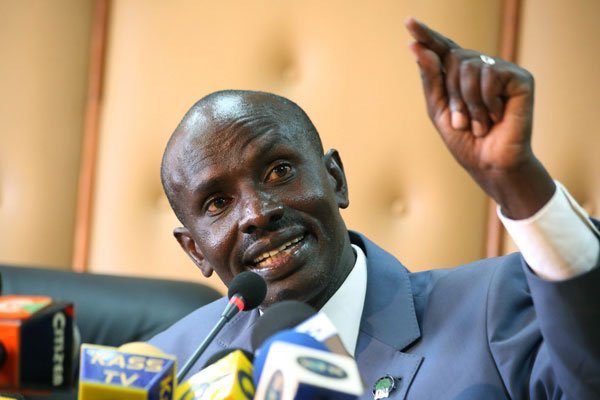
Wilson Sossion will continue serving as the Secretary General to the Kenya National Union of Teachers (KNUT). This is despite a court ruling that upheld the Teachers Service Commission, TSC, plea to expunge Sossion’s name from the teachers’ list; since he is a nominated Member of Parliament.
Here is the presser by KNUT National Chairman Wycliff Omucheyi dated 26th July, 2019;
‘The Kenya National Union of Teachers (KNUT) for the sake of clarity would like to state that Hon. Wilson Sossion has not been removed from the position of Secretary General following the Employment and Labour Relations Court ruling, upholding TSC’s deregistration of Sossion as a teacher.
Hon. Sossion will continue serving as the Secretary General of KNUT following an agreement with TSC and the Registrar of Trade Unions.
TSC, the Registrar of Trade Unions and KNUT had earlier appeared before the Employment and Labour Relations Court Judge, Maureen Onyango and agreed that Hon. Sossion continues serving as the KNUT Secretary General. The tripartite agreement was deposited in the Employment and Labour Relations Court.
Therefore, the Friday court ruling by Justice Nelson Abuodha does not affect Hon. Sossion’s position at KNUT.
It should be noted that while Justice Abuodha was delivering the ruling,
he categorically stated that as far as TSC was concerned, the release of Hon. Sossion from active teaching was to enable him to focus more on KNUT activities which exclusively concerned teachers’ affairs.
It should also be understood that Article 31(4)(a) of the Labour Relations Act states that the General Secretary of a Trade Union or the Chief Executive or Association Secretary of an employers’ organization may be a person not engaged or employed in the sector concerned.
However, KNUT is scrutinizing the Court Ruling with a view of instituting an Appeal.
Therefore, it should NOT be misinterpreted that Hon. Sossion has ceased being the Secretary General of the giant teachers’ Union.
Furtherance to this, during the Annual Delegates Conference (ADC), delegates unanimously endorsed Hon. Sossion to continue serving as Nominated Member of Parliament and the same time remain the Secretary-General of Kenya National Union of Teachers (KNUT).’
Also read;
MPs, Unions give TSC green light to hire over 87,000 intern teachers to plug shortages
The training of teachers on the new Competency Based Curriculum, CBC, is in jeopardy after the Kenya National Union of Teachers, KNUT, directed its members to boycott the exercise. The fate of the training of about 100,000 teachers that was to kick off on 22nd to 26th April, 2019, is now unknown following a directive by KNUT’s Secretary General, Hon Wilson Sossion, to the teachers to boycott the exercise.
In a memo dated April 16, 2019, Hon Sossion directs all branches’ executive secretaries to inform teachers to boycott the training. “You are hereby directed to inform all teachers under your jurisdiction to boycott the Competency Based Curriculum (CBC) training scheduled to begin on Tuesday April 23, 2019, at various centres throughout the country,” reads the memo, in part, by Hon Sossion.
Sossion says ‘the boycott is due to the fact that the CBC reform exercise and the implementation process was conducted in violation of the law’.
The Secretary General further argues that the government is ill-prepared for the full implementation of the curriculum that is now at grade three. “The government of Kenya, more particular the Ministry of Education, Science and Technology, are not fully prepared for the exercise as there are no teaching and learning resources, no standard infrastructures and compounded by the lack of adequate teachers for CBC education system,” explains Sossion.
This is going to be the first headache for the new Education Cabinet Secretary, Prof George Magoha, who took over from Dr Amina Mohammed; this year.
The government was hoping to train about 68,490 teachers in lower primary and 22,830 headteachers; to the the 170,000 teachers who have undergone the training so far.
Other reasons given by Sossion warranting the boycott include the fact that such education system has been rejected by teachers at the United States of America and Britain.
If the boycott comes to see light of day in Kenya then, it will be the biggest setback to the government’s push for implementation of the new curriculum.
Related Content:
| Programme | Duration | Offered at | Qualifications |
| Higher Diploma in • Blood Transfusion Science |
1 year | Nairobi | Diploma in Medical Laboratory Sciences and Registered by the KMLTTB |
| • Clinical Chemistry | 1 year | Nairobi | |
| • Haematology | 1 year | Nairobi | |
| • Histopathology and cytopathology | 1 year | Nairobi | |
| • Microbiology | 1 year | Nairobi | |
| • Parasitology and Entomology | 1 year | Nairobi | |
| • Virology | 1 year | Nairobi | |
| • Blood Transfusion Sciences | 1 year | Nairobi | |
| Diploma in Medical Laboratory Sciences | 3 years | Selected Campuses | Mean Grade C, C in English or Kiswahili and Biology/Biological Sciences and Chemistry/Physical Sciences, C in any one of the following: – Physics/Physical Sciences, Mathematics |
| Upgrading (from Certificate to Diploma) |
2 years | Lake Victoria- (Full Time September) | Certificate in Medical Laboratory Sciences. Registration by the KMLTTB |
TEACHERS SERVICE COMMISSION, TSC- CBA PHASE 1 MATRIX 1ST JULY 2017 – JUNE 30 2018
You may also like:
Teachers’ Minet Medical Scheme; Dental Service providers- Kenya:
You may also like:
However by 1934 Messrs. James Gichuru and Eluid Mathu formed a teacher’s organization known as Kenya African Teachers Union (KATU). This Union eventually fizzled away under the pressure of powers of the time. This was because it was very difficult to organize an effective national organization of workers at that time because of communication problems.
It was not until the early fifties, when Makerere and Kagumo Colleges produced a higher caliber of teachers, which teachers’ organizations began coming up because these teachers communicated after training and hence learnt of the diversity of their terms and conditions of service.
They began by forming sectional or regional Teachers Organizations based on denominations or Provinces. E.g.:
(i) Nyanza African Teachers Union (NATU);
(ii) Catholic African Teachers Association (CATA) both in Nyanza Province;
(iii) Rift Valley African Teachers Association (RATA);
(iv) Coast African Teachers Union (CATU);
(v) Central Province African Teachers Union called Kikuyu Teachers Union (KTU)
Still, there was no way teachers could correspond with their counterparts in other Provinces.
In 1955, one of the teacher’s leaders from Rift Valley Hon. Daniel T. Moi now the retired President of the Republic of Kenya was elected to the Legislative Council (Leg.co.) now called National Assembly. He later successfully moved a freelance motion in the house in 1957 that the Government should help the teachers of this country to form one national body. The Government accepted the motion.
This made the Minister for Education Mr. W.F. Coutts invite all leaders to a meeting in December 1957 at Pumwani D.E.B. School. At this meeting, one teacherâs organization called Kenya National Union of Teachers (KNUT) was born. An Interim Central Executive Committee was set up with Mr. Ignatius Mkok as interim President and Mr. Stephen J. Kioni as interim Secretary General.
On 10th December 1958, the Central Executive Committee (C.E.C) convened the first Annual Conference at the Pumwani D.E.B. School. At this Conference, the KNUT Conference was ratified. The 1st National elections were held and Mr. Samwel Ayany was elected the 1st President and Mr. Stephen J. Kioni the 1st Secretary General.
On 14th May 1959 KNUT was officially registered as A Trade Union.
The Growth and Further Development of the KNUT:
Even after the registration of KNUT as a Trade Union, no serious work could be done because Mr. Stephen Kioni who had been elected as Secretary General was still a full-time teacher at Kilimambogo Teachers Training College.
It was not until 1960 when Joseph Kioni resigned from teaching to devote his energy full-time to KNUT.
He established the first KNUT Office in one of the garages in Ruiru Town without salary, since the Union had no funds to pay him. That same year 1960 Mr. Samwel Ayany attended a World Confederation of Organisations of the Teaching Profession (WCOTP) Assembly in ROME where he got KNUT affiliated to WCOTP although he had been invited to attend as a representative of the Nyanza African Teachers Union (NATU). He made an approach for assistance to KNUT from WCOTP. The WCOTP accepted and undertook to pay Mr. S.J. Kioni part of his salary. This was so until 1964 when the Union began realizing some money from members through a check-off system.
Policy Demands:
Soon after setting up offices, the Central Executive Committee, which later became the National Executive Council, met and issued the first policy demands, which included:-
(a) A single Employer for all teachers.
(b) Unified Terms and Conditions of Service.
(c) Free Pension for all teachers.
(d) Provision for negotiating machinery.
(e) Pay rise for all teachers in all grades.
(f) Responsibility allowance for all posts of responsibility.
(g) Abolition of the Colonial Code of Discipline.
The government responded by appointing the Lawrence Sagini Commission to look into the demands of KNUT.
After prolonged negotiations, KNUT rejected the recommendations of this Commission. The government then appointed another body called the Teachers Salaries Commission. Whose recommendations were not very different from the Lawrence Commission. Here, the KNUT resolved to stage token strikes.
In 1961, went for Labour studies in the USA and James K. Njoroge acted as Secretary General. The same Njoroge became Permanent Secretary, Ministry of Education.
The Token Strikes:
These strikes were staged selectively in a number of branches to test the Unions capability in organizing a strike. There were two token strikes staged as follows:-
(a) 19th - 20th March 1962 covered the following branches - Nairobi, Nyeri, Mombasa, Kilifi, Baringo, South Nyanza and North Nyanza.
(b) 26th - 27th March 1962 – Machakos, Kiambu, Murang’a, Taita, Nakuru, kisii and Central Nyanza.
Both strikes were successful and encouraging, but the colonial government did not yield to the demands.
NATION WIDE STRIKES:
The Four Strikes between 1962 and 1969:
a) The first strike: 18th September - 11th October, 1962
This was a nationwide strike with the results that:
(i) The government appointed a joint consultative and negotiative committee under the chairmanship of Mr. W. Rogers of Nairobi University, and the Union effectively put the case to the satisfaction of Mr. Rogers who resigned as a result of the governmentâs refusal to implement the findings of this committee.
(ii) From 1st January, 1963 - the government accepted to introduce Check-Off-System for collection of union dues. It was effected in 1964.
(iii) 1965 - the establishment of a Teachers Service Commission under the chairmanship of Hon. Joseph Gatuguta and Mr. Solomon Adagala as Secretary. The commission was disbanded because of the pressure from KNUT - the KNUT did not accept the way it was constituted.
After the disbanding of the ill-constituted teachers commission the KNUT again threatened countrywide strike action and the Minister for Labour responded by appointing a Board of Inquiry. The Board was chaired by Mr. S.N. Waruhiu, a Nairobi advocate and Rev. Andrew Hake and a teacher Yusto Nyamolo Okal as its members.
The Board recommended a framework favorable to the teachers, but again the government refused to implement its findings. The KNUT was then ready for a second nationwide strike in 1965.
b) The next three strikes
i) The second national strike took place from 11th October, 1965. The strike was short-lived because it was promptly declared illegal by the government. As a result, union officials were arrested by the government. However, after the Minister for Labour referred the grievances to the industrial court, the government withdrew the cases against the KNUT officials. The key issue that remained unresolved was that of one employer for all teachers throughout. The KNUT had by now realized that by having one properly and legally constituted employer, all of her demands could be negotiated with the employer. As this issue remained unresolved, there arose a need for yet another national strike a year later.
ii) The third national strike took place from 1st to 3rd November, 1966. A brief but very historic act, that the government responded positively by accepting to establish the Teachers Service Commission. The TSC was established through a bill tabled in parliament by the then Minister for Education the Hon. Jeremiah Nyagah.
The TSC Act chapter 212 of the Laws of Kenya thus established the TSC as the sole employer for all teachers in public schools in Kenya. The bill having been passed in 1966 the TSC became operational from 1st July 1967.
Subsequent and very significant development included:
Thus the KNUT had succeeded in establishing competent organs for negotiating all forms of demand for teachers.
Future differences were from then expected to be mainly on implementation and details and not very fundamental issues.
iii) The fourth strike was staged from 4th to 11th November, 1969. After the creation of the Teachers Service Remuneration Committee (TSRC) the KNUT and TSC used the Committee to negotiate several issues that teachers had been raising over the years. After protracted negotiations the TSRC presented its recommendations to the Minister as provided for under the TSC Act. However, the Minister was not willing to implement most of the recommendations made by the TSRC and that is what led to the 1969 national strike. As a result of the strike the Minister agreed to implement the recommendation of the TSRC.
These four major strikes established the KNUT as an effective voice of teachers and from then on the employer and government accepted the broad principle of negotiating at length all issues raised by teachers through the Union. An effective grievances procedure has since been well established, and several issues negotiated and settled without recourse to strike action. Through such negotiations the KNUT has recorded numerous achievements for teachers as will be apparent in subsequent sections.
In 1965 a BOARD OF INQUIRY was formed to look into Terms and Conditions of Service for Teachers.
The government refused to implement the recommendations of the Board of Inquiry. This led the KNUT to threaten a strike demanding for one employer in 1966. The then President of KNUT the late JOB ROB betrayed the Union. This caused him expulsion from the Union by the Advisory Council on 29th October 1966.
The Advisory Council recalled Mr. David Mulindi who was then 1st Vice President to return from DENMARK to take over KNUT as President.
The strike eventually took place on 1st November 1966. The following day, all Union officials were arrested.
Mr. Mulindi arrived on 13/11/1966 and went to CID Headquarters offering to be arrested alongside his colleagues.
The government later released the Union officials and withdrew all charges against them.
As a result, Mr. J. Nyagah the then Minister for Education rushed a bill in Parliament of Teachers Service Commission.
On 1st July 1967 the Teachers Service Commission and KNUT signed Recognition Agreement.
In the year 1969 Mr. Kioni was jailed and Mr. E.J. Nyoka acted as Secretary General.
In 1970 December, Mr. Ambrose Adeya Adongo was elected the second KNUT Secretary General defeating Mr. Nyoka.
In August 1973 KNUT hosted a WCOTP Assembly at Kenyatta International Conference Centre (KICC) at which All African Teachers Organisation - AATO was born. Mr. Ambrose A. Adongo was elected its first President, a post he held until his death.
In 1982 – 1983, KNUT started leadership training.
On 2nd March 2001 Mr. Ambrose Adongo died.
On 20th June 2001 Mr. F. M. Ng’ang’a was elected the third KNUT Secretary General.
MAJOR CONSTITUTIONAL CHANGES IN KNUT:
In 1965 the KNUT Constitution was revised to allow KNUT to affiliate to COTU, to allow the KNUT to change the title of the President to National Chairman, and also to enable the Union to subject its Secretary General to election like it was in other Trade Unions.
In 1967 all Unions were prohibited from international affiliations but KNUT alone was allowed its affiliation with World Confederation of Organizations of the Teaching Profession (WCOTP) as a professional body by the government.
In 1982, there was a major amendment to include a women representative in the National Executive Council (NEC) and Branch Executive Committee (BEC).
In 1992 the post of School Representative was created.
You may also like:
Continue reading History of the Kenya National Union of Teachers- KNUT
Kenya National Union of Teachers, KNUT’s, Deputy General Secretary Hesbon Otieno has warned that teachers will down tools if TSC does not solve stinging industrial disputes. Among contentious issues that KNUT wants solved immediately are: Delocalization of teachers, scrapping of the Teachers’ appraisal programme and promoting teachers on attainment of higher qualifications, among others. Down load/ watch the video below to see the Deputy General Secretary’s warning: (Video Courtesy of KTN)
Click on this link to download, KNUT DSG, Hesbon Otieno’s warning of a looming strike
You may also like:
Kenya National Union of Teachers, KNUT, Constitution:
You may also like:
Over 200 teachers have written to the Kenya National Union of Teachers, KNUT, seeking the union’s intervention to revoke their transfers. The teachers, who are school heads, have asked KNUT to assist them revert to their stations. The teachers form part of the over 3,000 teachers who were delocalized by TSC in December, 2018. According to the list at our disposal, most of those teachers requesting for reversals are Union leaders at the branches levels and risk losing the posts as they have been transferred outside their areas of jurisdiction.
According to KNUT Secretary General, Hon Wilson Sossion, the union has received letters from the teachers and is compiling a report to be presented to the Conciliator soon. The Conciliation Committee was constituted by the Labour Ministry to iron out stinging matters between TSC and KNUT; with delocalization being one of them. The Labour and Relations Court, last week, ordered KNUT and TSC to continue holding conciliation talks and file a report on the progress made by 30th January, 2019.
Here is the list of Delocalized KNUT leaders, and the positions they hold at the branches:
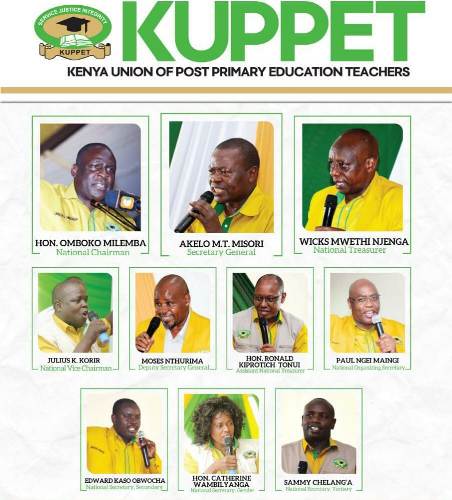
Kuppet latest news- The Kenya Union of Post Primary Education Teachers (Kuppet) held elections for the national officials on Saturday April 3, 2021 via the online platform (zoom). All the 10 elected members of the National Executive Board (NEB) retained their seats, unopposed.
The elected officials will serve for a term of five years (5 years); from 2021 to 2026. The heated 2021 branch officials elections culminated in the national officials’ elections; bringing to a halt of a rigorous and high octane electioneering period for the now powerful teachers’ union.
| S/No | Position | Position Holder | Year when joined Kuppet Leadership |
| 1 | NATIONAL CHAIRMAN | OMBOKO MILEMBA | 2002 |
| 2 | SECRETARY GENERAL | MR AKELO M.T MISORI | 2001 |
| 3 | NATIONAL TREASURER | WICKS MWETHI NJENGA | 2001 |
| 4 | NATIONAL SECRETARY SECONDARY | EDWARD KASO OBWOCHA | 2006 |
| 5 | NATIONAL ORGANIZING SECRETARY | PAUL JUVE NGEI MAINGI | 2001 |
| 6 | ASS. NATIONAL TREASURER | HON. RONALD KIPROTICH TONUI | 2010 |
| 7 | DEPUTY SECRETARY GENERAL | MOSES NTHURIMA | 2001 |
| 8 | CATHERINE WAMBILYANGA | NATIONAL SECRETARY GENDER | 2001 |
| 9 | NATIONAL SECRETARY TERTIARY | SAMMY CHELIMO CHELANG’A | 2006 |
| 10 | JULIUS KIMURGOR KORIR | NATIONAL VICE CHAIRMAN | 2006 |
See also;
The Kenya National Union of Teachers, KNUT, has given a presserv on the retreat meeting the KNUT and the Teachers Service Commission, TSC, held at Sawela Lodges. The giant teacher’s union will again meet the TSC in the next two weeks to iron out the contentious issues:
KNUT’s Reaction to the collapsed Naivasha talks- 2018
You may also like:
How to Pay for your, Kenya Power and Lighting Company, Electricity Bills in Kenya
The Teachers Service Commission, TSC, has not promoted a total of 12,080 teachers after acquiring higher qualifications. According to a list prepared by the Kenya National Union of Teachers, KNUT, the employer has failed to promote the teachers; despite the latter sending their higher qualifications certificates to TSC. These teachers are Diploma, Degree, Masters and PhD holders but are yet to be promoted by TSC. KNUT has revealed that of the 12,080, 257 teachers have Masters’ degrees, 6,370 with bachelor’s degrees and 5,453 are diploma holders.
KNUT and TSC are engaged in a tussle over promotion of teachers who have attained higher qualifications and delocalization of teachers. The two sides have failed to reach an amicable agreement with the Conciliator expected to give an update of the talks tomorrow. The Conciliation Committee is chaired by Charles Maranga who is on Wednesday, tomorrow; 31st January 2019, expected to present a report to the Employment and Labour Relations Court.
Nakuru KNUT branch leads with the highest number of teachers who want promotions followed by Mumias, Bungoma North, Kitui and Butere. TSC freezed promotions of Teachers way back in 2014.
HERE IS THE SUMMARY OF NUMBERS OF TEACHERS SEEKING PROMOTIONS; PER REGION.
CENTRAL REGION
COAST REGION
EASTERN REGION
NAIROBI REGION
NORTH EASTERN REGION
NYANZA REGION
RIFT VALLEY
WESTERN REGION