TVETA/PRIVATE/TVC/0033/2017
TVETA/PRIVATE/TVC/0033/2017
TVETA/PRIVATE/TVC/0028/2017
KNEC CONTACTS:
Use any of the following official KNEC contacts for quick assistance and/ or clarifications:
Head Office – 0720741001 0732333860
KCSE Section – 0771813972
KCPE Section – 0772069891
PTE Section – 0772069882
Technical Section – 0771813866 0771814259
Business Section – 0771814060 0771814105
Archives – 0732333566 0720741004
Email: [email protected]
If you’ve lost one of your certificates, you can download the application form for results certification here: https://www.knec.ac.ke/2018/10/23/result_application-form/
The official Kenya National Examination Council KNEC website is https://www.knec.ac.ke/. click on this Click on this link to access the website: https://www.knec.ac.ke/
Link: www.knec-registration.ac.ke/KCPE
Link: www.knec-registration.ac.ke/KCSE
Harambee Avenue
Tel:+254 – 020 246919 / 020-247204
Extelecoms House,3rd floor
Haile Selasie Avenue,
Tel: +254 -020 2211545/6/7
Dennis Pritt Road,
Kilimani
Tel:+254 – 020 2713874 / 020-2713894 / 020-2713845; 020-2715980 / 020-2711536
Ministry of Public Works, Supplies Branch,
Likoni Road.
Tel:+254 – 020 650821 / 020-650822
Email: [email protected]
You may also like:
Continue reading Important Kenya National Examinations Council, KNEC, Contacts
Why I Support Referendum To Change The Constitution
The world as we have created it is a process of our thinking. It cannot be changed without changing our thinking
– Albert Einstein
Unless one is a true sycophant, Kenya is in the throes of bankruptcy. Our voracious appetite for Loans, Eurobonds and Chinese freebies are digging us in a hole. It is like placing an alcoholic in a Brewery or a gambler in a casino. The only way to stop our Country collapsing is Constitutional Change.
I support Referendum to mark the following changes:
1. Women Representatives, Nominated MPs and Senators …. These Politicians have no work, no Constituency and no responsibilities. They end up being idle and get time for salon or bar or abuses.
2. Reduce MPs in the National Assembly to 180 …. With a population of 400m, US has 435 US Representatives being a ratio of 920,000 people to One Representative.
3. We reduce the Cabinet to 14 …. US has 15 and Switzerland has 7 …. Our Ministries are duplicated and we end up having Ministers fighting each other. And like Singapore, we increase Ministerial Salaries to Kshs. 20m per month praying they wouldn’t steal again.
4. We reduce the Counties to 14 drawn along shared language, tribe and religion like Britain and Switzerland … And Nairobi will be a Capital Territory like Washington in US and Canberra in Australia.
5. Make Corruption Capital offense like in China … Everyone must justify how they have made their money …. All Properties ownership must be put online and public … Tax payments be made public ….. One can’t be a Billionaire without companies that employ thousands …. Only lawyers, Architects, Doctors and Investment Bankers are allowed to be rich without employing hundreds of employees … Those who steal from the public must forfeit all and be shot!
6. Finally, the President must be the leader of the biggest party like in Turkey …. The President must also get at least 25% from Regions that have as the dominant tribe, Kikuyu, Kalenjin, Luo, Kisii, Luhya and Kamba. Other tribes are collateral.
7. All National Borrowing Agreements and Treaties must be made public and approved by the National and all the County
Assemblies …..
8. Constitutional Bodies and Institutions like Parliament, Judiciary, National Police Service, DPP, EACC etc must be truly independent.
The writer;
Donald B. Kipkorir is a managing partner , KTK Advocates.
What is your view? Do you support the current push for constitutional review?
Write to us: [email protected]
You may also like:
About Global Teacher Prize
The Global Teacher Prize is a US $1 million award presented annually to an exceptional teacher who has made an outstanding contribution to their profession.
The Global Teacher Prize serves to underline the importance of educators and the fact that, throughout the world, their efforts deserve to be recognised and celebrated. It seeks to acknowledge the impacts of the very best teachers – not only on their students but on the communities around them.
Global Teacher Prize Trophy
Why Teachers?
An inadequate education is a major factor behind the social, political, economic and health issues faced by the world today. We believe education has the power to reduce poverty, prejudice and conflict.
Teachers work tirelessly to provide an education for children around the world so the status of teachers is critically important to our global future. Teacher status has a significant impact on recruitment, retention, job satisfaction and performance.
Teacher Status
In 2013, the Varkey Foundation commissioned Populus, the leading research and strategy consultancy, to gather in-depth opinions from 21 countries to explore attitudes about the teaching profession; teachers’ salaries; students’ attitudes towards educators and how participants rated their own education systems.
The results, published as the Varkey Foundation Global Teacher Status Index, formed the first comprehensive attempt to compare the status of teachers across the world.
In many countries, it was clear that the profession’s status had dropped and the findings shocked Sunny Varkey, the Varkey Foundation’s Chairman, whose parents had both been teachers. He founded the Global Teacher Prize as a response with the aim of raising the profession’s profile.
Global Teacher Prize: the impact
We believe the Global Teacher Prize is making a real difference to the profession and having a very positive effect at both a grassroots level and on the global stage.
In the prize’s inaugural year, there were over 5,000 entries from 127 countries which generated a huge amount of media interest. Reporting around the world has been tremendously supportive of the shortlisted teachers while a host of high profile endorsers have included Her Majesty Queen Rania Al Abduallah of Jordan, Bill Gates, Bill Clinton and Tony Blair have been very vocal in their support.
The Global Teacher Prize is awarded by the Varkey Foundation under the patronage of His Highness Sheikh Mohammed bin Rashid Al Maktoum, UAE Vice President and Prime Minister of the United Arab Emirates and Ruler of Dubai. Every year since then, the Global Teacher Prize has been going from strength to strength with the 2018 Prize bringing in over 30,000 applications and nominations.
Eligibility & Criteria
Candidates for the Global Teacher Prize will be judged on a rigorous set of criteria to identify an exceptional teacher who has made an outstanding contribution to the profession.
Eligibility
The Prize is open to currently working teachers who teach children that are in compulsory schooling, or are between the ages of five and eighteen. Teachers who teach children age 4+ in an Early Years government-recognised curriculum are also eligible, as are teachers who teach on a part-time basis, and teachers of online courses. Teachers must spend at least 10 hours per week teaching children face-to-face, and plan to remain in the teaching profession for the next 5 years. The Prize is open to teachers in every kind of school and, subject to local laws, in every country in the world.
The closing date for applications is 9 September 2018, and the winner will be announced at the Global Education and Skills Forum in Dubai in March 2019. The Varkey Foundation decision on eligibility is final.
Criteria
Applicants for the Global Teacher Prize will be judged on a rigorous set of criteria to identify an extraordinary teacher who has made an outstanding contribution to the profession. The Academy will look for evidence of a combination of:
1. Employing effective instructional practices that are replicable and scalable to influence the quality of education globally.
2. Employing innovative instructional practices that address the particular challenges of the school, community or country and which have shown sufficient evidence to suggest they could be effective in addressing such challenges in a new way.
3. Achieving demonstrable student learning outcomes in the classroom.
4. Impact in the community beyond the classroom that provide unique and distinguished models of excellence for the teaching profession and others.
5. Helping children become global citizens through providing them with a values-based education that equips them for a world where they will potentially live, work and socialise with people from many different nationalities, cultures and religions.
6. Improving the teaching profession through helping to raise the bar of teaching, sharing best practice, and helping colleagues overcome any challenges they face in their school.
7. Teacher recognition from governments, national teaching organisations, head-teachers, colleagues, members of the wider community or pupils.
The winner will be chosen by the prominent Global Teacher Prize Academy made up of head-teachers, educational experts, commentators, journalists, public officials, tech entrepreneurs, company directors and scientists from around the world. Meet the Academy.
How is the Prize judged?
The Global Teacher Prize Judging Academy includes public officials, head teachers, academics, journalists, entrepreneurs, company directors, scientists and entertainment industry figures from around the world. They share the common goal of shining a spotlight on the great work that teachers do and use a comprehensive list of judging criteria. To ensure fairness and transparency, the process* is overseen by PwC.
* Please note that this report will not be accessible from tablets or smartphones. It must be detached and saved to a PC in order to launch properly.
Global Teacher Prize Methodology
We chose PWC to audit, evaluate and test our process for the 2015, 2016, 2017 and 2018 Prize and are working with them again for the 2019 Prize.
“PwC is honoured to be associated with the search for the best teacher in the world. From our annual CEO survey, human capital development continues to rank as one of the highest priorities of global CEO’s, and our school teachers play a vital role in the early stages of a future employee’s development potential. An award of this nature will achieve international recognition for the significant dedication and contribution made by thousands of teachers world-wide.” — Dennis Nally, Chairman of PwC International Ltd.
Apply today!
The Kenya National Examinations Council has instructed schools to upload Project / Oral/ Practical Examinations marks for 2018 before set deadlines or risk paying fines. Through a Circular, copied to Sub-County Directors of Education and All heads of Institutions offering candidates for the 2018 KCSE Examination, the KNEC warns that penalty for not keying scores online is Kshs. 500 per candidate.
“The Kenya National Examinations Council wishes to inform Sub County Directors of Education (for Private Candidates) and principals that the projects portal shall be opened on September 7, 2018, to enable schools offering the subjects with a project/ aural/ oral/ practical component key candidates scores”, reads the circular, written by Dr. Mercy G. Karogo; the Acting Chief Executive Officer.
Marking schemes for computer studies (451/3) were uploaded to the online portal for download on September 15, 2018, to enable teachers and education officials to assess the project examination. The Kenya National Examination Council has put up a raft of measures to ensure credibility of the National examinations. Read details here..
KNEC EXAM MANAGERS’ BRIEFING-2018
The deadlines for submission of scores for: Art & Design (442/3), Agriculture (443/3) and Computer Studies(451/3) is 30/09/2018. While, Wood Work (444/2), Metal Work (445/2) and Building Construction (446/2) deadline is 30/10/2018. Candidates taking practical examinations in Home Science- Foods and Nutrition will have their marks submitted online by November 1, 2018.
“It is the responsibility of the Sub County Directors of Education (for Private candidates) and Prncipal/ Subject teachers to ensure that the candidates’ scores are accounted for and keyed. Failure to do so shall attract a penalty fee of five hundred shillings (Kshs. 500) per candidate for KNEC to key the candidates score”, says Karogo.
Read also…
Form 4 candidates barred from Agriculture KNEC Project Exams by a Nyamira Principal
Dr. Karogo asks heads to ensure that all deceased cases are reported in writing and treated as Absent (AB). Candidates who did not attempt the project component should be keyed as Absent and a report detailing circumstances for not attempting the project; to be submitted to the council.
The National Examinations (theory and practical papers) will kick off in November, across the various exam centres, countrywide.
Read also...
Examiners who trained this year, 2018, can now access the KNEC Examiners’ portal using the link below to get their KNEC examiner’s Number.
https://cp.knec.ac.ke/examiner/edit/
You may also like:
KNEC Contracted Professionals expected to update their Data.
TEACHERS SERVICE COMMISSION SICK LEAVE, WHEN/ HOW CAN A TEACHER APPLY FOR A SICK LEAVE
Teachers Service Commission, TSC, Annual Leave given to teachers ; Procedure/ How to apply for annual leave
Quick, Convenient, fast, Cheap and unsecured Mobile loans in Kenya
The Kenya National Examinations Council, KNEC, briefing notes for Centre managers, Supervisors and Invigilators, 2018. Download the manual, here:
How a teacher can claim the Medical expenses/ Costs from the Teachers Service Commission
The Ministry of Education today held a meeting with critical stakeholders drawn from the Kenya National Examinations Council (KNEC), Kenya National Parents Association and Kenya Private Schools Association to discuss measures put in place to ensure credible national examinations.
With just three weeks remaining before the commencement of the national examinations on October 28, 2018, I am proud to announce to the country that the Ministry of Education has finalized all plans to deliver the examination to 1,060,759 KCPE and 664,586 KCSE candidates this year.
Over the next two weeks, the Ministry will work round the clock to ensure that all examination materials are delivered to the 459 containers across the country in readiness for the start of the examinations.
We have also met various stakeholders to discuss roles and responsibilities essential to support this process.
Last week, we met Regional Coordinators of Education, Kenya Secondary Schools Heads Association and Kenya Primary Schools Heads Association in all the regions to put in place a well-coordinated execution of this national exercise.
These meetings are informed by sector-specific findings gleaned from our year-long examinations pre-monitoring exercise. Today we have deliberated on the findings that concerned parents and private schools. Based on the discussions, we have resolved that:
All parents must desist from visiting boarding schools this term.
Parents whose children will be found with mobile phones in school will be held personally responsible for the actions. Their children will immediately be suspended from school, and such candidates will not be allowed to sit the examinations. Only centre managers will be allowed to possess mobile phones during the duration of the examinations.
The Kenya National Parents Association will work with Boards of Management during this final countrywide sensitization process to discourage school visits and use of mobile phones in schools.
The Kenya National Parents Association and Boards of Management will liaise with security teams to reign in parents and schools that have collected money under the pretext that they will use the same to facilitate cheating in the examinations.
Private school managers will ensure that all teachers who will participate in the examinations as science teachers to aid in practical subjects are fully registered with the Teachers Service Commission. The case applies to all those in public schools.
Stakeholders at today’s meeting have committed to abide by these resolutions to ensure they complement the work already undertaken by the Ministry and KNEC.
Further, we wish to warn schools, parents and teachers collecting money to compromise the administration and management of examinations that that they will be brought to book. So far, we have placed 30 centres under intensive surveillance. Those found culpable will be apprehended, charged and de-registered. Anyone found attempting to cheat, collude or compromise the examination process will be arrested on the spot, charged and prosecuted.
The Ministry also wishes to announce that we have completed the audit of all candidates who were recently displaced in Nairobi and Narok-Nakuru counties. We wish to announce that we have placed all the candidates in accessible neighbouring schools from where they will sit the examinations.
I also urge parents who have since moved from the affected areas in Narok County to visit the education office in Narok County for assistance and information regarding their childrens new examination centres.
Finally, I wish to call on all Kenyans, particularly political leaders and teachers unions, to sensitize their regions against examinations cheating and to fully support this national exercise. The future of our children and nation, depends on it.
The Ministry will be fair and just in the administration of the examinations to ensure all candidates score grades that they deserve.
A change in government policy or curriculum may render a teacher’s services redundant. In such a case, the teacher’s services may be discontinued following due process. This may not happen, though.
You may also like:
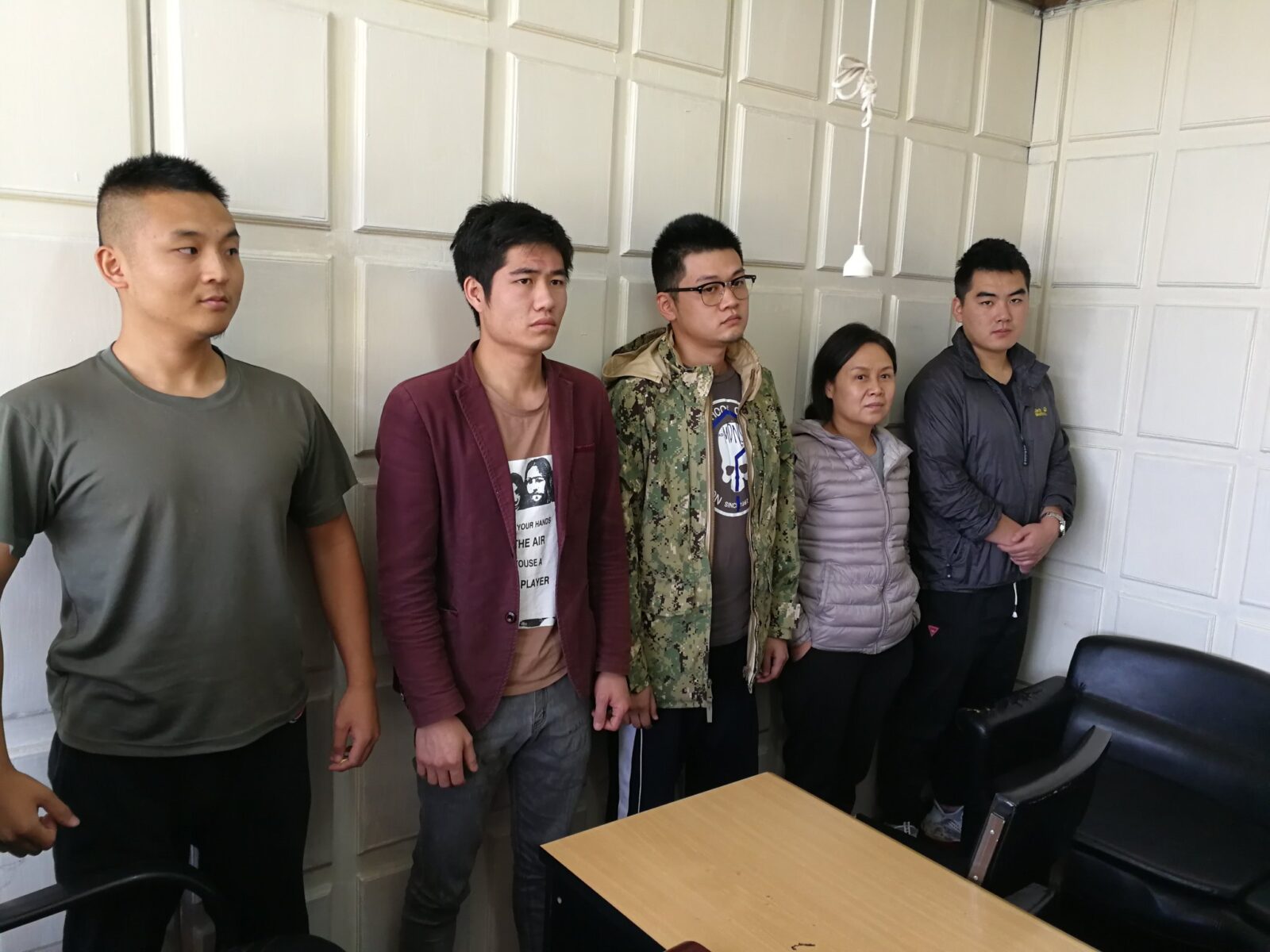
5 Chinese nationals arrested in Lavington with a number of items recovered that are believed to be a threat to our National Security.
Items recovered are, Radio Calls, Military uniforms, laptops metal detectors and many others. They will be detained for sometime as the investigating agencies do further investigations.
More to follow….


Send the application to the Kenya National Examinations Council.
You may also like:
Important Kenya National Examinations Council, KNEC, Contacts
Current allowances paid to Teachers in Kenya by the Teachers Service Commission: Hardship allowance.
Hardship allowances are paid to teachers working in areas classified as hardship. This allowance is paid on monthly basis
| S/NO | GRADE | TSC SCALE | FORMER JOB GROUP | Hardship Allowance- in Kshs per Month |
| 1 | B5 | 5 | G | 6,600 |
| 2 | C1 | 6 | H | 8,200 |
| 3 | C2 | 7 | I | 10,900 |
| 4 | C3 | 8 | J | 12,300 |
| 5 | C4 | 9 | K | 14,650 |
| 6 | C5 | 10 | L | 17,100 |
| 7 | D1 | 11 | M | 27,300 |
| 8 | D2 | 12 | N | 27,300 |
| 9 | D3 | 13 | P | 31,500 |
| 10 | D4 | 14 | Q | 31,500 |
| 11 | D5 | 15 | R | 38,100 |
You may also like:
Types of Allowances paid to Teachers by the Teachers Service Commission, TSC