
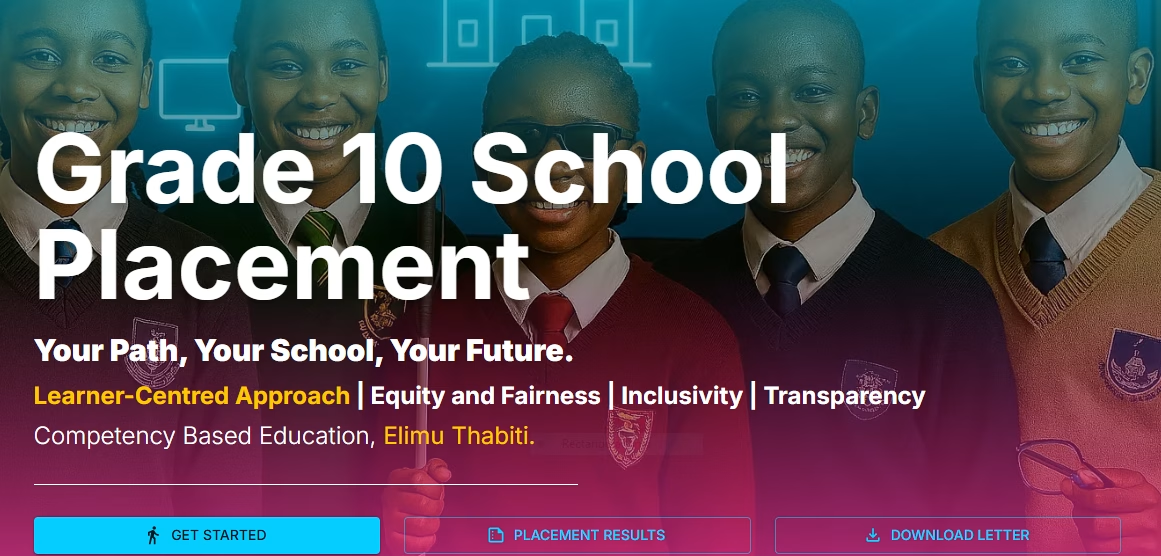
Explainer: How learners are selected and placed into Senior schools at Grade 10
How learners are selected and placed into Senior Secondary schools (Grade 10) in Kenya after the KJSEA (Kenya Junior Secondary School Education Assessment) — building on the earlier explanation of results and interpretation:
🎓 1. Total Score That Determines Placement
When placing learners into senior secondary school under the Competency-Based Curriculum (CBC), the final score used for placement is not just the KJSEA score alone. It’s a combined score made up of three components:
📌 KJSEA (Grade 9 Assessment): 60% — the national exam taken at the end of junior secondary.
📌 School-Based Assessment (Grades 7–8): 20% — includes projects, class tests, practicals and ongoing teacher evaluations.
📌 KPSEA (Grade 6 Primary Assessment): 20% — the earlier national assessment from primary school.
👉 All these together give a holistic placement score for each learner.
This system ensures placement decisions reflect learning over time — not just performance on one test.
Continue reading: Explanation of KJSEA results and how to interpret JSS (Junior Secondary School) performance in Kenya
🎯 2. Career Pathways (Learner Focused Selection)
Instead of a single general placement, learners are placed into one of three main Senior Secondary pathways based on their combined performance, interests, and strengths:
📌 • STEM (Science, Technology, Engineering & Mathematics)
Best suited for learners strong in sciences, maths, tech, and engineering tracks. It’s expected that about the majority of students will go this route because of how the curriculum and economy are structured.
📌 • Social Sciences
For learners whose strengths are in languages, humanities, business studies, and related disciplines.
📌 • Arts & Sports Science
For learners with interests or aptitudes in arts, creative disciplines, and physical education.
Learners usually indicate their preferred pathways and schools in advance as part of the placement process.
🏫 3. Choosing Schools & Pathways
Learners pre-select schools based on the pathway they aim to pursue:
📍 Typically, learners list up to 12 senior secondary schools they prefer, which must include schools that offer their chosen pathway and appropriate subject tracks.
👉 This list usually breaks down into:
7 schools for their first-choice pathway and track
3 schools for second choice
2 schools for third choice
These are selected based on where the learner hopes to study — considering factors like location, boarding/day status, and career interests. Out of these 12:
9 can be boarding schools (some within and outside the learner’s county)
3 are day schools closer to home/community.
While senior schools are still categorized in the traditional C1 to C4 tiers (National, Extra-County, County, Sub-County), the pathway choice and score alignment matter more than the old “ranked” system of placement.
📌 4. Placement Mechanics: Merit + Choice + Equity
The actual placement into a specific school happens automatically through the Ministry’s system, but it takes into account multiple factors:
📌 Performance: Learners with higher final (combined) scores have better chances of getting into more competitive schools and the first choice in their pathway.
📌 Learner Preferences: The choices the learner (and guardian) made when selecting schools and pathways matter.
📌 Track & Aptitude Fit: Placement aligns with the learner’s strengths and chosen pathway so they’re put where they can thrive.
📌 Equity & Quotas: The process also considers regional representation, school capacity, and equity measures like limiting how many students from one junior school go to the same senior school to promote diversity.
🧠 5. School Infrastructure & Pathway Availability
Not every school offers every pathway or track. Some schools might be fully equipped for STEM and Social Sciences, while others focus on Arts & Sports.
Placement is thus also influenced by:
✨ School offerings: Ensuring the chosen pathway is available there.
✨ Facilities: Labs, libraries, studios, sports facilities or specific teaching staff.
✨ Capacity: Number of available seats in each pathway.
📅 6. Timeline & Access
📌 Placement letters/results are issued after the national release of KJSEA results (decisions usually by December 20, 2025).
📌 Learners report to their senior schools in January 2026.
📌 You can check placement online by entering the learner’s assessment number on the Ministry’s portal (https://selection.education.go.ke/my-selections).
📌 Or via SMS by sending the assessment number to 22263 (cost ~ KSh 30).
🧩 7. Summary: What Matters Most in Selection
Factor Role in Placement
Final Combined Score Biggest determinant — impacts school and pathway allocation.
Choice of Schools/Pathways Determines where the learner wants to go; system matches score to these choices.
Pathway Fit Ensures learners are placed where their strengths match curriculum tracks.
Equity & Quotas Promotes balanced representation and fair access.

Related Posts
-
 2026 Revised Term Dates {School Calendar}
-
 Education Ministry Details on School Reopening Dates
-
 Learners receive free face masks
-
 Mwalimu National SACCO Membership, How To Join
-
 Grade 7 School Choices – List of schools selected to host Junior High School in Nandi County
-
 Application for admission to Diploma Teacher Training Colleges 2021; Intake, requirements and how to apply
About The Author
