The police report that last evening at about 8pm, a gang of men armed with AK 47 rifles attacked Chakama Trading centre in Chakama, Makongeni sub location in Kilifi county, about 80 kilometres west of Malindi town. The gang injured 5 local residents and abducting a young Italian Lady.
The attackers fired indiscriminately at residents injuring the following:
Samini Garama Dadu, aged 23 years was shot on the left side of the neck and is in serious condition,
Ibrahim Said, aged 16 years was shot on the left knee and his condition is stable,
Elias Mwaringa Kathua, aged 12 yrs was shot on the left thigh, his condition is stable,
Mohamed Kalume Konde,aged 10yrs was shot on the left eye, his condition stable and
Mang Katana Jeffa, aged 20yrs was shot on the right thigh, his condition stable.
All the injured persons were taken to hospital and contingents of police officers were deployed to track down the criminals.
The Gang, also, abducted an Italian lady aged 23 years who is a volunteer of Africa Milele Onlus; a Non Governmental Organization, NGO, operating in the area.
Neither the reasons for the attack nor the identity of the attackers have been established, so far. Now, the Police appeal to members of the public in the area to report promptly to the nearest Police Officer or Police Station should they sight the criminals with the abducted lady. The police have assured the public that they are sparing no effort in tracking down the criminals and to rescue the victim.
Today (Friday 12th April, 2019) morning in Mandera town at around 9.00 am, two Cuban doctors left their residence to Mandera Hospital in a County Government vehicle under the escort of two police officers . Along the way, they were blocked by two Toyota Probox cars.
Unfortunately, the Administration Police Service officer was shot at and fatally wounded. The criminals commandeered the car and occupants across the border to Somalia. So far, the County Government vehicle has been recovered and the driver is being held for interrogation.
All security agencies have been mobilized to pursue the criminals and rescue the victims. We urge members of the public to remain calm and avoid speculations as security agencies pursue the criminals.
The kidnapped Doctors are Dr Assel Herera Correa (General Physician) and Dr Landy Rodriguez (Surgeon)
The Director of Public Prosecutions (DPP), Noordin Haji, has moved to the Court of appeal to have state officers facing criminal offences to step aside until they are cleared by the courts.
Read, the DPP’ss Press Statement on application to bar State Officers charged with corruption from remaining in office.
This application procedure applies to Domestic (below 25kVA) and Premium applications (Above 25kVA, excluding SMEs with a load between 100kVA to 200kVA). This includes Additional Load and Meter Separation applications.
1. Application
We are encouraging all customers apply online https://selfservice.kplc.co.ke, submit with the applicable documents (refer to customer checklist below). You will be provided with an Application Reference Number instantly.
2. Quotation
You will receive a quotation based on your specifications in your enquiry.
The following quotation timelines will apply for various application types;
Application Connection Type
Time
Requiring a meter only
7 days
Requiring low voltage extension
14 days
Requiring low voltage extension (Single phase up to 8 kVa)
28 days
Requiring medium voltage extension and/or transformer
28 days
Requiring connection at high voltage
within the period agreed with the Customer.
A quotation is valid for ninety (90) days within which payment can be made via the following channels;
Electronic funds transfer (RTGS) to KPLC Bank Account No. 0104074121608
Mobile money (Pay bill number 888899, Account No: application reference No.)
Cheque to KPLC (Quote your application reference number and contact number overleaf of the cheque)
Cash payment at KPLC Payment office
3. Construction & Metering
We will obtain necessary consent where applicable to lay electricity supply lines and thereafter undertake construction and metering within the following timelines;
Type of Connection
Time
Requiring a meter only
3 days
Requiring low voltage extension (Single phase up to 8 kVa)
14 days
Requiring low voltage extension (3 phase above 8 kVa)
14 days
Requiring medium voltage extension and/or transformer
28 days
Requiring connection at high voltage
within the period agreed with the Customer.
Customer Checklist: Please attach the following documents when submitting your enquiry for supply form
All Applicants
Copy of National Identification (I.D) or Passport for Non-Kenyans/ Company Registration Certificates
Copy of your PIN Certificate
Route sketch map leading to premises where supply is required.
Copy of title deed and land search documents for ownership of property (to support wayleaves consent)
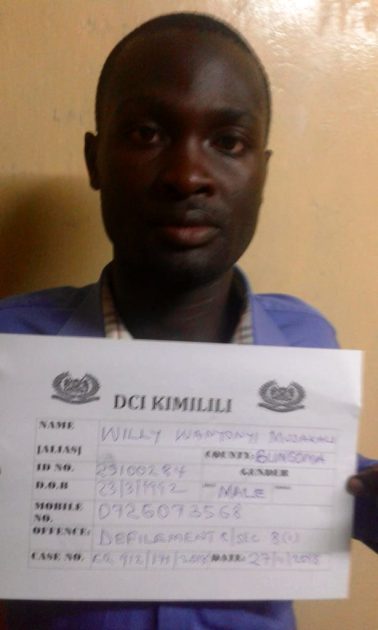
A Moi Girls High School teacher who was accused of defiling a student at the school has been arrested after being on the run for five months. Mr. Willy Wanyonyi Musikali, who is suspected to have raped the student in June this year, 2018, was arrested yesterday, Tuesday 27th November 2018, in Bungoma by detectives from the Directorate of Criminal Investigations, DCI .
Mr Wanyonyi allegedly defiled a 15 year old student at his office where he had summoned her for consultations. The teacher then fled after the incident became public and has been evading police arrest, since then.
Mr. Willy Wanyoni of Moi Girls Kamusinga after his arrest for defiling a student at the school
This arrest comes as reports indicate increases in cases of girls’ pregnancies. This has forced the education cabinet Secretary, Dr. Amina Mohammed, to order for teenage pregnancies’ analysis for the last three years: 2016, 2017 and 2018 .
Mr. Wanyonyi was expected to be arraigned, in court, today (Wednesday 28th November 2018) and be charged with the offence of defilement.
The African National Congress is saddened and mourns the passing away of the struggle veteran, Baba’ Eric “Stalin” Mtshali. Our condolences go to his family, friends and the entire movement.
The Kenya Medical Association, KMA, has written to the Kenya Medical Practitioners and Dentist Board protesting a move by parliament to scrap medical fees charged at private hospitals. According to the National Assembly, private hospitals should align their medical fees with the government’s Universal Health Coverage Agenda.
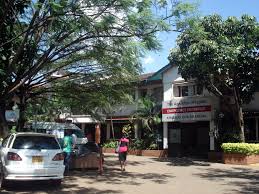
Aga Khan Hospital in Kisumu. Private hospitals vow to continue charging medical fees
Here is the memo sent to the Kenya Medical Practitioners and Dentist Board by KMA; dated 17th December, 2018:
“PROFESSIONAL FEES GUIDELINES
The Kenya Medical Association (KMA) is a membership organization for Doctors and Dentists registered to practice in Kenya established in 1968 with the twin mandate of championing the welfare of doctors and advocating for quality healthcare for all.
We are in receipt of your invitation to attend a stakeholders’ meeting to discuss professional fees chargeable by doctors in private practice. We are aware that a special committee of the Board was formed to review this matter pursuant to recommendations by the parliamentary committee on health, allegedly because the current fees are not supportive of the government’s Universal Health Coverage Agenda.
Our position as KMA is as follows:
Professional fees in private practice do not affect Universal Health Coverage in any way. The argument that NHIF (the National Hospital Insurance Fund) is paying exorbitant rates for this and for patients to go to India reflects failings at NHIF and has nothing to do with professional fee rules promulgated by the Medical Board. NHIF and other payers are allowed by law to negotiate mutually acceptable rates with practitioners, as long the fees do not exceed maximums set in the Rules.
Based on the Medical Board Professional Fees Rules of 2016, there is no justification to talk about ‘reducing the fees set in the guidelines’, given that the minimum fee as per the Rules is effectively zero. In a free market, the payer and the practitioner may agree to any fees as long as it not exceed the maximum (Fees) set by the Board.
It is in our view that the clamor for changes in private Practitioners’ fees is a side show meant to distract us from closely scrutinizing how the government and NHIF are utilizing public funds. KMA has said time and again that UHC (Universal Health Care) money should primarily be tax-derived and should be spent firstly on Public facilities in order to reduce the need for poor Kenyans to go to private facilities abroad.
It is our view that, should the Board succumb to pressure by politicians to tamper with private practitioners’ fees in the guise of supporting UHC, KMA shall reserve its right to advise members to disregard the illegal and unconstitutional Board guidance.
Further, KMA shall reserve its right to develop independent fee guidelines for members, and shall vigorously defend members’ rights to earn a decent living.”
The Ministry of Lands has instructed land owners in Naivasha Sub- County to present their documents to the Local land’s registry so as to fast track issuance of Title Deeds and Leases. See the schedule below;
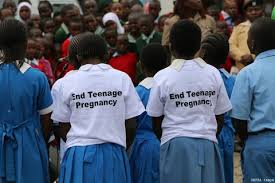
I have closely been following discussions in the print, social and broadcast media on the sensitive yet disturbing subject of teenage pregnancies. The discussions have attracted enormous opinions ranging from confining the adolescent girls to the house, not allowing them to visit relatives to restricting them from watching the TVs, using mobile phones, assessing internet and even visiting their friends. To me these are just but precipitating factors to an already vulnerable individual.
We ought to embrace the reality.
It may not be possible to isolate the girls from the society! It may not be possible to isolate the adolescents from their relatives and even domestic workers at home. It may not be possible to isolate these young people from their friends and is even equally impossible to separate them with smart phones, the TV and the most influential the internet!
Prevention of teenage pregnancies squarely depends on how the young girls handle these influences! They need to understand and appreciate the physiological changes that come with the adolescent stage! Studies and experience indicate that most adolescents do not have accurate knowledge about sexuality and how to deal with sexuality issues. How often do parents, teachers, religious leadership offer sexuality education to these girls? You will agree with me, rarely or never at all. These girls somehow get to learn from available sources including peers and the media! Such information may not be accurate! If they don’t learn from these sources, then Then it becomes guess work. The results are; teenage pregnancies and other related challenges!
This is a wake up call! A wake up call before all our teenagers in schools become mothers!! Let us teach them, let us give accurate sexuality knowledge both at home, school and even in religious gatherings!
Equally the young people need to be empowered with skills on how to handle the influences cited above! They need to be thoroughly trained on assertive skills and decision making skills. They need to be empowered on how to deal with peer pressure, they need to be trained on friendship formation. They too need to be empowered with negotiation skills! They need to be empowered on how to deal with adolescent relationship!
The teenager should know that they are the Chief Executive Officers, CEOs, of their future and lives! The answer to this challenge is empowering the teenagers to know how to handle these influences! The influences are there to stay! In fact, they become sophisticated each passing day!!
There is still HOPE!! Let us Empower and Mentor these Teenagers.
By Alice Songok Tenai
The Writer is a Teacher, Counselling Psychologist and Mentor.
Her contact: 0721688758
The National Transport and Safety Authority, NTSA, has taken stern action against a driver who was filmed while driving dangerously. The Sacco officials and the driver were summoned and appeared before a multi-agency team comprising of officers from NTSA and the National Police Service to address the complaint received. Following the meeting, a number of actions have been taken;
1). The Driver’s driving licence has been suspended
2). PSV licence ( Class A endorsement ) has been revoked and PSV badge withdrawn
3). The driver to be retested to assess his competencies
4). 2NK Sacco to remove the driver from their portal
5). 2NK Sacco to take responsibility and organize a road safety sensitization for the Sacco management, all its drivers and conductors within 7 days.
NTSA urges members of the public to continue supporting the Authority in weeding out rogue drivers in order to keep our roads safe. “The action of this driver put the lives of many innocent passengers at risk and we must all work to speak up about such vices. The use of mobile phones is a distraction. It takes the driver’s eyes off the road, with one hand on the wheel it is harder to navigate bends and respond to hazards,” NTSA says
“As an Authority, we are committed to taking action against any driver violating traffic rules and we encourage members of the public to continue reporting,” the agency adds.
Kenyans have taken Social media platforms by storm after photographs of Customs officers in new Zambian ‘Police’ uniforms were circulated online, this week. Social media platforms were awash with the blue and yellow stripped regalia that Kenyans have likened to the prison attire or pyjamas. The outfit is reportedly to be the new uniform for Zambia Revenue Authority (ZRA) customs officers.
Below is a photo shot of the new Zambia Revenue Authority (ZRA) customs officers’ uniforms that have caused online frenzy:
Some online users joked that the new Zambia Customs Policeuniform got its inspiration from a thing they are too familiar with, a suitcase and its strap, shown below:
Kenyans have made fun of the uniform saying the Kenyan police’s new blue uniform is far much better, shown below:
Maybe the debate on the uniforms would come to a halt now that it has been established that the new Zambian outfit does not belong to the police.
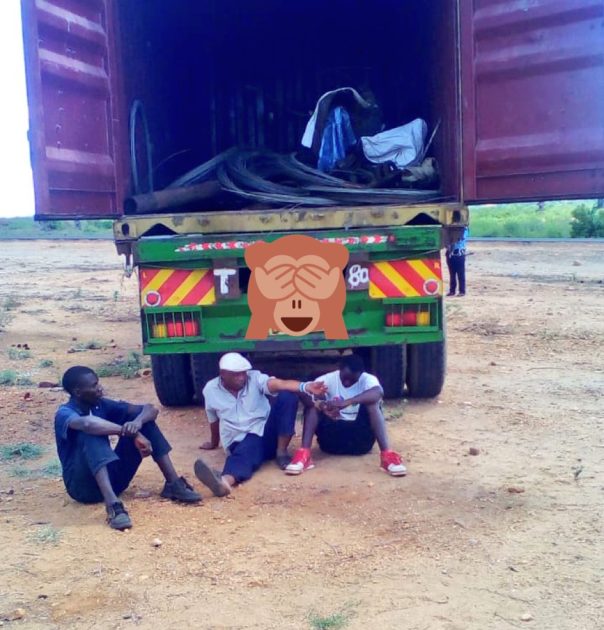
Three people found vandalising the Metre Gauge Railway materials; cable wires,nuts,rollers and loading them into a trailer lorry were yesterday night arrested by a combined team of Detectives from the Directorate of Criminal Investigations, DCI Kenya, and Kenya Wildlife Services, KWS, rangers at the Man Eaters area in Mtito Andei.
The three suspects together with the driver of the said lorry are currently in lawful custody and will be arraigned in court once necessary police action is done.
The four are:-
✅Andi Ibrahim~Driver of the Vehicle.
✅Bernard
Mwadime
✅Paul Wambua and
✅Nelson Kenneth.
The Government of Kenya through the Kenya Housing Fund is set to roll out a mandatory housing scheme for all workers. The housing scheme targets a minimum of Kshs. 3.4 Billion annually from employers and employers after the housing fund levy was signed into law by the President in the 2018 Finance Bill. provision of low cost housing units is part of President Uhuru Kenyatta’s big 4 Agenda. The housing scheme was expected to be rolled out in January 2019, but its implementation was halted by the High Court, in December 2018, after a petition was filled by the Central Organization of trade Unions’ (COTU) secretary, Mr. Francis Atwoli. Also opposed to the implementation of the housing scheme are the two teachers’ unions; the Kenya National Union of Teachers (KNUT) and the Kenya Union of Post Primary Education Teachers (KUPPET). Read more details here:Reprieve for employees as Court suspends the controversial Contributory housing scheme
Rationale behind the introduction of the Housing Scheme:
The implementation of the Housing Scheme is geared towards helping the government to deliver 500,000 affordable housing units in 5 years. This is in a bid to curb the expansion of slums in major towns in Kenya: Nairobi, Mombasa, Kisumu, Nakuru and other towns. Presently, Kenya as a country requires a minimum of 250,000 housing units annually. Unfortunately, the government and other private developers are able to build about 50,000 housing units. This leaves an unmet demand/ deficit of 200,000 housing units per year.
How much will each worker contribute?
Under the Affordable housing scheme, employees will contribute 1.5 percent of their monthly basic salaries towards the National Housing Development Fund while the employer tops up with an equal amount; provided that the sum of the employer and employee’s contributions do not exceed Kshs. 5,000 per month. Employees earning over kshs. 166,000 per month will contribute Kshs. 2,500. The housing scheme will be accessed through a tenant purchase scheme for those in the low cost housing bracket. For employees with high income, they will be given mortgages.
How will i get a housing unit, once I start contributing?
The kenyan government will run a yearly lottery to match the employees who have booked the number of housing units available. This is meant to block the the rich employees from buying several housing units so as to rent them out. The winners of the lotteries will hence start paying for the housing units.
When does the housing scheme mature?
According to the finance bill of 2018, a contributor will have to wait for a minimum period of fifteen years before the fund matures. “For employees who qualify for affordable housing, the contributions accrue to the employee and shall be used to finance the purchase of a home under the affordable housing scheme (upon expiry of the fifteen years from the date one starts to make contributions),” reads the 2018 finance bill, in part.
Contributions by individuals shall only be accessed for purposes of offsetting housing loans, security for mortgage or housing development after five years of uninterrupted contribution and shall attract such an annual return as may be determined by the Corporation. The Corporation shall set out the rate of return on investment for the contribution made by the employer and employee. The Corporation shall, on an annual basis specify the return applicable on members’ contributions into the Housing Fund.
How does one qualify for the Housing fund?
Home buyers will qualify for the social houses bracket if they earn less than Kshs. 15,000. Those earning between Kshs. 15,000 to Kshs. 49,000 per month will qualify for the low cost housing units. While, employees earning monthly salaries of Kshs. 50,000 to 99,000 will qualify for mortgages.
The home buyers will be given a 15% monthly tax relief on their gross earnings when they pay for the housing units.
Is the housing scheme open for self employed individuals?
For self employed individuals, they are classified as voluntary members under the contributory housing scheme. Every voluntary member shall contribute to the Housing Fund a minimum contribution of one hundred shillings designated to cover the costs and operations of the Housing Fund and a minimum amount of one hundred shillings per month to accrue as a benefit to the member.
Am I allowed to contribute more than the quoted figure of 1.5%?
Every member of the Housing Fund may make additional contributions which shall be credited to member’s individual account as the Housing Fund Credit.
The Corporation shall cause to be established and maintained for each member of the Housing Fund, an individual account to be known as the Housing Fund Credit to which shall be credited all contributions made to the Housing Fund by and in respect of each member of the Housing Fund.
What happens to my contributions if I earn over Kshs. 100,000?
Employees who earn over Kshs. 100,000 per month do not qualify for benefits from the housing scheme. Such employees do not qualify because they are classified under the high income range. For this group of employees, they will have their contributions and all interest accrued transferred to their retirement schemes after 15 years or upon reaching retirement age; whichever comes first.
What happens if I fail to contribute?
Any employer who fails, neglects or refuses to make a contribution under this regulation commits an offence and shall, upon conviction, be liable to imprisonment for a term of two years or to a fine not exceeding ten thousand shillings or to both.
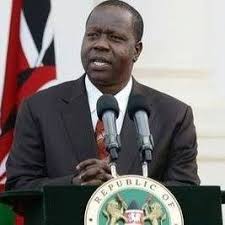
Interior Cabinet Secretary, Dr. Fred Matiang’i, has today reshuffled National Government Administration Officials at the eight Regions and 47 Counties, countrywide. According to Dr. Matiang’i, the deployments have been informed by the need to strengthen and enhance the leadership teams both at the Ministry’s headquarters and in the field.
“I have effected changes within the leadership structure of the National Government Administration Officials to enhance effectiveness into our approaches to addressing various security issues affecting Kenyans. The officers have taken up their new roles with immediate effect,” said Dr Matiang’i, via a presser; this evening.
The list below shows the officers who have been deployed:
S/N
NAME OF OFFICER
RANK
DEPARTMENT
1.
Mr. William Kangethe T.
Principal Administrative Secretary
Interior/ Head Quarters
2.
Mr. Wycliff Ogallo
Secretary- National Administration
Interior/ Head Quarters
3.
Mr. Moffat M. Kangi
Secretary- Internal Security
Interior/ Head Quarters
4.
Mr. Peter Thuku
Secretary- Peace Building and Conflict Management and Disasters Response
Interior/ Head Quarters
5.
Amb. Mohammed Saleh
Secretary- Liaison
Interior/ Head Quarters
6.
Mr. wilfred A. Nyagwanga
Regional Commissioner
Central Region
7.
Mr. Mongo Chimwaga
Regional Commissioner
Rift Valley Region
8.
Mrs Anne Ngetich
Regional Commissioner
Western Region
9.
Mr. James Kianda
Regional Commissioner
Nyanza Region
10.
Mr. Wilson Njega
Regional Commissioner
Nairobi Region
11.
Mr. John Elungata
Regional Commissioner
Coast Region
12.
Mr. Isaiah Nakoru
Regional Commissioner
Eastern Region
13.
Mr. Mohammed Birik
Regional Commissioner
North Eastern Region
14.
Ms. Flora Mworoa
County Commissioner
Nairobi County
15.
Mr. Fredrick M. Shishia
County Commissioner
Nyeri County
16.
Mr. Samson O. Ojwang
County Commissioner
Kirinyaga County
17.
Mr. Wilson Wanyanga
County Commissioner
Kiambu County
18.
Mr. Mohammed Barre
County Commissioner
Murang’a County
19.
Mr. Onesmus Kyatha
County Commissioner
Laikipia County
20.
Mr. Evans Achoki
County Commissioner
Mombasa County
21.
Mr. Karuku Ngumo
County Commissioner
Kwale County
22.
Mwangu Meru
County Commissioner
Garissa County
23.
Mr. Omingo Ole Sosio
County Commissioner
Tana River County
24
Mr. Joseph Kanyiri
County Commissioner
Lamu County
25.
Ms. Rhoda Onyancha
County Commissioner
Taita Taveta County
26.
Mr. Gilbert B. Kitiyo
County Commissioner
Marsabit County
27.
Mr. John Ondego
County Commissioner
Isiolo County
28.
Allan Machari
County Commissioner
Meru County
29.
Beverly Opwora
County Commissioner
Tharakanithi County
30.
Mr. Abdullahi G. Hiddi
County Commissioner
Embu County
31.
Mr. Magu Mutindika
County Commissioner
Kilifi County
32.
Ms. Esther Maina
County Commissioner
Machakos County
33.
Mr. Mohammed A. Maalim
County Commissioner
Makueni County
34.
Mr. Samuel Kimiti
County Commissioner
Kitui County
35.
Mr. Layford Kibaara
County Commissioner
Wajir County
36.
Mr. Olaka Kutswa
County Commissioner
Mandera County
37.
Ms. Pauline Dola
County Commissioner
Kisumu County
38.
Mr. Michael N. Tialal
County Commissioner
Siaya County
39.
Mr. Samson Irungu
County Commissioner
Homabay County
40.
Mr. Joseph rotich
County Commissioner
Migori County
41.
Mr. Amos Mariba
County Commissioner
Nyamira County
42.
Mr. Godfrey M. Kigochi
County Commissioner
Kisii County
43.
Mr. Seif Idd Matata
County Commissioner
Turkana County
44.
Mr. Apollo Okello
County Commissioner
West Pokot County
45.
Mr. Erastus Mbui
County Commissioner
Trans Nzoia County
46.
Mr. david Kipkemei
County Commissioner
Kajiado County
47.
Mr. George Natembea
County Commissioner
Narok County
48.
Mr. Joshua Nkanatha
County Commissioner
Nakuru County
49.
Mr. Henry Wafula
County Commissioner
Baringo County
50.
Mr. Boaz Cherutich
County Commissioner
Nyandarua County
51.
Mr. John Korir
County Commissioner
Samburu County
52.
Mr. Abdi M. Hassan
County Commissioner
Uasin Gishu County
53.
Dr. Ahmed Omar
County Commissioner
Elgeyo Marakwet County
54.
Boniface M. Wambua
County Commissioner
Nandi County
55.
Mr. George Omoding
County Commissioner
Bomet County
56.
Moses N. Mbaruku
County Commissioner
Kericho County
57.
Mr. abdirizak Jaldesa
County Commissioner
Kakamega County
58.
Stephen Kihara
County Commissioner
Bungoma County
59.
Mr. Jacob Namuleen Naleng’o
County Commissioner
Busia County
60.
Susan W. Ochanda
County Commissioner
Vihiga County
A site providing Education, TSC, Universities, Helb, Sports and Kuccps news in Kenya