Tag Archives: New currency notes

The Simple Rules for Exchanging Foreign Currency

As you’re preparing to live overseas or travel for an extended period of time, it’s important to know how you’ll get cash. Credit cards are ubiquitous in most countries. But, there’s still the odd moment where you’ll need cash – and, depending on your destination, cash may be the only option. At the very least, taking out cash to make your daily purchases can help you stick to a budget and make sure you’re not overspending on your credit cards. 

In the past, we’ve written an explanation of how foreign exchange rates work; today, here’s our guide to how to exchange foreign currency. There are many ways to trade one nation’s currency for another. Some are better than others. Stick to these rules to save money each time you exchange currency and get the best rates possible. 

Don’t exchange cash before you go

There’s a lot of confusion around whether or not you should exchange cash in your home country before departing. Some travelers prefer to have at least a little cash on them when they land. But, if you’re looking for the best exchange rate, it’s better to wait until you arrive to exchange currencies. Bring the bare minimum, as overseas exchange rates are higher than getting the right currency in-country. 

“Some tourists feel like they just have to have euros or British pounds in their pockets when they step off the airplane, but they pay the price in bad stateside exchange rates. Wait until you arrive to withdraw money,” writes travel expert Rick Steves

Avoid exchanging cash at an airport

Airport currency exchange kiosks are notoriously bad deals. “Airport currency kiosks, as well as those located near popular tourist areas, generally come with a larger exchange margin and more fees. If you changed dollars into the local currency when you landed in your destination airport, then changed your leftover foreign currency back into dollars before flying home, you’d end up losing money twice,” writes one expert

It’s better to exchange currency at a financial institution than at an airport. There will still be a small fee for making the exchange at a bank or credit union. However, you’ll get more money for your money than if you visit a tourist rip-off. 

Use an ATM to get cash

Instead of exchanging notes, get cash straight from the ATM. You’ll get a better deal since ATMs use the current bank rate. Some banks have no foreign transaction or ATM fees, allowing you to withdraw cash in the local currency. Other banks charge ATM fees of $1 to $5, and a debit transaction fee of up to 3%. Do some research to find the card with the best rates and minimize the number of withdrawals you make from the ATM, taking out a larger sum each time, to keep charges under control. Make sure you let your bank know before you travel abroad to ensure they don’t lock your card for seemingly fraudulent charges. 

Swipe your credit cards wisely

Credit cards can come in handy, especially during a big life transition like starting a new job overseas. But it’s easy to let credit card spending get out of hand – especially given the fees and charges that some credit companies take on to international purchases. As with the debit card, find a credit card that doesn’t charge any foreign transaction fees. 

“Most credit cards charge a foreign transaction fee of between 1% and 3% whenever you buy something abroad, but this is still the safest and often the cheapest way to make a large purchase. You’ll almost always come out ahead on the conversion since credit cards add their fee on top of the Interbank rate,” writes one travel expert from Fodors. Set aside your credit card to use for big purchases only, and try not to take a cash advance on your credit card unless it’s an emergency. 

Another good tip: pay in the currency of the country you’re in. When completing a transaction, you might be asked whether you wish to pay in USD or the local currency. Always choose the local currency. “If you pay in USD, not only will you get charged an inflated exchange rate but there is also a hidden 3-3.5% fee associated with this privilege.” 

Don’t forget: exchange rates apply to money transfers

Many travelers and expats forget that exchange fees also apply to money transfers. Make sure you get the best possible deal each time you send money home to friends and family. Not all transfer methods are created equal: a transfer agent like OFX, for example, has an exchange rate markup of less than 1%, while MoneyGram can charge up to 4% on exchange rate markups. 

Blockchain money transfer options are growing in popularity, mostly because this transfer doesn’t rely on banks. This means you can exchange currency at a lower cost (and faster, too!). Shop around to find the best option that won’t take advantage of an exchange rate to take your hard-earned cash.

Also read;

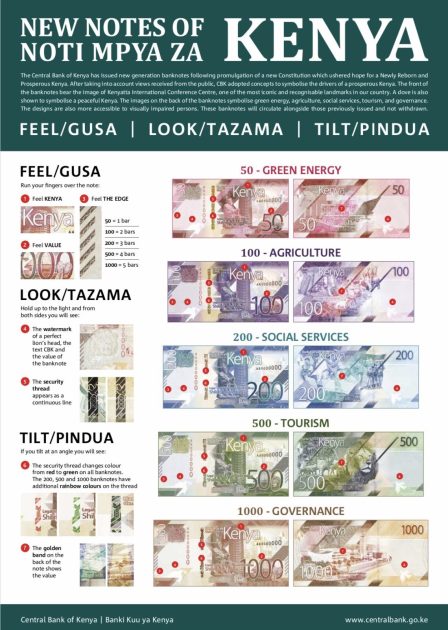
President Uhuru Kenyatta has just launched the new generation currency featuring animal photographs

Central Bank of Kenya issues guidelines on how old notes are to be exchanged

The Central Bank of Kenya, CBK, has today issued guidelines on how the old notes are to be withdrawn from circulation; ahead of the October deadline. Get details in the presser below;

‘Further to the issuance and launch of the New Generation banknotes CBK is pleased to advise that the new banknotes are already circulating in the country. It is expected that they will be available in all commercial bank branches in the coming days. CBK is also embarked on a wide Public Awareness Campaign to ensure all members of the public are familiar with the new banknotes and their features.

By Gazette Notice No. 4849 of May 31 2019, all the older 1,000 shillings banknotes shall be withdrawn and will cease to be legal tender on October 1, 2019. All other denominations are unaffected and will continue to circulate alongside the New Generation banknotes.

The objective of this measure is to deal conclusively with the emerging concerns about illicit financial flows and counterfeits. To ensure this measure is fully effective, the requirements of
Regulation 31 of the Proceeds of Crime and Anti-Money Laundering Regulations, 2013-that banks obtain confirmations from customers on the nature of their business that generate large cash transactions shall be adhered to. CBK is working with banks, forex bureaus, payment service providers, money remittance providers, other financial institutions, and investigative agencies to ensure that all requirements are observed.

Further guidance is provided below as to how the banknotes will be exchanged. These modalities are aimed at minimising business disruptions, ensuring the security of cash transactions, and safeguarding the integrity of the financial sector.

The intention is to make the process as straight forward as possible, particularly for smaller amounts.

The modalities are as follows:
Persons exchanging currency notes for amounts not exceeding Ksh.1 million of the withdrawn currency notes will exchange at their Commercial banks, CBK Branches and Currency Centres, or any nearest commercial bank.

Bank customers exchanging currency notes for amounts Ksh.1 million to Ksh.5 million of the withdrawn currency notes will exchange at their respective commercial banks, under the normal procedures and requirements.

Persons without bank accounts exchanging currency notes for amounts exceeding Ksh.1 million will require an endorsement from CBK.
Persons exchanging currency notes for amounts exceeding Ksh.5 million (bulk exchange) will require an endorsement from CBK. These persons should get in touch using the contacts shown below.

For enquiries on this matter, members of the public are requested to contact CBK by telephone at +254 20 2861032 or +254 20 2863122 or email: [email protected]