Chesta TTC- Fees, Intakes, Location, Admission Letters, Courses and Requirements

Get all the details about Chesta Teachers Training College, TTC including: Fees, Intakes, Location, Admission Letters, Courses and Requirements. Chesta Teachers college is a prime institution in the country . The College is committed to continuous improvement and quality in research and Teaching activities. Chesta TTC prides itself in offering Quality and Market oriented Education in in various fields.

Where is Chesta TTC Located?

Chesta Teachers Training College is a public teacher training institution located in West Pokot County, Kenya. Its name, “Chesta,” is derived from the local Pokot language meaning “Star.” It is recognized as the premier and only government teacher training college within the county.

The exact physical location of Chesta TTC is in the lowlands of Pokot Central Sub-County, approximately 103 kilometers East of Kapenguria in the Wei Wei area. The campus infrastructure features administrative spaces, lecture rooms, and boarding facilities, which have recently expanded to include a new women’s hostel block and a specialized Early Childhood Development Education (ECDE) classroom project funded by the local county government.

How Can I Contact Chesta TTC?

What is the Chesta TTC’s Official Name?

The College’s full Name is Chesta Teachers Training College.

What is the Brief History of Chesta TTC?

Chesta Teachers Training College (TTC), located in Pokot Central Sub-County, West Pokot County, was originally established in 1979 as a private mission center by ELCK missionaries. After closing due to unsustainability in 2013, the Ministry of Education re-established and registered it as a public diploma primary teacher training college on April 4, 2014.

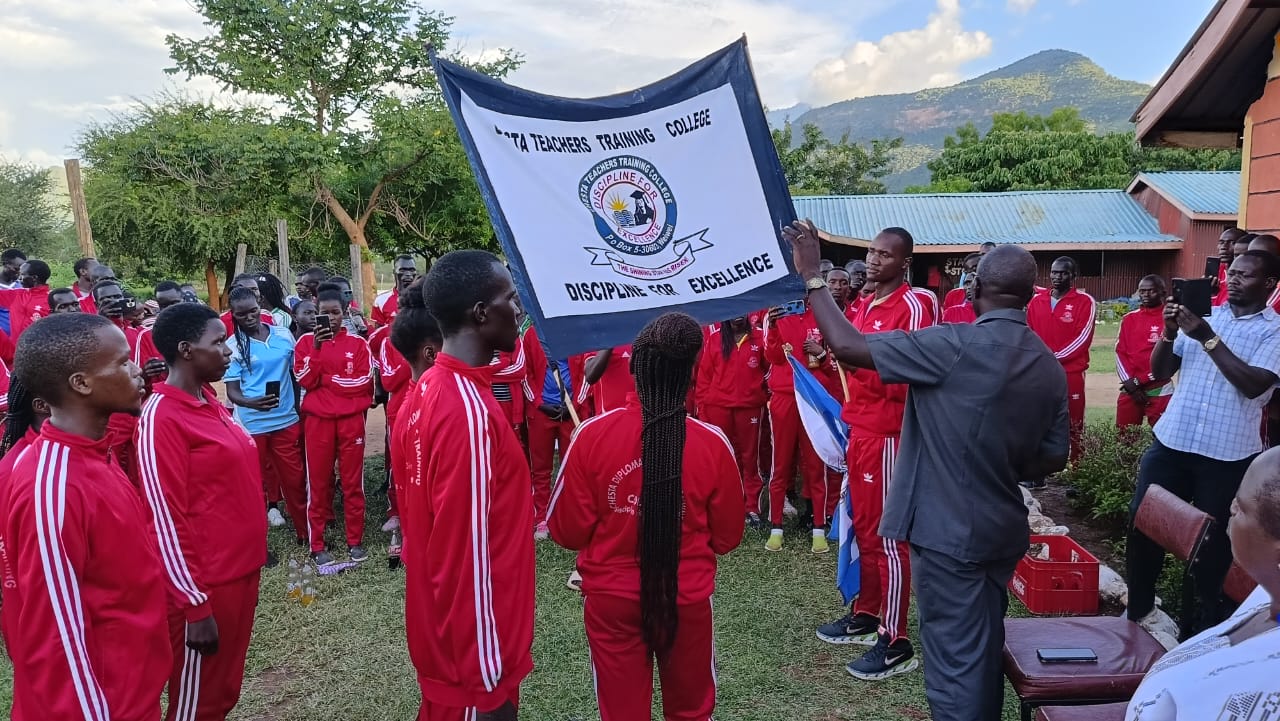
Its foundational goal is to prepare educators for impactful careers, with an emphasis on aligning teacher preparation with national competence frameworks, including the Competency Based Curriculum (CBC). The institutional motto is “Discipline for excellence.”

Chesta TTC’s History in summary:

  • 1979: Founded as a private entity by a group of Evangelical Lutheran Church in Kenya (ELCK) missionaries who established a local mission center.
  • 2013: The private college faced financial and structural challenges, leading to its closure as it was deemed not viable.
  • 2014: Re-established, taken over, and officially registered as a public teachers’ training college by the Kenyan Ministry of Education on April 4, 2014.

Chesta TTC’s Vision

To be a National Centre of Excellence in Teacher Training

Chesta TTC’s Motto

Discipline for excellence

Chesta TTC’s Mission

To produce Disciplined and Competent Teachers through Holistic Training

Chesta TTC’s Slogan

Keep Chesta Clean

Chesta TTC’s Full History

The term ‘Chesta’ means ‘star’ in Pokot language which is the language of the college catchment area. ELCK missionaries established the college in 2010. Unfortunately, the Chesta Private College was not sustainable from 2013. Having experienced the impact of an educational institution on the verge of collapse, the community highly treasured the justification and demand of establishing a government managed teacher training college.

Chesta TTC was then re-established and registered on 4th April 2014. Being the only public Teacher Training College in West Pokot County, the primary objective of re-establishment was to meet the high and unmatched demands for education because of increased youth and secondary school graduate population’s desire for training opportunities.

The college opened its doors to the first batch of 193 students in October 2014. This first cohort of students was selected during the national selection exercise.

The college re-located from the old ELCK college compound to its current location in October 2015. Today, it is the place where knowledge is brewed to thousands of Kenyans as a National Teachers Training College. Kenyans of all walks of life have had an opportunity to acquire knowledge, skills attitudes, values and wholesome training as teachers with basic life skills required for nation building.

It occupies an area of 56 acres, which provides enough space for infrastructural development and play grounds. From its humble beginning, the college has trained ECD, P1, DECTE and DPTE upgrade and DPTE regular students. It has pumped 461 qualified teachers into the Kenyan market across the country and 188 are graduating today.

The college boasts of notable development initiated by the National Government, County Government of West Pokot and the Board of Management. These includes the 10 permanent class tuition block, the college sanatorium, 1 new male hostel, 2 buses, 8 fabricated classrooms, 1 fabricated computer Lab, fabricated male hostels with a capacity of 190 and a fabricated female hostels with capacity of 320. The County government of West Pokot initiated construction of a 600 bed capacity female hostel, which has given the college a face-lift. It is our hope that this facility will soon be occupied.

The Board of Management is fully constituted with 17 members and has various functional sub-committees that execute various functions and mandate.

There is a cordial working relationship existing among our sister institutions and the entire community that has assisted us perform well.


Chesta TTC’s Professional Learning Areas/ Education Departemnt

Welcome to Professional Learning Areas/ Education department.

Subject/learning area Staff Members
Professional Learning Areas Education 1. Mr. Thomas Okari (HOD) 2. Ms. Margaret Cherotich 3. Mr. Dennis Cheruiyot 4. Dr. Omusula Christopher
I.c.t 1. Mr. Dennis G. Cheruiyot

Science And Mathematics Departemnt

Welcome to Science And Mathematics department.

Subject/Learning area Staff Members
Home Science 1. Mrs. Josphine Mudelwa
Mathematics 1. Mr. Japheth L.khalejera 2. Dr. Omusula Christopher
Science 1. Mr. Kiboi Cheprot (HOD) 2. Mr. Bethwel Kalum
Agriculture 1. Mr. Tom Mocha Omboga

Languages Departemnt

Welcome to Languages department.

Subject/Learning area Staff Members
English 1. Mr. Odima Deodatus (HOD) 2. Mr. Daniel Cheruiyot
Kiswahili 1. Mrs. Irene Chepchumba 2. Mr. Joseph Tuwei
Indigenous Languages 1. Mr. Odima Deodatus 2. Mr. Daniel Cheruiyot 3. Mr. Joseph Tuwei

Social Sciences Departemnt

Welcome to Social Sciences department.

Subject/Learning area Staff Members
Social Studies Mr. Ben K. Maiyo (HOD) 2. Mr. Limo Benson Cheres
Religious Education (C.r.e & I.r.e) 1. Ms. Dorcas Jepkemei Chelagat

Creative Arts Departemnt

Welcome to Creative Arts department.

Subject/Learning area Staff Members
Art/Craft 1. Mr. Gerard O. Motondi 2. Mr. Peter Kioni Njoroge
Music 1.Mr. Alfred M. Jumba (HOD) 2.Mr. Samuel K. Chesire
Physical Health Education 1.Mr. Duncan M. Okwaro 2.Mr. John M. Gitau 3.Mr. Kimaiywa K. Samuel

Who regulates Chesta TTC?

The College is regulated by Ministry of Education (State Department for Higher Education and Research).

Who posts Tutors at Chesta TTC?

Tutors at this college are posted and paid by the Teachers Service Commission, TSC.

Is Chesta TTC A Public or Private Teachers’ Training College?

This is a public teacher training institution under the Ministry of Education. The good news is that this College is registered by the Kenya Universities and Colleges Central Placement Service (KUCCPS) to offer various teacher education programs. Placement at the College is mostly done via KUCCPS.

When does Chesta TTC Admit New Students?

The College admits new Students in September of every year.

Which Courses are offered at Chesta TTC,  plus their Requirements?

The Teachers Training Colleges Offers Diploma in Teacher Education (DPTE) and Diploma in Early Childhood Teacher Education (DECTE).

To join the Diploma in Teacher Education (DPTE) Course, a minimum of a C (plain) mean grade at the Kenya Certificate of Secondary Education (KCSE) Exams is required.

Meanwhile, the Minimu KCSE Mean Grade Requirement for the Diploma in Early Childhood Teacher Education (DECTE) is equally a C (Plain).

Full List of Courses offered by the Chesta TTC

The TTC offers the following Courses:

  1. Diploma in Primary Teacher Education {DPTE – 3years} {Kuccps Placement}: This is the standard training program for prospective primary school teachers.
  2. Diploma in Early Childhood Development Education {DECTE – 3 years} {Kuccps Placement}: Focused on early childhood development and early-grade instructional designs.
  3. Upgrade Diploma in Primary Teacher Education {UDPTE – 1 year} {Direct Placement By The TTC}.
  4. Upgrade Diploma in Early Childhood Development Education {UDECTE – 1 year}. {Direct Placement By The TTC}.

Units offered at the Diploma in Primary Teacher Education {DPTE} Course

This Course takes 3 years. The following 6 units are covered under the Diploma in Primary Teacher Education {DPTE} Course:

  1. EDUCATION/PROFESSIONAL STUDIES UNIT

This involves:

  •    Child Development and Psychology.
  •    Curriculum Studies.
  •    Educational Resources.
  •    ICT Integration in Education.
  •    Educational Assessment.
  •     Research skills.
  •    Inclusive Education.
  •    Education Leadership and Management
  •    Sociological and Philosophical Foundations  of  Education.
  •    Historical and Comparative Foundations of  Education.
  •    Micro Teaching.
  •    Practicum.

2. LANGUAGES UNIT

This covers:

  1. English
  2. Kiswahili
  3. Indigenous Languages
  4. Foreign Languages

3. Mathematics Unit

  • This unit covers  studies in Mathematics

4. Integrated Science Unit

Studies in this unit involves:

  1. Science and Technology
  2. Agriculture
  3. Home science

5. Creative Arts Unit

Covering:

  1. Art & Craft
  2. Music
  3. Physical Health Education.

6. Social Sciences

This unit involves:

  1. Christian Religious Education {CRE}
  2. Social studies
  3. Islamic Religious Education {IRE}

Diploma in Early Childhood Teacher Education (DECTE)’s Units

The 3 year Diploma in Early Childhood Teacher Education (DECTE) has the following 6 units:

  1. EDUCATION/PROFESSIONAL STUDIES UNIT

This unit involves the following learning areas:

  1. Child Development and Psychology
  2. Curriculum Studies
  3. Educational Resources
  4. ICT Integration in Education
  5. Educational Assessment
  6. Research skills
  7. Inclusive Education
  8. Education Leadership and Management
  9. Sociological and Philosophical Foundations of Education
  10. Historical and Comparative Foundations of Education
  11. Micro Teaching
  12. Practicum.

2. Languages Unit

It has these three (3) learning areas:

  1. English Language Activities
  2. Kiswahili Language Activities
  3. Foreign Languages
  4. Indigenous Languages

3. Mathematics Activities Unit

4. Integrated Science Unit

  1. Environmental Education
  2. Health & Nutrition

6. Creative Arts Unit

Covering:

  1. Art & Craft
  2. Music
  3. Physical Health Education.

7. Social Sciences.

Covers studies in:

  • Christian Religious Education {CRE}

How Long does the Diploma in Teacher Education (DPTE) and Diploma in Early Childhood Teacher Education (DECTE) Courses Take at Chesta TTC?

The Diploma in Teacher Education (DPTE) and Diploma in Early Childhood Teacher Education (DECTE) courses take a duration of 2 years. This is both class work and attachment (Teaching Practice).

What is the Fees Structure at Chesta TTC?

The annual fees for the Courses is KSH 72,076. Remeber, this only Tuition Fees.

How Can I Apply For Placement at Chesta TTC?

To apply for placement at the TTC, use the KUCCPS Student Portal. This way, you will qualify for Government Funding through the Higher Education Funding (HEF) and Higher Education Loans Board (HELB).

How Do I Download the Chesta TTC Admission Letter?

To download your TTC Admission Letter, visit the KUCCPS Student Portal.


Does the Chesta TTC Offer Accomodation and Meals?

Yes. The Teachers Training College operates as a boarding institution providing a standard balanced diet to all trainees. Students are required to bring their own personal boarding items (such as a mattress, warm clothing due to the cold climate in the Aberdares/Nyahururu region, and personal hygiene effects).


Does the Chesta TTC Offer Medical Care?

Definately. Yes. The TTC has a health Facility within the College that handles minor ailments. Students are strongly encouraged to register for the Social Health Authority (SHA) cover to handle any external referrals or serious medical costs.


What are the Chesta TTC’s Admission Requirements & Joining Guidelines?

 Have you been placed at the TTC or are planning to apply for admission at the College? you will need to provide these specified documents during registration and admission.

  • The official KUCCPS/College Admission Letter (fully filled out).
  • Original and copies of your National ID Card.
  • Original K.C.S.E. Certificate and School Leaving Certificate.
  • Original Birth Certificate.
  • A recommendation letter from your area Assistant Chief or a local religious leader.
  • Two recent, certified color passport-sized photographs.

Does the Chesta TTC Offer Co-curricular Activities?

Yes. The College offers the following Inter-Colleges Co-curricular Activities:

  • Ball games like Soccer, Volleyball, Hanball, Netball, Basketball and Rugby
  • Goal ball
  • Athletics
  • Indoor games including: Badminton, Table Tennis and Lawn Tennis.
  • Hockey
  • Swimming

These events are called the Kenya Teachers Training Colleges (KTTC) National Sports & Ball Games Championship.

Chesta’s Games and Sports

Chesta TTC Games Sports is proud to represent the college in regional and national tournaments. The College welcomes new recruits to join soccer, athletics, hockey, netball, handball and volleyball teams to succeed while also gaining teamwork and leadersip skills. Chesta TTC is the regional winner in volleyball men and women, hockey women and netball men.
Chesta College's Players photo-file
Chesta College’s Players photo-file

Who participates in the Kenya Teachers Training Colleges (KTTC) National Sports & Ball Games Championship?

Participants: Teams from all Teachers Training College regions across Kenya.


Where Can I Be Employed Upon Completing Diploma in Teacher Education (DPTE) and Diploma in Early Childhood Teacher Education (DECTE) courses from Chesta TTC?

Graduates in Diploma in Teacher Education (DPTE) and Diploma in Early Childhood Teacher Education (DECTE) courses are employed to Teach in both Public and Primary Schools.

More Details on TTCs in Kenya.

Chesta Teachers Training College photos,
Chesta Teachers Training College Fees structure,
Chesta Teachers Training College Fees STRUCTURE pdf,
Chesta teachers training college admission letter,
Chesta teachers training college location,
Chesta TTC,
Chesta TTC admission letter pdf,
Mosoriot Teachers College,

Bunyore TTC- Fees, Intakes, Location, Admission Letters, Courses and Requirements

Get all the details about Bunyore Teachers Training College, TTC including: Fees, Intakes, Location, Admission Letters, Courses and Requirements.

Where is Bunyore TTC Located?

Bunyore TTC is a public teacher training institution located in Vihiga County, Kenya. It is registered and accredited by the Ministry of Education (MoE) and serves as an official Kenya National Examinations Council (KNEC) examination center.

The College is specifically located along the Stendikisa–Yala Road at Ilungu Market within the Emuhaya Constituency of Vihiga County. The infrastructure includes dedicated lecture spaces, administrative offices, student boarding facilities, and a structured library designed to support academic coursework.

How Can I Contact Bunyore TTC?

What is the Bunyore TTC’s Official Name?

The College’s full Name is Bunyore Teachers Training College.

What is the Brief History of Bunyore TTC?

Founded in 2016 and formally established under the Basic Education Act (2014) in March 2021, the college operates as a public institution sponsored by the African Interior Church (AIC). It is a standalone institution with no external branches, operating a unified campus setup.

Bunyore TTC’s History in Summary

  • Establishment: Founded in 2016, the college was built to expand access to quality teacher education and address the growing demand for qualified educators in Kenya.
  • Accreditation: Bunyore TTC is an officially accredited Kenya National Examinations Council (KNEC) examination center and is fully registered with the Ministry of Education.
  • Sponsorship: The institution operates under the sponsorship of the African Interior Church (AIC), aligning its foundational values with holistic training and character development for educators.

How to Apply for a course at Bunyore TTC

Find a teaching course of your choice from Bunyore TTC’s list and apply for the next intake. Click here.

How to Apply for scholarship at Bunyore TTC

The Higher Education Loans Board invites applications for First Time TVET Loan and Bursary from Kenyan students. Click here.

What is Bunyore TTC’s Vision?

A Model Centre of Provision of Quality Teacher Education & Training

What is Bunyore TTC’s Mission?

To foster Quality Teacher education & Training that promotes equity to produce Competent & Innovative Teacher

What is Bunyore TTC’s Core Mandate?

To Induct, Mentor, Train & Coach Diploma in Primary Teacher Education trainees, both Pre-service & Upgrade

Which Departments are available at Bunyore TTC?

Bunyoye TTC has 5 departments, which are:


Who regulates Bunyore TTC?

The College is regulated by Ministry of Education (State Department for Higher Education and Research).

Who posts Tutors at Bunyore TTC?

Tutors at this college are posted and paid by the Teachers Service Commission, TSC.

Is Bunyore TTC A Public or Private Teachers’ Training College?

This is a public teacher training institution under the Ministry of Education. The good news is that this College is registered by the Kenya Universities and Colleges Central Placement Service (KUCCPS) to offer various teacher education programs. Placement at the College is mostly done via KUCCPS.

When does Bunyore TTC Admit New Students?

The College admits new Students in September of every year.

Which Courses are offered at Bunyore TTC,  plus their Requirements?

The Teachers Training Colleges Offers Diploma in Teacher Education (DPTE) and Diploma in Early Childhood Teacher Education (DECTE).

To join the Diploma in Teacher Education (DPTE) Course, a minimum of a C (plain) mean grade at the Kenya Certificate of Secondary Education (KCSE) Exams is required.

Meanwhile, the Minimu KCSE Mean Grade Requirement for the Diploma in Early Childhood Teacher Education (DECTE) is equally a C (Plain).

Full List of Courses offered by the Bunyore TTC

The TTC offers the following Courses:

  1. Diploma in Primary Teacher Education {DPTE – 3years} {Kuccps Placement}: This is the standard training program for prospective primary school teachers. A comprehensive 3,000-hour pre-service curriculum incorporating structured coursework, summative assessments, and a mandatory teaching practicum.
  2. Diploma in Early Childhood Development Education {DECTE – 3 years} {Kuccps Placement}: Focused on early childhood development and early-grade instructional designs.
  3. Upgrade Diploma in Primary Teacher Education {UDPTE – 1 year} {Direct Placement By The TTC}.
  4. Upgrade Diploma in Early Childhood Development Education {UDECTE – 1 year}. {Direct Placement By The TTC}.

Units offered at the Diploma in Primary Teacher Education {DPTE} Course

This Course takes 3 years. The following 6 units are covered under the Diploma in Primary Teacher Education {DPTE} Course:

  1. EDUCATION/PROFESSIONAL STUDIES UNIT

This involves:

  •    Child Development and Psychology.
  •    Curriculum Studies.
  •    Educational Resources.
  •    ICT Integration in Education.
  •    Educational Assessment.
  •     Research skills.
  •    Inclusive Education.
  •    Education Leadership and Management
  •    Sociological and Philosophical Foundations  of  Education.
  •    Historical and Comparative Foundations of  Education.
  •    Micro Teaching.
  •    Practicum.

2. LANGUAGES UNIT

This covers:

  1. English
  2. Kiswahili
  3. Indigenous Languages
  4. Foreign Languages

3. Mathematics Unit

  • This unit covers  studies in Mathematics

4. Integrated Science Unit

Studies in this unit involves:

  1. Science and Technology
  2. Agriculture
  3. Home science

5. Creative Arts Unit

Covering:

  1. Art & Craft
  2. Music
  3. Physical Health Education.

6. Social Sciences

This unit involves:

  1. Christian Religious Education {CRE}
  2. Social studies
  3. Islamic Religious Education {IRE}

Diploma in Early Childhood Teacher Education (DECTE)’s Units

The 3 year Diploma in Early Childhood Teacher Education (DECTE) has the following 6 units:

  1. EDUCATION/PROFESSIONAL STUDIES UNIT

This unit involves the following learning areas:

  1. Child Development and Psychology
  2. Curriculum Studies
  3. Educational Resources
  4. ICT Integration in Education
  5. Educational Assessment
  6. Research skills
  7. Inclusive Education
  8. Education Leadership and Management
  9. Sociological and Philosophical Foundations of Education
  10. Historical and Comparative Foundations of Education
  11. Micro Teaching
  12. Practicum.

2. Languages Unit

It has these three (3) learning areas:

  1. English Language Activities
  2. Kiswahili Language Activities
  3. Foreign Languages
  4. Indigenous Languages

3. Mathematics Activities Unit

4. Integrated Science Unit

  1. Environmental Education
  2. Health & Nutrition

6. Creative Arts Unit

Covering:

  1. Art & Craft
  2. Music
  3. Physical Health Education.

7. Social Sciences.

Covers studies in:

  • Christian Religious Education {CRE}

How Long does the Diploma in Teacher Education (DPTE) and Diploma in Early Childhood Teacher Education (DECTE) Courses Take?

The Diploma in Teacher Education (DPTE) and Diploma in Early Childhood Teacher Education (DECTE) courses take a duration of 2 years. This is both class work and attachment (Teaching Practice).

What is the Fees Structure at Bunyore TTC?

The annual fees for the Courses is KSH 72,076. Remeber, this only Tuition Fees.

Fees Payment Guidelines: Tuition and administrative fees must be deposited directly into the institution’s official bank account (KCB Bank, Mbale Branch; Account Name: Bunyore Teachers’ Training College). Fees can also be paid via Bankers Cheques made out to the institution. Cash payments and personal cheques are explicitly not accepted.

How Can I Apply For Placement at Bunyore TTC?

To apply for placement at the TTC, use the KUCCPS Student Portal. This way, you will qualify for Government Funding through the Higher Education Funding (HEF) and Higher Education Loans Board (HELB).

How Do I Download the Bunyore TTC Admission Letter?

To download your TTC Admission Letter, visit the KUCCPS Student Portal.

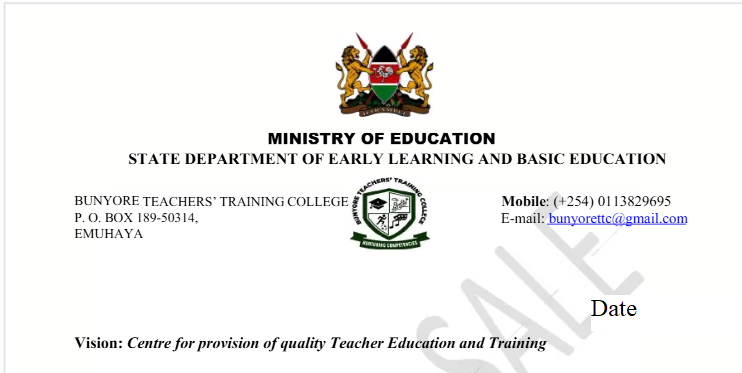
Bunyore TTC's Admission Letter
Bunyore TTC’s Admission Letter

Does the Bunyore TTC Offer Accomodation and Meals?

Yes. The Teachers Training College operates as a boarding institution providing a standard balanced diet to all trainees. Students are required to bring their own personal boarding items (such as a mattress, warm clothing due to the cold climate in the Aberdares/Nyahururu region, and personal hygiene effects).


Does the Bunyore TTC Offer Medical Care?

Definately. Yes. The TTC has a health Facility within the College that handles minor ailments. Students are strongly encouraged to register for the Social Health Authority (SHA) cover to handle any external referrals or serious medical costs.


What are the Bunyore TTC’s Admission Requirements & Joining Guidelines?

 Have you been placed at the TTC or are planning to apply for admission at the College? you will need to provide these specified documents during registration and admission.

  • The official KUCCPS/College Admission Letter (fully filled out).
  • Original and copies of your National ID Card.
  • Original K.C.S.E. Certificate and School Leaving Certificate.
  • Original Birth Certificate.
  • A recommendation letter from your area Assistant Chief or a local religious leader.
  • Two recent, certified color passport-sized photographs.

Does the Bunyore TTC Offer Co-curricular Activities?

Yes. The College offers the following Inter-Colleges Co-curricular Activities:

  • Ball games like Soccer, Volleyball, Hanball, Netball, Basketball and Rugby
  • Goal ball
  • Athletics
  • Indoor games including: Badminton, Table Tennis and Lawn Tennis.
  • Hockey
  • Swimming

These events are called the Kenya Teachers Training Colleges (KTTC) National Sports & Ball Games Championship.

Who participates in the Kenya Teachers Training Colleges (KTTC) National Sports & Ball Games Championship?

Participants: Teams from all Teachers Training College regions across Kenya.


Where Can I Be Employed Upon Completing Diploma in Teacher Education (DPTE) and Diploma in Early Childhood Teacher Education (DECTE) courses?

Graduates in Diploma in Teacher Education (DPTE) and Diploma in Early Childhood Teacher Education (DECTE) courses are employed to Teach in both Public and Primary Schools.

More Details on TTCs in Kenya.

Bunyore Teachers Training College photos,
Bunyore Teachers Training College location,
Bunyore Teachers Training College fees structure,
Bunyore TEACHERS TRAINING COLLEGE admission letters,
Bunyore teachers training college fees structure pdf,
Bunyore TEACHERS TRAINING COLLEGE courses offered,
Bunyore TTC portal,
Bunyore teachers training college admission letters pdf,

Borabu TTC- Fees, Intakes, Location, Admission Letters, Courses and Requirements

Get all the details about Borabu Teachers Training College, TTC including: Fees, Intakes, Location, Admission Letters, Courses and Requirements.

Where is Borabu TTC Located?

Borabu Teachers Training College (Borabu TTC) is a public teacher training institution located in Nyamira County, Kenya. It plays an important role in training educators from the western and Nyanza regions to implement Kenya’s competency-based curriculum (CBC/ CBE). The exact location of this college is in Borabu Subcounty near Kijauri town; off the Kisii-Sotik Highway.

Borabu TTC’s Quick Facts File.

Attribute Details
Location Situated in the Borabu constituency, Nyamira County.
Postal Address P.O. Box 110 – 40502, Nyansiongo, Kenya
Primary Email [email protected]
Placement Category Recognized public college listed under the Ministry of Education via KUCCPS.

Does Borabu TTC Offer Teaching Practice?

Yes. The college coordinates an extensive School Practicum Program annually. This maps student teachers to registered primary and early childhood schools across Nyamira, Kisii, and surrounding sub-counties, ensuring hands-on classroom teaching experience before graduation. These schools are located in:

  • Nyamira Sub-counties
  • Neighboring Kisii County schools
  • Bomet / Kericho border-zone basic education centers

How Can I Contact Borabu TTC?

Contact info

0715 984654
  • Postal Address: P.O. Box 110 – 40502, Nyansiongo, Kenya

  • Official Email: [email protected]

  • Physical Location: Situated in the agricultural highlands of the Borabu sub-county. The infrastructure links connect through the Eronge–Kebuse–Kahawa–Memisi road network toward Omonyenya and the Nyansiongo Mission area.

What is the Borabu TTC’s KUCCPS Institutional Code?

The Borabu TTC’s Kenya Universities and Colleges Central Placement Service (KUCCPS) Institutional Code is 1391.

Who regulates Borabu TTC?

The College is regulated by Ministry of Education (State Department for Higher Education and Research).

Who posts Tutors at Borabu TTC?

Tutors at this college are posted and paid by the Teachers Service Commission, TSC.

What is the Borabu TTC’s Official Name?

The College’s full Name is Borabu Teachers Training College, TTC.

What is the Brief History of Borabu TTC?

Borabu Teachers Training College (TTC), located in Esise within Nyamira County, was established around 2020. Construction for the college was initiated under the area NG-CDF to decentralize teacher education.

Is Borabu TTC A Public or Private Teachers’ Training College?

This is a public teacher training institution under the Ministry of Education. The good news is that this College is registered by the Kenya Universities and Colleges Central Placement Service (KUCCPS) to offer various teacher education programs. Placement at the College is mostly done via KUCCPS.

When does Borabu TTC Admit New Students?

The College admits new Students in September of every year.

Which Courses are offered at Borabu TTC,  plus their Requirements?

The Teachers Training Colleges Offers Diploma in Teacher Education (DPTE) and Diploma in Early Childhood Teacher Education (DECTE).

To join the Diploma in Teacher Education (DPTE) Course, a minimum of a C (plain) mean grade at the Kenya Certificate of Secondary Education (KCSE) Exams is required.

Meanwhile, the Minimu KCSE Mean Grade Requirement for the Diploma in Early Childhood Teacher Education (DECTE) is equally a C (Plain).


Borabu TTC focuses heavily on national competency-based curriculum (CBC/ CBE) trainer requirements. The primary programs offered are:

  1. Diploma in Primary Teacher Education (DPTE)

    • Focus: Training teachers for the primary school education tier.

    • Duration: 3 Years (including integrated school practice).

  2. Diploma in Early Childhood Teacher Education (DECTE)

    • Focus: Specialized instruction methodology for early childhood development and foundational levels.

    • Duration: 3 Years.

  3. Diploma in Teacher Education (DTE)

    • Focus: Secondary school teacher options (with specific arts/science combination profiles).

Full List of Courses offered by the Borabu TTC

The TTC offers the following Courses:

  1. Diploma in Primary Teacher Education {DPTE – 3years} {Kuccps Placement}: This is the standard training program for prospective primary school teachers.
  2. Diploma in Early Childhood Development Education {DECTE – 3 years} {Kuccps Placement}: Focused on early childhood development and early-grade instructional designs.
  3. Upgrade Diploma in Primary Teacher Education {UDPTE – 1 year} {Direct Placement By The TTC}.
  4. Upgrade Diploma in Early Childhood Development Education {UDECTE – 1 year}. {Direct Placement By The TTC}.

Units offered at the Diploma in Primary Teacher Education {DPTE} Course

This Course takes 3 years. The following 6 units are covered under the Diploma in Primary Teacher Education {DPTE} Course:

  1. EDUCATION/PROFESSIONAL STUDIES UNIT

This involves:

  •    Child Development and Psychology.
  •    Curriculum Studies.
  •    Educational Resources.
  •    ICT Integration in Education.
  •    Educational Assessment.
  •     Research skills.
  •    Inclusive Education.
  •    Education Leadership and Management
  •    Sociological and Philosophical Foundations  of  Education.
  •    Historical and Comparative Foundations of  Education.
  •    Micro Teaching.
  •    Practicum.

2. LANGUAGES UNIT

This covers:

  1. English
  2. Kiswahili
  3. Indigenous Languages
  4. Foreign Languages

3. Mathematics Unit

  • This unit covers  studies in Mathematics

4. Integrated Science Unit

Studies in this unit involves:

  1. Science and Technology
  2. Agriculture
  3. Home science

5. Creative Arts Unit

Covering:

  1. Art & Craft
  2. Music
  3. Physical Health Education.

6. Social Sciences

This unit involves:

  1. Christian Religious Education {CRE}
  2. Social studies
  3. Islamic Religious Education {IRE}

Diploma in Early Childhood Teacher Education (DECTE)’s Units

The 3 year Diploma in Early Childhood Teacher Education (DECTE) has the following 6 units:

  1. EDUCATION/PROFESSIONAL STUDIES UNIT

This unit involves the following learning areas:

  1. Child Development and Psychology
  2. Curriculum Studies
  3. Educational Resources
  4. ICT Integration in Education
  5. Educational Assessment
  6. Research skills
  7. Inclusive Education
  8. Education Leadership and Management
  9. Sociological and Philosophical Foundations of Education
  10. Historical and Comparative Foundations of Education
  11. Micro Teaching
  12. Practicum.

2. Languages Unit

It has these three (3) learning areas:

  1. English Language Activities
  2. Kiswahili Language Activities
  3. Foreign Languages
  4. Indigenous Languages

3. Mathematics Activities Unit

4. Integrated Science Unit

  1. Environmental Education
  2. Health & Nutrition

6. Creative Arts Unit

Covering:

  1. Art & Craft
  2. Music
  3. Physical Health Education.

7. Social Sciences.

Covers studies in:

  • Christian Religious Education {CRE}

How Long does the Diploma in Teacher Education (DPTE) and Diploma in Early Childhood Teacher Education (DECTE) Courses Take?

The Diploma in Teacher Education (DPTE) and Diploma in Early Childhood Teacher Education (DECTE) courses take a duration of 2 years. This is both class work and attachment (Teaching Practice).

What is the Fees Structure at Borabu TTC?

The annual fees for the Courses is KSH 72,076. Remeber, this only Tuition Fees.

How Can I Apply For Placement at Borabu TTC?

To apply for placement at the TTC, use the KUCCPS Student Portal. This way, you will qualify for Government Funding through the Higher Education Funding (HEF) and Higher Education Loans Board (HELB).

How Do I Download the Borabu TTC Admission Letter?

To download your TTC Admission Letter, visit the KUCCPS Student Portal.


Does the TTC Offer Accomodation and Meals?

Yes. The Teachers Training College operates as a boarding institution providing a standard balanced diet to all trainees. Students are required to bring their own personal boarding items (such as a mattress, warm clothing due to the cold climate in the Aberdares/Nyahururu region, and personal hygiene effects).


Does the Borabu TTC Offer Medical Care?

Definately. Yes. The TTC has a health Facility within the College that handles minor ailments. Students are strongly encouraged to register for the Social Health Authority (SHA) cover to handle any external referrals or serious medical costs.


What are the Borabu TTC’s Admission Requirements & Joining Guidelines?

 Have you been placed at the TTC or are planning to apply for admission at the College? you will need to provide these specified documents during registration and admission.

  • The official KUCCPS/College Admission Letter (fully filled out).
  • Original and copies of your National ID Card.
  • Original K.C.S.E. Certificate and School Leaving Certificate.
  • Original Birth Certificate.
  • A recommendation letter from your area Assistant Chief or a local religious leader.
  • Two recent, certified color passport-sized photographs.

Does the Borabu TTC Offer Co-curricular Activities?

Yes. The College offers the following Inter-Colleges Co-curricular Activities:

  • Ball games like Soccer, Volleyball, Hanball, Netball, Basketball and Rugby
  • Goal ball
  • Athletics
  • Indoor games including: Badminton, Table Tennis and Lawn Tennis.
  • Hockey
  • Swimming

These events are called the Kenya Teachers Training Colleges (KTTC) National Sports & Ball Games Championship.

Who participates in the Kenya Teachers Training Colleges (KTTC) National Sports & Ball Games Championship?

Participants: Teams from all Teachers Training College regions across Kenya.


Where Can I Be Employed Upon Completing Diploma in Teacher Education (DPTE) and Diploma in Early Childhood Teacher Education (DECTE) courses?

Graduates in Diploma in Teacher Education (DPTE) and Diploma in Early Childhood Teacher Education (DECTE) courses are employed to Teach in both Public and Primary Schools.

More Details on TTCs in Kenya.

Borabu teachers training college portal,
Borabu teachers Training College Fees Structure pdf,
Borabu Teachers Training College courses offered,
Borabu Teachers Training College location,
Borabu TEACHERS TRAINING College Admission Letter,
Borabu teachers training college website,
Borabu Teachers Training College contacts,
Borabu Teachers College photos,

Bondo TTC- Fees, Intakes, Location, Admission Letters, Courses and Requirements

Get all the details about Bondo Teachers Training College, TTC including: Fees, Intakes, Location, Admission Letters, Courses and Requirements.

Where is Bondo TTC Located?

Bondo Teachers Training College (commonly referred to as Bondo Teachers College) is a public teacher training institution located in Siaya County, Kenya. It plays a significant role in training teachers for primary and early childhood development education across the country.

Bondo TTC’s Quick Facts File.

Attribute Details
Location Located along the Bondo–Usenge Road, approximately 7 km from the Nyamonye Girls High School junction in Bondo, Siaya County.
Postal Address P.O. Box 424 – 40601, Bondo, Kenya
Primary Contacts +254 717 610 794 / +254 712 270 423
Email Address [email protected]
Official Website bondottc.ac.ke
Motto Service to My Country

How Can I Contact Bondo TTC?

What is the Bondo TTC’s Official Name?

The College’s full Name is Bondo Teachers Training College

What is the Brief History of Bondo TTC?

Bondo Teachers College was established in 1991. Upon its inception it was domiciled at Nyakasumbi within Bondo town, Maranda division of Bondo Sub county ,Siaya county. In that year it admitted its first lot of students in certificate course in primary teacher education (PTE), who eventually graduated as P1 in 1993.

Following the need and expansion of University education in Kenya,Bondo Teachers College became a constituent of Maseno University just like several other institutions of Primary teachers training colleges in Kenya. Consequently in 2009,Jaramogi Oginga Odinga University of Science and Technology (JOOUST) took over the facility that was Bondo Teachers Training at Nyakasumbi to become a fully-fledged chartered University.

Proceeding from the above events, a new site for the Teachers training college was identified at Bar Kanyango in Usigu Division, Bondo sub County , Siaya county where the primary teacher college relocated to in 2010. The current Bondo Diploma Teachers Training College was therefore incepted in 2010, however it was still offering training in P1 certificate. Two years (2012) after inception, the first cohort of 202 graduands were released into the teaching force labor market with a P1 certificate. The above number grew steadily to 213(2013), 341(2014), 348(2015), 403(2016), a drop in 2017 to 317, 354(2018) respectively. With the need for education still growing in the country, the college made a step in meeting this demand and started offering diploma and certificate in early childhood development (ECDE).

Bondo TTC’s Vision

Bondo TTC’ Mission


Bondo TTC’s Core Values

Professionalism

We are committed to the highest levels of achievement obtainable through competence and relevant skills.

Integrity and Honesty

We are committed to acting in honest, accountable and transparent mannerin all our endeavors.

Tolerance and empathy

We shall strive at all times to be sensitive to the welfare of our clients.

Responsibility

We shall hold ourselves accountable in the use of resources at our disposal for the purposes intended.

Peace and Unity

We shall strive to work in harmony at all times.

Respect and Courtesy

We shall endeavor to be courteousto all our clients and other stake holders all the time


Bondo TTC’s Working Hours

  • Monday – Friday 9.00 am – 5.00
  • Saturday 9.00am – 1.00pm

Is Bondo TTC A Public or Private Teachers’ Training College?

This is a public teacher training institution under the Ministry of Education. The good news is that this College is registered by the Kenya Universities and Colleges Central Placement Service (KUCCPS) to offer various teacher education programs. Placement at the College is mostly done via KUCCPS.

When does Bondo TTC Admit New Students?

The College admits new Students in September of every year.

Which Courses are offered at Bondo TTC,  plus their Requirements?

The Teachers Training Colleges Offers Diploma in Teacher Education (DPTE) and Diploma in Early Childhood Teacher Education (DECTE).

To join the Diploma in Teacher Education (DPTE) Course, a minimum of a C (plain) mean grade at the Kenya Certificate of Secondary Education (KCSE) Exams is required.

Meanwhile, the Minimu KCSE Mean Grade Requirement for the Diploma in Early Childhood Teacher Education (DECTE) is equally a C (Plain).

Full List of Courses offered by the Bondo TTC

The TTC offers the following Courses:

  1. Diploma in Primary Teacher Education {DPTE – 3years} {Kuccps Placement}
  2. Diploma in Early Childhood Development Education {DECTE – 3 years} {Kuccps Placement}
  3. Upgrade Diploma in Primary Teacher Education {UDPTE – 1 year} {Direct Placement By The TTC}.
  4. Upgrade Diploma in Early Childhood Development Education {UDECTE – 1 year}. {Direct Placement By The TTC}.
  5. Diploma in Teacher Education (DTE): Secondary options covering diverse arts and science combinations.

Units offered at the Diploma in Primary Teacher Education {DPTE} Course

This Course takes 3 years. The following 6 units are covered under the Diploma in Primary Teacher Education {DPTE} Course:

  1. EDUCATION/PROFESSIONAL STUDIES UNIT

This involves:

  •    Child Development and Psychology.
  •    Curriculum Studies.
  •    Educational Resources.
  •    ICT Integration in Education.
  •    Educational Assessment.
  •     Research skills.
  •    Inclusive Education.
  •    Education Leadership and Management
  •    Sociological and Philosophical Foundations  of  Education.
  •    Historical and Comparative Foundations of  Education.
  •    Micro Teaching.
  •    Practicum.

2. LANGUAGES UNIT

This covers:

  1. English
  2. Kiswahili
  3. Indigenous Languages
  4. Foreign Languages

3. Mathematics Unit

  • This unit covers  studies in Mathematics

4. Integrated Science Unit

Studies in this unit involves:

  1. Science and Technology
  2. Agriculture
  3. Home science

5. Creative Arts Unit

Covering:

  1. Art & Craft
  2. Music
  3. Physical Health Education.

6. Social Sciences

This unit involves:

  1. Christian Religious Education {CRE}
  2. Social studies
  3. Islamic Religious Education {IRE}

Diploma in Early Childhood Teacher Education (DECTE)’s Units

The 3 year Diploma in Early Childhood Teacher Education (DECTE) has the following 6 units:

  1. EDUCATION/PROFESSIONAL STUDIES UNIT

This unit involves the following learning areas:

  1. Child Development and Psychology
  2. Curriculum Studies
  3. Educational Resources
  4. ICT Integration in Education
  5. Educational Assessment
  6. Research skills
  7. Inclusive Education
  8. Education Leadership and Management
  9. Sociological and Philosophical Foundations of Education
  10. Historical and Comparative Foundations of Education
  11. Micro Teaching
  12. Practicum.

2. Languages Unit

It has these three (3) learning areas:

  1. English Language Activities
  2. Kiswahili Language Activities
  3. Foreign Languages
  4. Indigenous Languages

3. Mathematics Activities Unit

4. Integrated Science Unit

  1. Environmental Education
  2. Health & Nutrition

6. Creative Arts Unit

Covering:

  1. Art & Craft
  2. Music
  3. Physical Health Education.

7. Social Sciences.

Covers studies in:

  • Christian Religious Education {CRE}

How Long does the Diploma in Teacher Education (DPTE) and Diploma in Early Childhood Teacher Education (DECTE) Courses Take?

The Diploma in Teacher Education (DPTE) and Diploma in Early Childhood Teacher Education (DECTE) courses take a duration of 2 years. This is both class work and attachment (Teaching Practice).

What is the Fees Structure at Bondo TTC?

The annual fees for the Courses is KSH 72,076. Remeber, this only Tuition Fees.

How Can I Apply For Placement at Bondo TTC?

To apply for placement at the TTC, use the KUCCPS Student Portal. This way, you will qualify for Government Funding through the Higher Education Funding (HEF) and Higher Education Loans Board (HELB).

How Do I Download the Bondo TTC Admission Letter?

To download your TTC Admission Letter, visit the KUCCPS Student Portal.


Does the Bondo TTC Offer Accomodation and Meals?

Yes. The Teachers Training College operates as a boarding institution providing a standard balanced diet to all trainees. Students are required to bring their own personal boarding items (such as a mattress, warm clothing due to the cold climate in the Aberdares/Nyahururu region, and personal hygiene effects).


Does the Bondo TTC Offer Medical Care?

Definately. Yes. The TTC has a health Facility within the College that handles minor ailments. Students are strongly encouraged to register for the Social Health Authority (SHA) cover to handle any external referrals or serious medical costs.


What are the Bondo TTC’s Admission Requirements & Joining Guidelines?

 Have you been placed at the TTC or are planning to apply for admission at the College? you will need to provide these specified documents during registration and admission.

  • The official KUCCPS/College Admission Letter (fully filled out).
  • Original and copies of your National ID Card.
  • Original K.C.S.E. Certificate and School Leaving Certificate.
  • Original Birth Certificate.
  • A recommendation letter from your area Assistant Chief or a local religious leader.
  • Two recent, certified color passport-sized photographs.
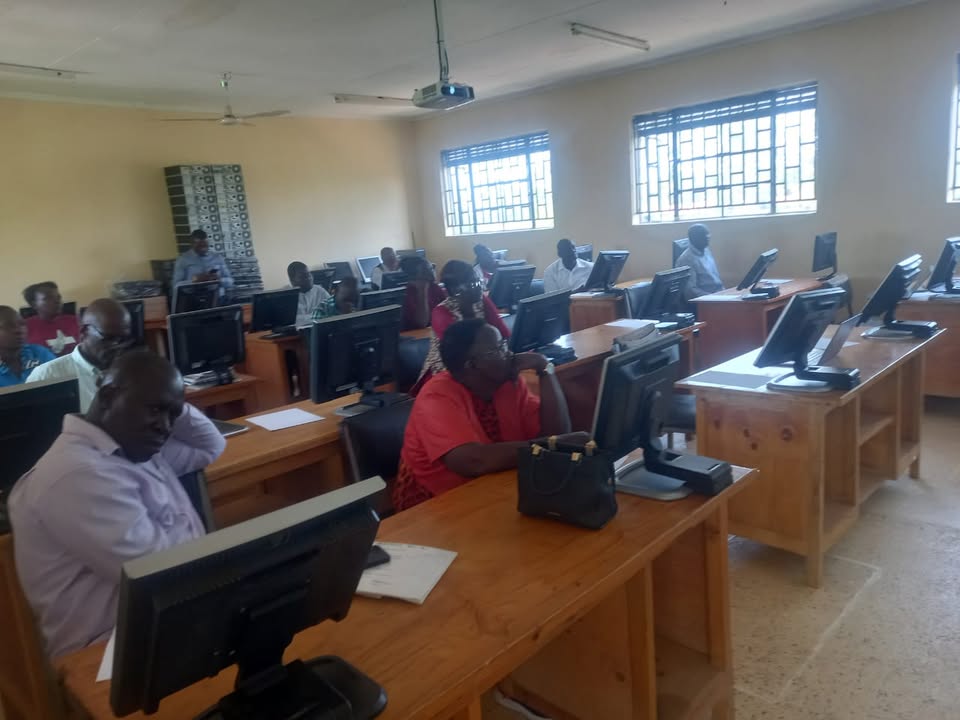
Bondo Teachers College's Computer Laboratory
Bondo Teachers College’s Computer Laboratory

Does the Bondo TTC Offer Co-curricular Activities?

Yes. The College offers the following Inter-Colleges Co-curricular Activities:

  • Ball games like Soccer, Volleyball, Hanball, Netball, Basketball and Rugby
  • Goal ball
  • Athletics
  • Indoor games including: Badminton, Table Tennis and Lawn Tennis.
  • Hockey
  • Swimming

These events are called the Kenya Teachers Training Colleges (KTTC) National Sports & Ball Games Championship.

Who participates in the Kenya Teachers Training Colleges (KTTC) National Sports & Ball Games Championship?

Participants: Teams from all Teachers Training College regions across Kenya.


Where Can I Be Employed Upon Completing Diploma in Teacher Education (DPTE) and Diploma in Early Childhood Teacher Education (DECTE) courses?

Graduates in Diploma in Teacher Education (DPTE) and Diploma in Early Childhood Teacher Education (DECTE) courses are employed to Teach in both Public and Primary Schools.

More Details on TTCs in Kenya.

Bondo Teachers Training College FEE Structure,
Bondo Teachers Training College Fee Structure pdf,
Bondo teachers training college portal,
Bondo teachers TRAINING college Admission Letter download,
Bondo Teachers Training College Courses offered,
Bondo Teachers Training College photos,
Bondo teachers training college portal registration,
Bondo Teachers Training College admission Letter download,

Bishop Mahon TTC- Fees, Intakes, Location, Admission Letters, Courses and Requirements

Get all the details about Bishop Mahon Teachers Training College, TTC including: Fees, Intakes, Location, Admission Letters, Courses and Requirements.

Where is Bishop Mahon TTC Located?

Bishop Mahon Teachers Training College is a public primary teacher training institution managed by the Ministry of Education. Situated in the northern region of Kenya; Lodwar Town, approximately 1 kilometer from the Lodwar Post Office, Turkana County. The College plays a vital role in training educators under the country’s Competency-Based Curriculum (CBC/ CBE) framework.

How Can I Contact Bishop Mahon TTC?

  • Location: Situated within the former Turkana Resource Centre in Lodwar Town, approximately 1 kilometer from the Lodwar Post Office, Turkana County.
  • Postal Address: P.O. Box 148 – 30500, Lodwar
  • Official Phone: 0112972138
  • Official Email: [email protected]

What is the Bishop Mahon TTC’s Official Name?

The College’s full Name is Bishop Mahon Teachers Training College.

What is the Brief History of Bishop Mahon TTC?

Twenty-eight years ago, catholic Diocese of lodwars first bishop the late Rt. Reverend Bishop John Mahon had a dream of building teacher’s training college (TTC) in the region. This, he planned to do with support of the Norwegian government. However, the plan did not take off after the National Government declined to register the institution in 1992.
According to Fr. Desmond Miller, a priest at the catholic Diocese of Lodwar, the ministry of  education could not register a day teacher training college. The institution was then turned into a resource center until 2020 when it was registered to aperate as a full TTC.
Fr Areman said Bishop Mahon Teacher’s training was registered on January 10,2020. It received its first principal in October 2020 and seven tutors from the TSC.

Advert for Placement at Bishop Mahon TTC

Intake: September intake

🎓 BISHOP MAHON TEACHERS TRAINING COLLEGE – 𝐒𝐄𝐏𝐓𝐄𝐌𝐁𝐄𝐑 𝐈𝐍𝐓𝐀𝐊𝐄

🔥 Not just a college — it’s your passport to the world!
From humble beginnings to global impact your journey as a future educator starts right here.
Every form submitted, every hoodie worn, every bus boarded is a step toward a brighter future.
🚌 Our modern inspired college buses aren’t just for transport they’re symbols of the journey ahead. Because at BISHOP MAHON TTC, our buses are ready to take you around the world through knowledge, experience and opportunity! 🌍

💼 Why BISHOP MAHON TTC?

✅ Nationally recognized teacher training programs
✅ Vibrant and welcoming campus life
✅ Bold branding from hoodies to backpacks, wear your identity with pride
✅ Reliable transport, spacious classrooms and real mentorship
✅ A growing alumni network making waves in Kenya and beyond
🌟 Education is Light. At BISHOP MAHON TTC, we don’t just light the way we drive you there.
📞 Call or WhatsApp 0716101346 to reserve your slot
📍 Visit our admissions office and join the line the future is waiting!
🚀 September Intake  is in motion. Jump in we’ll take you places.

Is Bishop Mahon TTC A Public or Private Teachers’ Training College?

Bishop Mahon TTC a public teacher training institution under the Ministry of Education. The good news is that this College is registered by the Kenya Universities and Colleges Central Placement Service (KUCCPS) to offer various teacher education programs. Placement at the College is mostly done via KUCCPS.

Which Courses are offered at Bishop Mahon TTC,  plus their Requirements?

The Teachers Training Colleges Offers Diploma in Teacher Education (DPTE) and Diploma in Early Childhood Teacher Education (DECTE).

To join the Diploma in Teacher Education (DPTE) Course, a minimum of a C (plain) mean grade at the Kenya Certificate of Secondary Education (KCSE) Exams is required.

Meanwhile, the Minimu KCSE Mean Grade Requirement for the Diploma in Early Childhood Teacher Education (DECTE) is equally a C (Plain).

Full List of Courses offered by the Bishop Mahon TTC

The TTC offers the following Courses:

  1. Diploma in Primary Teacher Education {DPTE – 3years} {Kuccps Placement}
  2. Diploma in Early Childhood Development Education {DECTE – 3 years} {Kuccps Placement}
  3. Upgrade Diploma in Primary Teacher Education {UDPTE – 1 year} {Direct Placement By The TTC}.
  4. Upgrade Diploma in Early Childhood Development Education {UDECTE – 1 year}. {Direct Placement By The TTC}.

Units offered at the Diploma in Primary Teacher Education {DPTE} Course

This Course takes 3 years. The following 6 units are covered under the Diploma in Primary Teacher Education {DPTE} Course:

  1. EDUCATION/PROFESSIONAL STUDIES UNIT

This involves:

  •    Child Development and Psychology.
  •    Curriculum Studies.
  •    Educational Resources.
  •    ICT Integration in Education.
  •    Educational Assessment.
  •     Research skills.
  •    Inclusive Education.
  •    Education Leadership and Management
  •    Sociological and Philosophical Foundations  of  Education.
  •    Historical and Comparative Foundations of  Education.
  •    Micro Teaching.
  •    Practicum.

2. LANGUAGES UNIT

This covers:

  1. English
  2. Kiswahili
  3. Indigenous Languages
  4. Foreign Languages

3. Mathematics Unit

  • This unit covers  studies in Mathematics

4. Integrated Science Unit

Studies in this unit involves:

  1. Science and Technology
  2. Agriculture
  3. Home science

5. Creative Arts Unit

Covering:

  1. Art & Craft
  2. Music
  3. Physical Health Education.

6. Social Sciences

This unit involves:

  1. Christian Religious Education {CRE}
  2. Social studies
  3. Islamic Religious Education {IRE}

Diploma in Early Childhood Teacher Education (DECTE)’s Units

The 3 year Diploma in Early Childhood Teacher Education (DECTE) has the following 6 units:

  1. EDUCATION/PROFESSIONAL STUDIES UNIT

This unit involves the following learning areas:

  1. Child Development and Psychology
  2. Curriculum Studies
  3. Educational Resources
  4. ICT Integration in Education
  5. Educational Assessment
  6. Research skills
  7. Inclusive Education
  8. Education Leadership and Management
  9. Sociological and Philosophical Foundations of Education
  10. Historical and Comparative Foundations of Education
  11. Micro Teaching
  12. Practicum.

2. Languages Unit

It has these three (3) learning areas:

  1. English Language Activities
  2. Kiswahili Language Activities
  3. Foreign Languages
  4. Indigenous Languages

3. Mathematics Activities Unit

4. Integrated Science Unit

  1. Environmental Education
  2. Health & Nutrition

6. Creative Arts Unit

Covering:

  1. Art & Craft
  2. Music
  3. Physical Health Education.

7. Social Sciences.

Covers studies in:

  • Christian Religious Education {CRE}

How Long does the Diploma in Teacher Education (DPTE) and Diploma in Early Childhood Teacher Education (DECTE) Courses Take at Bishop Mahon TTC?

The Diploma in Teacher Education (DPTE) and Diploma in Early Childhood Teacher Education (DECTE) courses take a duration of 2 years. This is both class work and attachment (Teaching Practice).

What is the Fees Structure at Bishop Mahon TTC?

The annual fees for the Courses is KSH 72,076. Remeber, this only Tuition Fees.

How Can I Apply For Placement at Bishop Mahon TTC?

To apply for placement at the TTC, use the KUCCPS Student Portal. This way, you will qualify for Government Funding through the Higher Education Funding (HEF) and Higher Education Loans Board (HELB).

How Do I Download the Bishop Mahon TTC Admission Letter?

To download your TTC Admission Letter, visit the KUCCPS Student Portal.


Does Bishop Mahon TTC Offer Accomodation and Meals?

Yes. The Teachers Training College operates as a boarding institution providing a standard balanced diet to all trainees. Students are required to bring their own personal boarding items (such as a mattress, warm clothing due to the cold climate in the Aberdares/Nyahururu region, and personal hygiene effects).


Does Bishop Mahon TTC Offer Medical Care?

Definately. Yes. The TTC has a health Facility within the College that handles minor ailments. Students are strongly encouraged to register for the Social Health Authority (SHA) cover to handle any external referrals or serious medical costs.


What are the Bishop Mahon TTC’s Admission Requirements & Joining Guidelines?

 Have you been placed at the TTC or are planning to apply for admission at the College? you will need to provide these specified documents during registration and admission.

  • The official KUCCPS/College Admission Letter (fully filled out).
  • Original and copies of your National ID Card.
  • Original K.C.S.E. Certificate and School Leaving Certificate.
  • Original Birth Certificate.
  • A recommendation letter from your area Assistant Chief or a local religious leader.
  • Two recent, certified color passport-sized photographs.

Does Bishop Mahon TTC Offer Co-curricular Activities?

Yes. The College offers the following Inter-Colleges Co-curricular Activities:

  • Ball games like Soccer, Volleyball, Hanball, Netball, Basketball and Rugby
  • Goal ball
  • Athletics
  • Indoor games including: Badminton, Table Tennis and Lawn Tennis.
  • Hockey
  • Swimming

These events are called the Kenya Teachers Training Colleges (KTTC) National Sports & Ball Games Championship.

Who participates in the Kenya Teachers Training Colleges (KTTC) National Sports & Ball Games Championship?

Participants: Teams from all Teachers Training College regions across Kenya.


Where Can I Be Employed Upon Completing Diploma in Teacher Education (DPTE) and Diploma in Early Childhood Teacher Education (DECTE) courses?

Graduates in Diploma in Teacher Education (DPTE) and Diploma in Early Childhood Teacher Education (DECTE) courses are employed to Teach in both Public and Primary Schools.

More Details on TTCs in Kenya.

Bishop Mahon TTC admission letter,
Bishop Mahon TTC fee structure,
Bishop MAHON Teachers Training college location,
Top 10 government Teachers Training colleges in Kenya,
List of Teachers TRAINING colleges in Kenya,
Diploma teachers Training Colleges in Kenya,
List of government TEACHERS TRAINING Colleges in Kenya,
Top 10 TEACHERS TRAINING colleges in Kenya,

Asumbi TTC- Fees, Intakes, Location, Admission Letters, Courses and Requirements

Get all the details about Asumbi Teachers Training College, TTC including: Fees, Intakes, Location, Admission Letters, Courses and Requirements.

Where is Asumbi TTC Located?

Asumbi Teachers Training College (Asumbi TTC) is a prominent public teacher training institution with a rich history, established through the efforts of the Catholic Church in 1936. Sponsored by the Ministry of Education, it is one of Kenya’s premier colleges for primary and early childhood teacher education. Asumbi TTC is located in a serene learning environment within Homa Bay County; with its specific location being Rangwe Constituency, Kajulu Sub-location, East Kagan Location, Homa Bay County (Nyanza Region).

How Can I Contact Asumbi TTC?

Contact Asumbi TTC through:

  • Location: Rangwe Constituency, Kajulu Sub-location, East Kagan Location, Homa Bay County (Nyanza Region)
  • Postal Address: P.O. Box 119 – 40300, Asumbi
  • Official Phone: 059-21201 / 0722326632 / 0733656685
  • Website: asumbittc.ac.ke
  • Mobile Phone Contact: (254) 707831679
  • Official Email:  [email protected]
  • Website Full Link: https://asumbittc.ac.ke/

What is the Asumbi TTC’s Official Name?

The College’s full Name is Asumbi Teachers Training College.

What is the Brief History of Asumbi TTC?

Asumbi Teachers Training College is a public registered Teachers Training College formally established through the effort of Catholic Church in 1936. It is sponsored by the Ministry of Education, specifically the State Department of Basic Education Act 2013.

The college’s main responsibility is to train teachers for primary schools, covering early childhood to senior primary levels. It has a mandate to provide the required leadership in designing suitable plans and strategies that will contribute to high and sustainable social economic development.

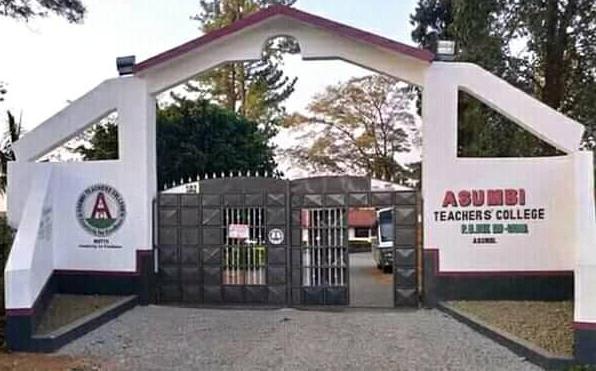
Main entrance at Asumbi TTC

Asumbi TTC is located in Rangwe constituency, Kajulu Sub-location, East kagan Location in Rangwe Division of Homa Bay Sub-county in Homa Bay County; within the Nyanza region of Kenya.


What makes Asumbi TTC unique?

Apart from the Curriculum, the College also excels in Co-curricular Activities like Basketball, Soccer, Drama and Music.


Asumbi TTC’s Vision

To be a Centre of Excellence in Teacher Education and Training Globally.

Asumbi TTC’s Mission Statement

Promoting quality teacher education and training withing an aesthetic environment so as to produce competent, effective and caring teacher for national development.
Asumbi TTC’s Core Values

Asumbi TTC operational environment is governed by a set of core values, which constitute the desired institutional culture. These are:

  • Respect for human dignity
  • Professionalism
  • Intergrity
  • Teamwork
  • Innovation

Which Courses are offered at Asumbi TTC,  plus their Requirements?

The Teachers Training Colleges Offers Diploma in Teacher Education (DTE; Secondary option, including Science and Arts) Diploma in Teacher Education (DPTE) and Diploma in Early Childhood Teacher Education (DECTE).

To join the Diploma in Teacher Education (DPTE) Course, a minimum of a C (plain) mean grade at the Kenya Certificate of Secondary Education (KCSE) Exams is required.

Meanwhile, the Minimu KCSE Mean Grade Requirement for the Diploma in Early Childhood Teacher Education (DECTE) is equally a C (Plain).

Full List of Courses offered by the Asumbi TTC

The TTC offers the following Courses:

  1. Diploma in Primary Teacher Education {DPTE – 3years} {Kuccps Placement}
  2. Diploma in Early Childhood Development Education {DECTE – 3 years} {Kuccps Placement}
  3. Upgrade Diploma in Primary Teacher Education {UDPTE – 1 year} {Direct Placement By The TTC}.
  4. Upgrade Diploma in Early Childhood Development Education {UDECTE – 1 year}. {Direct Placement By The TTC}.
  5. DTE: Diploma in Teacher Education (Secondary option, including Science and Arts)
  6. Diploma in Teachers Education (Teachers Education)
  7. Diploma in Journalism and Mass Media Communications (Journalism)
  8. Diploma in Education (Science)
  9. Bridging Course in Mathematics (Mathematics)
  10. Bachelor of Arts (Criminology & Security Studies)

Units offered at the Diploma in Primary Teacher Education {DPTE} Course at Asumbi TTC

This Course takes 3 years. The following 6 units are covered under the Diploma in Primary Teacher Education {DPTE} Course:

  1. EDUCATION/PROFESSIONAL STUDIES UNIT

This involves:

  •    Child Development and Psychology.
  •    Curriculum Studies.
  •    Educational Resources.
  •    ICT Integration in Education.
  •    Educational Assessment.
  •     Research skills.
  •    Inclusive Education.
  •    Education Leadership and Management
  •    Sociological and Philosophical Foundations  of  Education.
  •    Historical and Comparative Foundations of  Education.
  •    Micro Teaching.
  •    Practicum.

2. LANGUAGES UNIT

This covers:

  1. English
  2. Kiswahili
  3. Indigenous Languages
  4. Foreign Languages

3. Mathematics Unit

  • This unit covers  studies in Mathematics

4. Integrated Science Unit

Studies in this unit involves:

  1. Science and Technology
  2. Agriculture
  3. Home science

5. Creative Arts Unit

Covering:

  1. Art & Craft
  2. Music
  3. Physical Health Education.

6. Social Sciences

This unit involves:

  1. Christian Religious Education {CRE}
  2. Social studies
  3. Islamic Religious Education {IRE}

Diploma in Early Childhood Teacher Education (DECTE)’s Units at Asumbi TTC

The 3 year Diploma in Early Childhood Teacher Education (DECTE) has the following 6 units:

  1. EDUCATION/PROFESSIONAL STUDIES UNIT

This unit involves the following learning areas:

  1. Child Development and Psychology
  2. Curriculum Studies
  3. Educational Resources
  4. ICT Integration in Education
  5. Educational Assessment
  6. Research skills
  7. Inclusive Education
  8. Education Leadership and Management
  9. Sociological and Philosophical Foundations of Education
  10. Historical and Comparative Foundations of Education
  11. Micro Teaching
  12. Practicum.

2. Languages Unit

It has these three (3) learning areas:

  1. English Language Activities
  2. Kiswahili Language Activities
  3. Foreign Languages
  4. Indigenous Languages

3. Mathematics Activities Unit

4. Integrated Science Unit

  1. Environmental Education
  2. Health & Nutrition

6. Creative Arts Unit

Covering:

  1. Art & Craft
  2. Music
  3. Physical Health Education.

7. Social Sciences.

Covers studies in:

  • Christian Religious Education {CRE}

How Long does the Diploma in Teacher Education (DPTE) and Diploma in Early Childhood Teacher Education (DECTE) Courses Take at Asumbi ?

The Diploma in Teacher Education (DPTE) and Diploma in Early Childhood Teacher Education (DECTE) courses take a duration of 2 years. This is both class work and attachment (Teaching Practice).

What is the Fees Structure at Asumbi TTC?

The annual fees for the Courses is KSH 72,076. Remeber, this only Tuition Fees.

How Can I Apply For Placement at Asumbi TTC?

To apply for placement at the TTC, use the KUCCPS Student Portal. This way, you will qualify for Government Funding through the Higher Education Funding (HEF) and Higher Education Loans Board (HELB).

How Do I Download the Asumbi TTC Admission Letter?

To download your TTC Admission Letter, visit the KUCCPS Student Portal.


Does the Asumbi TTC Offer Accomodation and Meals?

Yes. The Teachers Training College operates as a boarding institution providing a standard balanced diet to all trainees. Students are required to bring their own personal boarding items (such as a mattress, warm clothing due to the cold climate in the Aberdares/Nyahururu region, and personal hygiene effects).


Does the Asumbi TTC Offer Medical Care?

Definately. Yes. The TTC has a health Facility within the College that handles minor ailments. Students are strongly encouraged to register for the Social Health Authority (SHA) cover to handle any external referrals or serious medical costs.


What are the Asumbi TTC’s Admission Requirements & Joining Guidelines?

 Have you been placed at the TTC or are planning to apply for admission at the College? you will need to provide these specified documents during registration and admission.

  • The official KUCCPS/College Admission Letter (fully filled out).
  • Original and copies of your National ID Card.
  • Original K.C.S.E. Certificate and School Leaving Certificate.
  • Original Birth Certificate.
  • A recommendation letter from your area Assistant Chief or a local religious leader.
  • Two recent, certified color passport-sized photographs.

Where Can I Be Employed Upon Completing Diploma in Teacher Education (DPTE) and Diploma in Early Childhood Teacher Education (DECTE) courses at Asumbi?

Graduates in Diploma in Teacher Education (DPTE) and Diploma in Early Childhood Teacher Education (DECTE) courses are employed to Teach in both Public and Primary Schools.

More Details on TTCs in Kenya.

Asumbi TEACHERS TRAINING COLLEGE intake,
Asumbi Teachers Training College contact Number,
Asumbi Teachers Training College FEE STRUCTURE PDF download,
Asumbi Teachers Training College Courses and fees,
Asumbi Teachers Training College courses offered,
Asumbi Teachers Training College Contacts,
Asumbi TEACHERS Training College online application,
Asumbi Teachers Training College location,

Aberdare TTC- Fees, Intakes, Location, Admission Letters, Courses and Requirements

Get all the details about Aberdare Teachers Training College, TTC including: Fees, Intakes, Location, Admission Letters, Courses and Requirements.

Where is Aberdare TTC Located?

Aberdare Teachers Training College (Aberdare TTC) is a public teacher training institution under the Ministry of Education. It is located in Nyandarua County, near Nyahururu, and is registered by the Kenya Universities and Colleges Central Placement Service (KUCCPS) to offer various teacher education programs.

How Can I Contact Aberdare TTC?

  • Location: Nyahururu, Nyandarua County, Kenya
  • Postal Address: P.O. Box 200 – 20300, Nyahururu
  • Official Phone: 0719453380
  • Official Email: [email protected] (or as provided on official KUCCPS portals)
  • Website: aberdarettc.ac.ke

What is the Aberdare TTC’s Official Name?

The College’s full Name is Aberdare Teachers Training College.

Is Aberdare TTC Offering the CBE/ CBC curriculum?

Yes. The College is offering the Competency Based Education (CBE)/ CBC curriculum.

What is the Brief History of Aberdare TTC?

Aberdare Teachers Training College is one of the Public Primary Teacher Training Colleges (PTTCs) in the country, it was registered in 2015 by the Ministry of Education, and started by support of the National Government Constituency Development Fund (NG-CDF) – Ndaragwa.

The college is situated at Dairy Pondo along Mairo Inya- Ndogino road in Ndaragwa Constituency, Nyandarua North Sub County, of Nyandarua County. It is 7kms from Mairo Inya shopping centre along the Nyahururu – Nyeri road, 12.5 kms North East of Nyahururu town and 48 kms from Ol’kalou, the County Headquarters.

The college opened its doors to the first batch of 40 students in November 2015. A total of 924 students have trained here so far.  They have been presented for the Primary Teacher Education (PTE) Examination from the academic year 2017 to the academic year 2020.

In the first PTE examination year 2017, the college produced the best candidate in the Nation who got a distinction of 18 points.

The college is managed by a Board of Management.

Aberdare TTC’s  Main Mission

To Offer Quality Teachers Education and Training For Innovation, Research and National Development.

Which KUCCPS Courses are offered at Aberdare TTC,  plus their Requirements?

Aberdare Teachers Training Colleges Offers Diploma in Teacher Education (DPTE) and Diploma in Early Childhood Teacher Education (DECTE).

To join the Diploma in Teacher Education (DPTE) Course, a minimum of a C (plain) mean grade at the Kenya Certificate of Secondary Education (KCSE) Exams is required.

Meanwhile, the Minimu KCSE Mean Grade Requirement for the Diploma in Early Childhood Teacher Education (DECTE) is equally a C (Plain).

Full List of Courses offered by Aberdare TTC

Aberdare TTC offers the following Courses:

  1. Diploma in Primary Teacher Education {DPTE – 3years}
  2. Diploma in Early Childhood Development Education {DECTE – 3 years}
  3. Upgrade Diploma in Primary Teacher Education {UDPTE – 1 year}
  4. Upgrade Diploma in Early Childhood Development Education {UDECTE – 1 year}.

Units offered at the Diploma in Primary Teacher Education {DPTE} Course

This Course takes 3 years. The following 6 units are covered under the Diploma in Primary Teacher Education {DPTE} Course:

  1. EDUCATION/PROFESSIONAL STUDIES UNIT

This involves:

  •    Child Development and Psychology.
  •    Curriculum Studies.
  •    Educational Resources.
  •    ICT Integration in Education.
  •    Educational Assessment.
  •     Research skills.
  •    Inclusive Education.
  •    Education Leadership and Management
  •    Sociological and Philosophical Foundations  of  Education.
  •    Historical and Comparative Foundations of  Education.
  •    Micro Teaching.
  •    Practicum.

2. LANGUAGES UNIT

This covers:

  1. English
  2. Kiswahili
  3. Indigenous Languages
  4. Foreign Languages

3. Mathematics Unit

  • This unit covers  studies in Mathematics

4. Integrated Science Unit

Studies in this unit involves:

  1. Science and Technology
  2. Agriculture
  3. Home science

5. Creative Arts Unit

Covering:

  1. Art & Craft
  2. Music
  3. Physical Health Education.

6. Social Sciences

This unit involves:

  1. Christian Religious Education {CRE}
  2. Social studies
  3. Islamic Religious Education {IRE}

Diploma in Early Childhood Teacher Education (DECTE)’s Units

The 3 year Diploma in Early Childhood Teacher Education (DECTE) has the following 6 units:

  1. EDUCATION/PROFESSIONAL STUDIES UNIT

This unit involves the following learning areas:

  1. Child Development and Psychology
  2. Curriculum Studies
  3. Educational Resources
  4. ICT Integration in Education
  5. Educational Assessment
  6. Research skills
  7. Inclusive Education
  8. Education Leadership and Management
  9. Sociological and Philosophical Foundations of Education
  10. Historical and Comparative Foundations of Education
  11. Micro Teaching
  12. Practicum.

2. Languages Unit

It has these three (3) learning areas:

  1. English Language Activities
  2. Kiswahili Language Activities
  3. Foreign Languages
  4. Indigenous Languages

3. Mathematics Activities Unit

4. Integrated Science Unit

  1. Environmental Education
  2. Health & Nutrition

6. Creative Arts Unit

Covering:

  1. Art & Craft
  2. Music
  3. Physical Health Education.

7. Social Sciences.

Covers studies in:

  • Christian Religious Education {CRE}

How Long does the Diploma in Teacher Education (DPTE) and Diploma in Early Childhood Teacher Education (DECTE) Courses Take at Aberdare TTC?

The Diploma in Teacher Education (DPTE) and Diploma in Early Childhood Teacher Education (DECTE) courses take a duration of 2 years. This is both class work and attachment (Teaching Practice).

What is the Fees Structure at Aberdare TTC?

The annual fees for the Courses is KSH 72,076. Remeber, this only Tuition Fees.

How Can I Pay Fees at Aberdare TTC?

All tuition and college fees must be paid directly into the institution’s official bank account. Cash payments or personal checks are not accepted at the finance office.

  • Bank: Co-operative Bank
  • Account Name: Aberdare Teachers Training College
  • Account Number: 01139689225000

How Can I Apply For Placement at Aberdare TTC?

To apply for placement at the TTC, use the KUCCPS Student Portal. This way, you will qualify for Government Funding through the Higher Education Funding (HEF) and Higher Education Loans Board (HELB).

How Do I Download the Aberdare TTC Admission Letter?

To download your TTC Admission Letter, visit the KUCCPS Student Portal.


Does Aberdare TTC Offer Accomodation and Meals?

Yes. Aberdare Teachers Training College operates as a boarding institution providing a standard balanced diet to all trainees. Students are required to bring their own personal boarding items (such as a mattress, warm clothing due to the cold climate in the Aberdares/Nyahururu region, and personal hygiene effects).


Does Aberdare TTC Offer Medical Care?

Definately. Yes. Aberdare TTC has a health Facility within the College that handles minor ailments. Students are strongly encouraged to register for the Social Health Authority (SHA) cover to handle any external referrals or serious medical costs.


What are the Aberdare TTC’s Admission Requirements & Joining Guidelines?

 Have you been placed at Aberdare TTC or are planning to apply for admission at the College? you will need to provide these specified documents during registration and admission.

  • The official KUCCPS/College Admission Letter (fully filled out).
  • Original and copies of your National ID Card.
  • Original K.C.S.E. Certificate and School Leaving Certificate.
  • Original Birth Certificate.
  • A recommendation letter from your area Assistant Chief or a local religious leader.
  • Two recent, certified color passport-sized photographs.

Where Can I Be Employed Upon Completing Diploma in Teacher Education (DPTE) and Diploma in Early Childhood Teacher Education (DECTE) courses?

Graduates in Diploma in Teacher Education (DPTE) and Diploma in Early Childhood Teacher Education (DECTE) courses are employed to Teach in both Public and Primary Schools.

More Details on TTCs in Kenya.

Aberdare TEACHERS TRAINING COLLEGE fees,
Aberdare TEACHERS TRAINING COLLEGE admission letters,
Aberdare Teachers Training College fee structure pdf,
Aberdare TEACHERS TRAINING COLLEGE intake,
Aberdare Teachers Training College location,
Aberdare Teachers Training College photos,
Aberdare TEACHERS TRAINING COLLEGE courses offered,
Aberdare Teachers Training College admission letters pdf,