Tag Archives: TPAD2

TSC final CBA for teachers 2021-2025

The Teacher Service Commission (TSC) has finally agreed and signed the new 2021-2025 Collective Bargaining Agreement (CBA) with teachers’ unions. The new CBA was signed on July 13th, 2021. Read details on the new CBA below.

In the new non-monetary CBA, female teachers will now ‘enjoy’ an enhanced maternity leave of 120 days; up from the current 90 days.

On their part, male teachers will now proceed on a 21 days’ paternity leave; up from the current 14 days.

The Commission has at the same time offered a preadoptive leave for teachers adopting kids plus a promise to fast track promotions of teachers in arid and semi-arid areas.

Also in the TSC basket of ‘goodies’ for teachers is a transfer allowance; equivalent to one month’s salary.

See also; New TSC teachers salary scales 2021-2025

This means that teachers will continue earning their current salaries as the Salaries and Remuneration Commission (SRC) has freezed salary increment for teachers and other public servants; for a period of two years.

You may also like;

TSC News Today- All the latest TSC news

TSC salary and allowances for a newly employed teacher

TSC job groups, grades, for primary and Secondary School Teachers and salary scales (Simplified explanation)

Latest TSC salary increments for teachers; New salary scales

Salaries that TSC will pay primary school teachers in Grade B5 (Primary school teacher II): July 2020-2021 teachers’ new salary scales

See the full list of latest TSC Allowances for all teachers.

TSC teacher promotions and new salaries 2021

SIGNING OF THE 2021-2025 COLLECTIVE BARGAINING AGREEMENTS WITH TEACHER UNIONS

On June 29, 2021, the Teachers Service Commission (TSC) met with officials of all the three recognized trade unions representing teachers in the public sector to kick-start negotiations for the 2021-2025 Collective Bargaining Agreement (CBA).

The three unions are: The Kenya National Union of Teachers (KNUT), Kenya Union of Post Primary Education Teachers (KUPPET) and Kenya Union of Special Needs Education Teachers (KUSNET).

At the first meeting held here at the Safari Park hotel, TSC tabled its offer on the CBA. Although the unions’ proposals included financial components, the Commission besieged the parties to factor in the advice of the Salaries Remuneration Commission (SRC) that directed a freeze in salary reviews in the public sector for the 2021/2022 and 2022/2023 financial years.

The Commission also considered the current economic situation obtaining in the country  and  the  persistent  COVID-19 pandemic, which has immensely affected the world of work.

During the negotiations, the teachers’ unions did not agree with the fact that remunerative components would remain as currently obtaining in the teaching service.

Keen to ensure industrial harmony within the sector, the TSC invited the unions to a second meeting on July 13th, 2021 to scale up the negotiations and agree on a new CBA that will succeed the 2017-2021 CBA which expired on June 30th, 2021.

After frank, sincere and open discussions the TSC and teachers’ unions reached an agreement. The Commission, therefore, on 13th July, 2021, signed a new CBA with the three recognized teacher unions to cover the period 2021-2025.

The TSC thanked the unions for embracing dialogue and professionalism in the spirited fight for the rights of their members, who are indeed TSC employees.

TSC, also appreciated both parties for taking into account the current economic situation in the country and the effects of the persistent Covid-19 pandemic.

The TSC thanked all the three unions for hitting yet another milestone in the teaching service. The unions demonstrated restraint, commitment and sacrifice during negotiations, especially in the middle of very harsh economic times in the country.

The Commission thanked all teachers for being committed to serve, toil and shine for the betterment of our children’s education.

TSC assured teachers that it shall work round the clock to continuously improve your terms and conditions of service in the best way Possible.

The TSC vowed to continue providing a conducive environment for all the 330,671 teachers to effectively discahrge and excel in their duties.

As part of the Commission’s efforts to recognize exemplary teachers, the Commission has rolled out an exercise to capture data of all those staff who excel in various spheres of work with a view to rewarding them accordingly as would be decided from time to time.

These areas would include excellence in national examinations, sport, theater, institutional management, innovation, research, and advocacy, among others.

TPAD Archived Reports: How to retrieve, View, Download and Print your Previous TPAD 2021, 2022, 2023 Reports

The Teachers Service Commission, TSC, has advertised promotions vacancies for teachers in various job grades. To submit your application, you must visit the TSC Promotions Portal.

This is the TSC Promotions’ application link: https://tsconline.tsc.go.ke/adverts

Required during the application process:

  • A scanned copy of your KCSE Certificate. Please, kindly note the Certificate number.
  • Your TPAD Rating Summaries (averages) for 2021, 2022 and 2023. These can be extracted from the TPAD portal (Under ‘archives’).

NB: The Chapter 6 documents (KRA, Helb Compliance…) are not required at the application stage.

It is now very easy for you to view and download all your previous TPAD appraisal reports. The TPAD summaries are required during applications for TSC Promotions. You will also be required to present a hard copy of your TPAD reports during TSC interviews for promotions.

Step by Step Guide on How to Retrieve Previous TPAD Reports.

Step 1: Visit the TSC TPAD portal at https://tpad2.tsc.go.ke/.

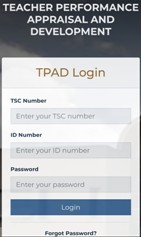
Step 2: Then, click on login. Now enter your TSC Number, ID Number and Password as shown in the window below; Click on ‘Login’ once done.

TPAD2 Portal Login Window

Step 3: On successful login, click on ‘Self Appraisals, and then ‘Self Assessment’. You will see the window below.

TPAD Archived Reports Window

Step 4: Left Click on ‘View Archived reports’, the window below will be displayed. Do not be afraid. Just click on ‘Advanced’ followed by Proceed to tpadarchive.tsc.go.ke (unsafe).

TPAD Archived Reports Privacy Window

Step 5: You are now finally here; as shown in the window below; Click on ‘Incomplete Appraisals’

TPAD Archived Reports

Step 6: Scroll down and you will see your previous appraisals;

My Appraisals Window

Step 7: Move across the year for whose TPAD reports you wish to view/ Print. At the far right click on ‘View Appraisal’. To print the appraisal, scroll to the bottom of the pageand select ‘Print Detailed Appraisal’. You can also save a PDF of the appraisal report; see the window below. Simply click on ‘Destination’ to toggle between Printing and Saving.

Printing or saving a PDF copy of your appraisal report.

You can now access all the Archived/ Previous TPAD reports as easily as that.

Also read; How to download and print your TSC TPAD 2 reports

In case you are using your Mobile phone, follow the same procedure as shown in Step 1 to 7 above. But, to save a PDF copy of the appraisal, Click on the 3 dots at the far top right corner. Next, select ‘Share’ followed by ‘Print’ and then ‘Save as PDF’. Your appraisal will automatically be stored under ‘downloads’ in your phone.

Copied: This guide is courtesy of Segera Festus- The current Kuppet VC Nyamira Branch.

How to apply and join TPD training at MKU University

To enroll for Teachers Professional development, click on https://tpd.mku.ac.ke or download MKU TPD app from play store and click enroll.

Online Induction and pre training activities are going on every Saturday at 2.30 – 4 pm .

To join download microsoft teams and click on the link https://bit.ly/3GU6MRv.

(For the enrolled use email and password sent to you to login). STOP *456*9*5#

How to create, open Login to new TSC TPAD Account

The Teacher Performance Appraisal and Development (TPAD) system, implemented by the Teachers Service Commission (TSC), serves as a performance evaluation mechanism designed to assess teachers’ work against established standards.

This evaluation system ensures accountability, enhances teaching quality, and aids in teacher development.

Key Objectives of TPAD

Oversight Role:

Heads of institutions play a critical role in overseeing teacher appraisals within their schools, ensuring that all educators are evaluated accurately.

Promotion and Career Development:

Appraisal reports are used as a basis for decisions regarding teacher promotion, deployment, and rewards.

Training and Development:

The TPAD system helps identify training needs and areas where corrective measures may be necessary in cases of underperformance.

Guidelines and Tools:

The system includes guidelines and appraisal tools that are periodically reviewed and accessible through the TSC website.
How to Create a TPAD Account

To participate in the TPAD system, teachers must first create an account. Follow these steps:

1. Visit the TPAD Portal: Go to https://tpad2.tsc.go.ke/auth/create_account.

2. Fill in the Required Details:

TSC Number
ID Number
Phone Number (07xxxxxxxx)
Email Address
Password (confirm password)
Mode of notification (select SMS)

3. Create Account: After submitting the details, a success message will appear, and a verification token will be sent to the phone number you registered. Enter the token and click “Verify Token” to complete the process.

Adding Your Bio Data

Once registered, users are required to input their bio-data and academic information:

1. Bio/Institution Information: Enter basic information such as contact details and institutional affiliation.

2. Subjects Combination: Add your teaching subjects by selecting from the list provided.

3. Educational Information: Provide details about your KCSE grade, highest level of education, and institution of study.

TPAD Roles

Roles of Teachers

1). Self-Appraisal:

Teachers are expected to perform self-appraisals in areas such as lesson planning, teaching, and classroom management.

2). Data Upload:

Teachers must create and upload their appraisal data online for review.

Roles of Principals

1). Induct New Teachers:

Principals introduce newly recruited teachers to the TPAD system.

2). Activate and Manage Teacher Accounts:

Principals activate new teacher accounts and remove those who leave the institution.

3). Oversight and Appraisal:

The Principals monitor the appraisal process, evaluate teachers, appraise deputy principals, and submit termly appraisal reports.

4). Observations and Arbitration:

Principals observe teacher performance and mediate any disputes that arise during the appraisal process.

Roles of Deputy Principals

1). Lesson Attendance:

Update lesson attendance records on a weekly basis.

2). Appraisal of HODs and Teachers:

Deputy principals appraise heads of departments (HODs) and teachers under their supervision.

3). Observation and Arbitration:

They schedule appraisal meetings, observe teaching practices, and help resolve disputes in teacher appraisals.

TPAD Process Steps

The TPAD process is structured and follows eight key steps:

1). Development of Appraisal Calendar: An appraisal calendar is developed, specifying timelines.

2). Setting Targets: Teachers set performance targets in alignment with the teaching standards.

3). Implementation of Targets: Teachers implement the set targets, and evidence is gathered to support the process.

4). Self-Appraisal: Teachers evaluate their own performance based on competencies and standards.

5). Appraisal Rating: Appraisers review evidence and rate the teacher’s performance.

6). Appraisal Meeting: The appraiser and appraisee meet to discuss ratings and evidence.

7). Gap Identification: Both the appraiser and appraisee identify areas of improvement.

8). Support and Development: Teacher support and performance development measures are implemented to address gaps.

TPAD Teaching Standards

The new TPAD tool comprises five standards classified into three broad categories. These categories evaluate various aspects of teaching, such as:

1). Professional Knowledge: Teacher’s understanding of content and pedagogy.

2). Professional Practice: Delivery of lessons, classroom management, and assessment techniques.

3). Professional Engagement: Teacher’s participation in co-curricular activities, parent-teacher engagement, and collaboration with colleagues.
Conclusion

The TPAD system is a comprehensive mechanism that ensures teachers are held accountable for their performance while also providing opportunities for growth and development. With the system’s structured appraisal process and clear roles for teachers, principals, and deputy principals, it supports the continuous improvement of teaching quality across Kenyan schools.