
• Home
  • Contact Us
  • Advertise With Us
  • Teachers’ Resources
  • Latest Education News
  • TSC News Portal
  • KUCCPS portal
  • Knec Schools Exams Portal
  • Search
Newsblaze.co.ke
  • Home
  • Contact Us
  • Advertise With Us
  • Teachers’ Resources
  • Latest Education News
  • TSC News Portal
  • KUCCPS portal
  • Knec Schools Exams Portal
  • Search
No Result
View All Result
  • Home
  • Contact Us
  • Advertise With Us
  • Teachers’ Resources
  • Latest Education News
  • TSC News Portal
  • KUCCPS portal
  • Knec Schools Exams Portal
  • Search
No Result
View All Result
Newsblaze.co.ke
No Result
View All Result

Home » CBA KNEC Guidelines; How to carry out assessment, transfer learners

CBA KNEC Guidelines; How to carry out assessment, transfer learners

by Hillary Kangwana
January 9, 2026
in KNEC News Portal
Reading Time: 7 mins read
A A
0
The Knec CBA portal login https://cba.knec.ac.ke/

The Knec CBA portal login https://cba.knec.ac.ke/

The Kenya National Examinations Council (Knec) has released a guide on the Competency Based Assessment (CBA). In the guideline, below, the council explains what CBA is, the difference between CBC and CBA and how to use CBA. Get all the details below.

TABLE OF CONTENTS show
1. Introduction to CBA
2. What is Competency Based Assessment (CBA)?
2.1. RelatedPosts
2.2. KCSE 2026 Project, Practical Exams Materials & Marking Schemes {Free PDF Downloads}
2.3. Knec list of 8 requirements for registration of 2026 KCSE exam candidates
2.4. Knec Guidelines on Teacher Education Courses Assessments on the E-Assessment Portal
2.5. KCSE 2022/2023 Nyeri County Best Performing Schools
3. Are CBA and CBC the same thing?
4. How is Basic Education structured under CBC?
5. How is CBA different from regular examinations?
6. What are the types of assessments in CBA?
7. Structure of CBA
8. When are the assessments done?
9. At what levels?
10. Which methods and tools are used to assess competencies?
11. Does CBA address the needs of learners with special needs?
12. How are assessments records tracked and maintained in CBA?
13. Why is parental support in the learning process so important?
14. How can the parent help to nurture the learner’s potential?
15. What if a parent is not well educated?
16. What happens to the records of a learner transferring schools?
17. The procedure for transferring learners will be as follows;
17.1. Related news;
18. How are assessment scores uploaded to the KNEC portal?
19. How are scores amended?

Introduction to CBA

Assessments are critical to the educational process. Without them teachers would never know when to move on to the next concept or how to enhance understanding of concepts when facilitating learning.

What is Competency Based Assessment (CBA)?

It is a purposeful systematic continuous process of gathering information from multiple sources for making decisions on what learners know, needs to learn, has learned and can do.

It involves creating opportunities for learners to apply the knowledge, skills attitudes and values they have learnt to solve real world problems.

RelatedPosts

KCSE 2026 Project, Practical Exams Materials & Marking Schemes {Free PDF Downloads}

Knec list of 8 requirements for registration of 2026 KCSE exam candidates

Knec Guidelines on Teacher Education Courses Assessments on the E-Assessment Portal

KCSE 2022/2023 Nyeri County Best Performing Schools

Are CBA and CBC the same thing?

Competency Based Curriculum (CBC) is the curriculum or the umbrella structure that guides how teaching is to be conducted. It is falls under the mandate of the Kenya Institute of Curriculum Development (KICD).

On the other hand, Competency Based Assessment (CBA) is the process of determining the capability of a learner to apply a set of related Knowledge, Skills, Values and Attitudes required to successfully perform a task.

The Kenya National Examinations Council (KNEC) is mandated to carry out assessments as envisaged in the Basic Education Curriculum Framework (BECF) based on the CBC Designs.

How is Basic Education structured under CBC?

  • Early Years Education – two years pre-primary (PP1, PP2) and three years lower primary (Grades 1, 2, 3).
  • Middle School Education – three years Upper Primary (Grades 4, 5, 6) and three years Lower Secondary (Grades 7, 8, 9).
  • Senior School – Grades 10, 11, 12 and which marks the end of Basic Education.

How is CBA different from regular examinations?

An examination such as KCPE or KCSE is a battery of tests written by a candidate to demonstrate their level of theoretical knowledge at the end of a learning cycle and for certification.

An examination is usually one-off and is done after the instruction has taken place. It is often a mark of completion of a learning phase and its purpose is mainly to inform learner placement at subsequent levels.

On the other hand, an assessment, such as the CBA, is a systematic way of collecting information and documenting what the learner knows and can do before they learn, as they learn and as they transit from one level to another based on specified competencies and criteria.

An assessment uses a wider variety of tools and gives opportunities to learners, peers, teachers and parents to track the progress of the learner through real time feedback mechanisms.

What are the types of assessments in CBA?

The figure below summarises the types of assessments in CBA.
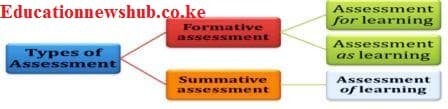
Types of assessments in CBA

Structure of CBA

The following are the ways CBA is structured for institutionalization in CBC.

  • Classroom assessment: This is a continuous assessment and is carried out at the entire basic level of education (thus, at early years, middle school and at senior school). The teacher develops the assessment tools.
  • School-based assessment: This assessment starts from Grade 4 to Grade 12. KNEC develops and uploads the tools for this assessment on the Council’s website. The teacher downloads the tools from the website and administers them to the learners.
  • Summative assessment: The National Assessment shall be carried out at Grades 6, 9 and 12 to inform policy and education stakeholders on level specific interventions for quality education of our learners

When are the assessments done?

  • Before learning (diagnostic assessment)
  • During teaching and learning (formative assessment)
  • At the end of teaching and learning (summative assessment)

At what levels?

  • At the end of Pre-Primary 2: The learners are assessed internally then all transition to Grade 1 in Lower Primary (Grades 1, 2, 3).
  • At Grade 3: They take a school-based national assessment that is not used for ranking or placement, after which they all proceed to Upper Primary (Grades 4, 5, 6).
  • Upper Primary assessments: Learners are assessed at each of the Upper Primary grades to track their learning progress ahead of the National
  • Assessment at Grade 6. The school-based assessments will account for 60 per cent of the total score.
  • At Grade 6: A summative assessment is administered at the end of Grade 6 which will comprise the remaining 40 per cent of the total scores. This marks the end of the primary cycle. Performance of the learners at this level and their interests will be used to place them in junior secondary school (JSS, Grades 7, 8 and 9).
  • At Grade 9: Learners will again be formatively assessed with a summative assessment at the end of JSS (Grade 9). Their scores and preferences will be used for placement in senior secondary school (SSS) where they will follow one of their preferred career pathways.

Which methods and tools are used to assess competencies?

The methods and tools are varied in order to address the learning needs of different individual learners. They include;

  • tests,
  • observation schedules,
  • questions and answers,
  • checklists,
  • quizzes,
  • rubrics,
  • journals,
  • portfolio,
  • learner profiles,
  • anecdotal records,
  • oral or aural questions,
  • questionnaires,
  • rating scales and
  • project where a learner is required to carry out several activities over a period of time.

The three main types are classroom, school-based and national assessments.

Does CBA address the needs of learners with special needs?

For learners with special needs and disabilities in the age-based pathway, assessment tools are modified to cater for their individual needs e.g., provided in accessible formats such as braille, audio and large print versions for learners with visual impairment as well as the provision of Kenyan Sign Language for learners with hearing impairment.

How are assessments records tracked and maintained in CBA?

Assessment records will be maintained both at school and at KNEC. Learners are captured in the KNEC system every year at Grade 3 onwards with each learner provided with a Unique Personal Identification (UPI) number.

It is either a NEMIS number from MoE or an assessment number from KNEC for those who do not have a NEMIS number. The number will be used by the learner up to the end of Grade 12.

Why is parental support in the learning process so important?

A parent is the first and most important educator in a child’s life. A parent is usually a child’s role model, and the child will usually mirror the parent’s actions and behaviour.

Parental influence, therefore, contributes highly in determining the learner’s outcome in school.

How can the parent help to nurture the learner’s potential?

  • Provide enabling environment conducive to learning.
  • Instill values and promote positive attitudes in the child towards the family and the community.
  • Be involved in the child’s learning by engaging them, understanding them and monitoring their progress.
  • Provide learners with available or accessible resources for extended activities.

What if a parent is not well educated?

A parent’s level of education does not matter. The parent should get to know the child’s experiences in school and offer psychological support.

What happens to the records of a learner transferring schools?

Transfer of learners shall be done by the Sub County Director of Education and will be allowed to take place at Grade 3, 4, 5 and all the four levels of the Stage-Based Curriculum Pathway.

No transfer shall be allowed at Grade 6 due to preparation of the summative assessment that will be taking place at the end of the year;

The procedure for transferring learners will be as follows;

  • The Head Teacher of the school where the learner was learning shall write a letter releasing the learner.
  • The Head teacher releasing the learner will have to include the learner’s assessment number and name as it appears in KNEC registration database.
  • The head teacher receiving the learner must write an acceptance letter to the Sub County Director of Education acknowledging acceptance of the learner.
  • The Sub County Director of Education will log into the KNEC portal: www.cba.knec.ac.ke using the Sub County log in CP2 credentials to transfer or add a learner. Deletion of learners can only be done by KNEC.

Related news;

KNEC User Manual for Transfer of a Learner in the CBA Portal

The Knec CBA portal login, capture learner scores, download CBA tools and results at https://cba.knec.ac.ke/

How are assessment scores uploaded to the KNEC portal?

  • Log in to KNEC website: cba.knec.ac.ke
  • Enter the username and password to log in;
  • Select grade;
  • Click on capture assessment outcomes;
  • Select the learning area and click on capture assessment outcomes;
  • Enter scores for every learner in the spaces provided under every task and click save outcomes; and
  • Repeat the same for all learners.

How are scores amended?

  • Click on view/edit outcomes;
  • Click on edit for the learner you want to amend; and
  • Amend the scores and save.
Tags: cba knec portalKNEC examiners portalknec loginknec portal lcbe assessmentKNEC PORTAL LOGINknec portal technicalmlp knec portalwww.knec-portal.ac.ke results
Previous Post

TSC gives new methods on how to access services: TSC News today

Next Post

Riokindo Boys High School’s KCSE 2023/2024 Results Analysis, Ranking Grades Distribution and Location

Hillary Kangwana

Related Posts

KCSE 2026 Project, Practical Exams Materials & Marking Schemes {Free PDF Downloads}
KNEC News Portal

KCSE 2026 Project, Practical Exams Materials & Marking Schemes {Free PDF Downloads}

March 11, 2026
0
See the Smartpadlocks used by Knec to secure KCSE, KJSEA, KILEA and KPSEA Exams
KNEC News Portal

Knec list of 8 requirements for registration of 2026 KCSE exam candidates

February 17, 2026
0
Knec Guidelines on Teacher Education Courses Assessments on the E-Assessment Portal
KNEC News Portal

Knec Guidelines on Teacher Education Courses Assessments on the E-Assessment Portal

January 11, 2026
0
KCSE 2022/2023 Nyeri County Best Performing Schools
KNEC News Portal

KCSE 2022/2023 Nyeri County Best Performing Schools

January 11, 2026
0
Next Post

Riokindo Boys High School's KCSE 2023/2024 Results Analysis, Ranking Grades Distribution and Location

Leave a Reply

Your email address will not be published. Required fields are marked *

April 2026
M T W T F S S
 12345
6789101112
13141516171819
20212223242526
27282930  
« Mar    

LATEST NEWS.

  • Bomet University Courses’ Latest Cutoff Points, Fees, How To Apply, Kuucps Letters Download Portal & Contacts
  • AMREF University Courses’ Latest Cutoff Points, Fees, How To Apply, Kuucps Letters Download Portal & Contacts
  • Alupe University Courses’ Latest Cutoff Points, Fees, How To Apply, Kuucps Letters Download Portal & Contacts
  • Africa Nazarene University Courses’ Latest Cutoff Points, Fees, How To Apply, Kuucps Letters Download Portal & Contacts
  • Africa International University Courses’ Latest Cutoff Points, Fees, How To Apply, Kuucps Letters Download Portal & Contacts

TSC NEWS TODAY

  • Reprieve as Major Improvements are made to the TSC Teachers’ Medical Scheme
  • Fate of 44,000 teachers recruited by TSC hangs in the balance
  • Mwalimu National Sacco FOSA Salary Advance Application Form {Free Download}
  • Mwalimu National Sacco FOSA Instant Loan Application Form {Free Download}
  • Advertised TSC Secretariat Vacancies in 2026 {Requirements and How To Apply}

KNEC LATEST NEWS

  • Kanga Boys’ High Senior School’s History, Location, Performance, Reviews & Contacts
  • Nyambari Boys’ High Senior School’s History, Location, Performance, Reviews & Contacts
  • Naivasha Girls Senior School’s History, Location, Performance, Reviews & Contacts
  • Top 10 Best Performing Senior Schools in Siaya County
  • Orero Boys High Senior School’s History, Location, Performance, Reviews & Contacts

KUCCPS NEWS

  • Bomet University Courses’ Latest Cutoff Points, Fees, How To Apply, Kuucps Letters Download Portal & Contacts
  • AMREF University Courses’ Latest Cutoff Points, Fees, How To Apply, Kuucps Letters Download Portal & Contacts
  • Alupe University Courses’ Latest Cutoff Points, Fees, How To Apply, Kuucps Letters Download Portal & Contacts
  • Africa Nazarene University Courses’ Latest Cutoff Points, Fees, How To Apply, Kuucps Letters Download Portal & Contacts
  • Africa International University Courses’ Latest Cutoff Points, Fees, How To Apply, Kuucps Letters Download Portal & Contacts

EDUCATION NEWS

  • Property worth millions of shillings destroyed at Majiwa Secondary School
  • Wavumbuzi Entrepreneurship Challenge {Complete Details}
  • Haere are the Kenya Science & Engineering Fair (KSEF) Collated Results for 2026.
  • Senior Schools’ Setbooks List {Ministry of Education Circular}
  • Education Ministry to crack the whip on 20 School Heads over ghost learners scandal

KMTC NEWS

  • President Ruto unveils major infrastructure boost for KMTC Nyamira Campus
  • KMTC students set to benefit from education funding
  • KMTC to recruit additional lecturers to strengthen training capacity
  • KMTC welcomes new students for the March 2026 intake
  • Diploma in Kenya Registered Nursing KMTC Course, Qualifications & Campuses where offered

HELB NEWS TODAY

  • List of the 35 University TVETs in Kenya
  • 153 Public Colleges in other ministries and KMTC – Eligible for HELB Loan only
  • 273 Public Colleges Eligible for Government Scholarship and HELB Loan
  • List of Public Universities Eligible for Government Scholarship and HELB Loan
  • Helb releases list of Private Universities eligible for Helb Loan

UNIVERSITIES AND COLLEGES

  • GICHUGU TECHNICAL AND VOCATIONAL COLLEGE’s LATEST COURSE LIST
  • GATANGA TECHNICAL AND VOCATIONAL COLLEGE’s LATEST COURSE LIST
  • GARSEN TECHNICAL AND VOCATIONAL COLLEGE’s LATEST COURSE LIST
  • FRIENDS COLLEGE KAIMOSI’s LATEST COURSE LIST
  • FAYYA TECHNICAL AND VOCATIONAL COLLEGE’s LATEST COURSE LIST

TEACHERS' RESOURCES

  • Latest CBE Holiday Assignments for Primary and Juniour Schools
  • Free Form 1 to 4 Topical Revision Questions and Answers For All Subjects
  • Full list of 2019 Wealth Declaration non-compliant teachers Per County- Turkana County
  • Latest All Lesson Plans Free Downloads
  • Business studies questions and answers pdf download

BANKS AND MOBILE LOANS

  • Stanbic Bank Unsecured Loan Repayment for Teachers & Civil Servants
  • Virtual Fields, Real Profits: The Advantages of Online Platforms in Agricultural Product Trading
  • Dash Dynamics: The Fast and Private Cryptocurrency
  • Quick and Easy Personal mobile loans: The Stashfin loan App and how to get lending easily
  • Equity Bank’s Wings to Fly Program- 410 Wings to Fly scholars offered employment as they join the Equity Africa Lead

HEALTH AND NUTRITION

  • Latest List of Accredited Palliative medicinists Doctors {Check Contacts & Location}
  • Kericho County NHIF Latest List of Approved Facilities/ Hospitals: Location, Contacts, Services, Hospital Type and Code
  • SHA, SHIF Accredited Hospitals in Homa Bay County
  • Kisumu County NHIF Outpatient Hospitals- Location, Contacts, Requirements
  • Latest List of Accredited Surgeon Doctors {Check Contacts & Location}
  • Advertisement
  • Banks and Money
  • BEST TOP TEN
  • Breaking News
  • Cheap Mobile Loans
  • Crimes and Courts
  • Editorial
  • Featured
  • FREE KCPE REVISION MATERIALS
  • General News
  • Health & Nutrition tips
  • HELB Portal
  • How to, Did You Know?
  • IEBC KENYA NEWS
  • IEBC PORTAL
  • Insurance news
  • International news
  • Jobs
  • KCSE Revision Materials
  • KMTC News Portal
  • KNEC News
  • KNEC News Portal
  • Knec Schools Exams Portal
  • Knec Schools Portal
  • KNUT NEWS
  • KRA Portal
  • KSSSA Portal
  • KUCCPS portal
  • KUPPET
  • Latest Education News
  • NSSF PORTAL
  • NTSA Service Portal
  • Politics & Govt
  • Sponsored
  • Sports
  • Teachers' Resources
  • Tech News
  • Trending
  • TSC Latest News
  • TSC News Portal
  • Uncategorized
  • Universities & Colleges information
  • Universities and Colleges
  • Latest CBE Holiday Assignments for Primary and Juniour Schools
  • Free Form 1 to 4 Topical Revision Questions and Answers For All Subjects
  • Full list of 2019 Wealth Declaration non-compliant teachers Per County- Turkana County
  • Latest All Lesson Plans Free Downloads
  • Business studies questions and answers pdf download
  • Bomet University Courses’ Latest Cutoff Points, Fees, How To Apply, Kuucps Letters Download Portal & Contacts
  • AMREF University Courses’ Latest Cutoff Points, Fees, How To Apply, Kuucps Letters Download Portal & Contacts
  • Alupe University Courses’ Latest Cutoff Points, Fees, How To Apply, Kuucps Letters Download Portal & Contacts
  • Africa Nazarene University Courses’ Latest Cutoff Points, Fees, How To Apply, Kuucps Letters Download Portal & Contacts
  • Africa International University Courses’ Latest Cutoff Points, Fees, How To Apply, Kuucps Letters Download Portal & Contacts
  • Home
  • Contact Us
  • Advertise With Us
  • Teachers’ Resources
  • Latest Education News
  • TSC News Portal
  • KUCCPS portal
  • Knec Schools Exams Portal
  • Search

All Rights Reserved: Newsblaze Since 2018

No Result
View All Result
  • Home
  • Contact Us
  • Advertise With Us
  • Teachers’ Resources
  • Latest Education News
  • TSC News Portal
  • KUCCPS portal
  • Knec Schools Exams Portal
  • Search

All Rights Reserved: Newsblaze Since 2018

This website uses cookies. By continuing to use this website you are giving consent to cookies being used.