Gitui Mixed Secondary School’s CBE Subjects, Pathways, Contacts, Location {Full Details}

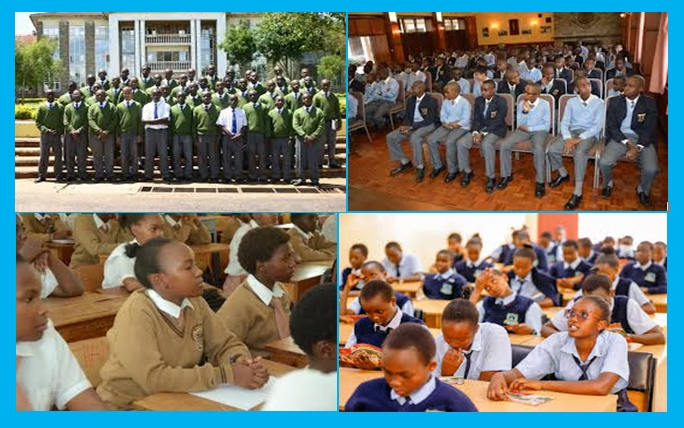
Gitui Mixed Secondary School is a public Mixed, (Boys’ and Girls’) Sub-County Level Day  School that is located at Kahuro Subcounty in Murang’a County of the Central Region, Kenya. The School’s Official Phone Number Contact is: +254112724366

Key Details about the school.

Country where found: Kenya.

Region: Central.

County: Murang’a.

Subcounty: Kahuro.

School Type/ Ownership: A Public School.

Nature os School/ CBE Level: Senior School (SS).

Category: Regular School

School’s Official Name: Gitui Mixed Secondary School

Sex: Mixed, (Boys’ and Girls’)  School.

School Cluster/ Level: Sub-County School whose Classification is C4.

Accomodation Type: Day  School.

Knec Code:  10238126

School’s Official Phone Number:  +254112724366

Total Number of Subjects Combinations Offered at the School: 3

Subject Combinations Offered at Gitui Mixed Secondary School

View all available subject combinations at this school

STEM

2
APPLIED SCIENCESCode: ST2075
Agriculture,Geography,Physics
3 SubjectsSTEM
PURE SCIENCESCode: ST1045
Biology,Business Studies,Chemistry
3 SubjectsSTEM

SOCIAL SCIENCES

1
HUMANITIES & BUSINESS STUDIESCode: SS2069
Christian Religious Education,Fasihi ya Kiswahili,History & Citizenship
3 SubjectsSOCIAL SCIENCES

📍 How to get more Information about the School

For more information about admission requirements, facilities, and application procedures, contact the school directly. Use the official phone number indicated above to get information about the school’s fees, uniform, meals and performance.

How to Select Grade 10 Subjects and schools

To select Grade 10 schools and subjects under the Competency-Based Curriculum (CBC) in Kenya, Grade 9 learners should first choose a career pathway (STEM, Social Sciences, or Arts & Sports Science). Then, they’ll select three subject combinations within that pathway and finally, choose four schools for each combination, totaling 12 schools. To select preferred Grade 10 Schools and Subject Combinations, use the Ministry of Education portal selection.education.go.ke.

1. How you can Choose a Career Pathway:

  • Identify your interests and potential career aspirations.
  • Select one of the three pathways: STEM, Social Sciences, or Arts & Sports Science.
  • Confirm your choice to proceed with the pathway.

2. Select Subject Combinations:

  • The portal will provide you with a list of subject combinations available within your chosen pathway.
  • Choose three subject combinations that align with your interests and strengths.

3. Select Preferred Senior Schools:

  • For each subject combination, select four schools from the available clusters.
  • This ensures a diverse range of options and equal representation from different categories of schools.
  • A total of 12 schools will be selected: 4 for the first subject combination, 4 for the second, and 4 for the third.

LIST OF ALL SENIOR SCHOOLS PER COUNTY.

Senior School Subjects and Pathways selection Form.

Senior School Selection Form educationnewshub.co.ke

Education Ministry to develop software to locate and track textbooks

The ministry of education is set to develop a software that will be used to track and report the exact location of the books that it distributes to schools, under the new text-books’ distribution policy. Appearing before the Parliamentary Education Committee, the Education PS, Dr. Belio Kipsang told the Hon. Julius Melly led committee that they are developing the software to enable easy monitoring of the books. “At any one time we will know where the books are,” said Dr. Kipsang

Dr. kipsang said the ministry is working with the Kenya Institute of Curriculum Development, KICD, to develop a serialization software to track the location of the books that is similar to those used on drugs and other pharmaceutical commodities. This tracking system works by imprinting a unique code onto each commodity after packaging. This latest move comes amid claims of delays by publishers to timely distribute the textbooks to various parts of the country citing poor weather and terrain. Under the new textbook policy duped ‘one text book policy’, Moran, Longhorn, Kenya Literature Bureau, oxford press and East african Educational Publishers were awarded the Kshs. 7.6 Billion tender to cut off cartels and corruption in the old dispensation where schools were mandated with the responsibility of procuring of the textbooks.

A report released by Ethics and Anti- Corruption Commission, EACC, in 2016 exposed heightened corruption and fraud where schools’ heads could fail to purchase the textbooks and diverted the cash meant for the books to other uses. The shocking revelations showed that school heads and procurement committees could forge signatures, over price the text books or even single source the books, flouting the procurement rules.

The government has already disbursed textbooks for core subjects for all form ones who joined high school, this year.

you may also like:

How TSC has messed up the Teaching Profession and Teachers.


SCHEMES OF WORK FORM TWO ENGLISH TERM 1-3


SCHEME OF WORK                     FORM    TWO   ENGLISH                TERM  ONE  20………….  NAME………………………….
  
WK NO
L/
NO
 
TOPIC
 
SUBTOPIC
LESSON / SPECIFIC
OBJECTIVES
TEACHING / LEARNING
ACTIVITIES
MATERIALS
  /
RESOURCES
REF.
     REMARKS 
11,


2

Reading.Comprehension.

Reading & answering questions.


Review of Questions.

By the end of the lesson, the learner should be able to:

Answer questions derived from a passage.

Infer meanings of new words as used in the passage.


Silent reading;

Writing;

Reading aloud;

Answering questions.


Standard dictionary.


INTEGRATED

ENGLISH,

NEW EDITION

BK. II.


 PP 2-4

  
3Grammar.Collective nouns.Identify collective nouns in given sentences.

Assign the correct collective noun to a group of entities.

Answering questions;

Oral exercise on collective nouns;

Written exercises.

Supplementary references.PP 5-6  
4


5

Grammar.Phrasal quantifiers.


Phrasal quantifiers with uncountable nouns.

Identify phrasal quantifiers in given sentences.

Use phrasal quantifiers with uncountable nouns, countable nouns and abstract nouns correctly.


Q/A to review word gratifiers;

Exposition of phrasal quantifiers;

Questions and answers;

Exercises & review.

 PP 5-7  
6Listening and speaking.Idioms.Define an idiom.


Give meanings of some common English idioms.

Brainstorming;

Give examples of common idioms;

Group exercises;

Written exercise.


Supplementary references.PP  8-9  
21Listening and speaking.Telephone etiquette.Observe various rules when receiving a personal or business call, making a call and ending a call.


Guided group work, discussion and simulations / presentations. PP 10-12  
2Grammar.Pronouns.Identify singular and plural forms of personal pronouns.Q/A to review personal pronouns; singular and plural forms of pronouns and the three persons.

Oral exercise.

Written exercise.


 PP 13-16  
3Grammar.Indefinite pronouns.List down examples of indefinite pronouns.

Use indefinite pronouns in singular and plural forms.


Oral and written exercises;

Exercise review.

 P 16  
4Writing.Skimming a text.Skim through a text and give a suitable title for the text.

Skim through a text and decide what sort of text it is and its intended function.


Guided practice & supervision;

Reading;

Listening;

Writing.

Supplementary references.PP 17-22  
5Functional writing.Text messaging.

(sms)

Write a text message briefly and precisely.

Translate a text message and rewrite it in the correct English with the appropriate punctuation.


Guided activity;

Group competitions;

Reading;

Listening;

Writing.


Mobile phones.PP 22-24  
6Functional writing.Sending a text message.Send a text message on a mobile phone.Guided practical activity;

Writing and sending a text message;

Replying to text message.


Mobile phones;

Sample text messages.

P 24  
31Grammar.Punctuation:


The comma.

State uses of commas in sentences.

Punctuate sentences with commas and other punctuation marks.

List of sentences showing uses of the comma.

Oral and written exercises.


 PP 26-29  
2Reading.Reading comprehension.Read a passage and answer questions derived from it in complete sentences.


Infer meanings of new words as used in the passage.

Silent reading;

Writing;

Reading aloud;

Listening;

Answering questions.

Supplementary references, dictionary.PP 29-31  
3Grammar.The future time (1).Express planned events using the words “going to”.Examples of sentences both in the affirmative and the negative;


Oral exercise.

 PP 31-32  
4Grammar.The future time.Use present simple tense to anticipate events in a timetable, programme, etc.List down events in a given program using present simple tense;

Exercises.

Timetable / programme of an event.PP 33-34  
5Grammar.The future time.Indicate future arrangements using the present continuous tense and using the verb ”to be”.


Consider given examples.


Oral exercise.

 PP 35-37  
6Writing.Personal writing.Make lists of related items.

Draft a plan of action in tabular form.

Group work.


Making lists as guided, and then comparing them.


Supplementary references.PP 37-38  
41,


2

Listening and speaking.Listening & speaking.


The sound /s/ and

/z /.

Distinguish the sound /s/ from the sound /z/ and pronounce them correctly.


Oral exercise.

Pronunciation of words;

Correcting wrong pronunciations.

Supplementary references.PP 39-42  
3Listening comprehension.Listening comprehension.Answer questions based on a passage that has been read out.Teacher reads a text to the class.

Students answer questions derived from the text.

Review of the questions.


Supplementary references.PP 42-43  
4


5


Grammar.The future time (2).


Contracted forms.

State the functions of will and shall in given sentences.

Use the contracted forms ‘ll, won’t, shan’t appropriately.


Examples of sentences showing functions of shall and will.


Oral & written exercises.

 PP 43-45  
6Poetry.Haiku.Define the term haiku.

Outline features of a haiku.

Exposition, brief discussion.Supplementary references.PP 45-47  
51Reading.Reading comprehension.Read a passage and answer questions derived from it in complete sentences.

Infer meanings of new words as used in the passage.


Silent reading;

Writing;

Reading aloud;

Listening;

Answering questions.


Standard dictionary.

PP 48-49  
2Writing.Fact and fiction.Distinguish an actual fact from fiction, and a fact from an individual’s opinion.


Group work:

Establish factual truth /opinion in statements.

Brief discussion.

Supplementary references.PP 49-50  
53,


4

Grammar.The verb “to do”.

-positive statements / interrogatives.


-negative statements / interrogatives.


Use the verb “to do” in positive and

negative statements & interrogatives.

Q/A: different forms of the verb “to do .”

Oral exercise.

Written exercise.

 PP 51-53  
5,6Listening and speaking.


Non-verbal listening skills.Identify good and bad listening skills.


Guided group activities;

Simulation.

 PP 53-55  
61,2Oral literature.Myths.Define the term myth.

Compare and contrast given myths.

Reading aloud;

Listening;

Answering questions.

Supplementary references.PP 56-58  
3,4Listening and speaking.Public speaking.Prepare, review, organize and present a given topic.Reading;

Speaking;

Listening.


 PP 59-61  
5


6

Grammar.Possessives.

–        Singular.


–        Plural.


Show possession in both singular and plural forms.

Rewrite sentences using possessive form of a noun / pronoun, putting an apostrophe where appropriate.


Oral exercise: position of the apostrophe.


Written exercises.


Review the exercise.

 PP 62-64  
71Grammar.Interjections.Identify interjections used in a written text.

List down interjections of expressing shock, disapproval, pain or surprise.

Read paragraphs and Identify the interjections.

Teacher exposes other interjections.

Assignment: common interjections.


 PP 65-66  
2,


3

Reading.Reading comprehension.Read a passage and answer questions derived from it in complete sentences.

Infer meanings of new words as used in the passage.


Silent reading;

Writing;

Reading aloud;

Listening;

Answering questions.


Standard dictionary.

PP 66-68  
4Grammar.Present perfect tense.Use present perfect tense correctly.

Rewrite sentences in the present perfect tense.

Oral exercise:

Use of has, have, recently, so far, yet, etc.

Written exercise.

 PP 68-71  
5Grammar.Quotation marks (inverted commas).Punctuate sentences with quotation marks.Brainstorming, oral & written exercises. PP 71-72  
6TEST     
8


8


1Writing.Advertisements.Identify features of advertisements.

Interpret advertisements.

Examine an actual advertisement.


Brief discussion.


Posters, newspaper cutting, PP 73-74  
2Grammar.


Present perfect continuous tense.Rewrite sentences using present perfect forms of verbs.Teacher gives examples of verbs in the present perfect continuous tense.

Students give further examples.

Written exercise.

 PP 75-76  
3Reading.Listening comprehension.Carry out a task based upon a passage that has been read out.Listening & writing an exercise.Chart: family tree.PP 77-78  
4,


5

Writing.Paragraphing a text.Explain importance of paragraphing a text.

Identify the topic sentence for a given paragraph.

Paragraph a text written in continuous prose.


Reading two texts: one in continuous prose and the other paragraphed.

Exposition: meaning of the term “topic sentence”.

Supervised exercise & review of the exercise.

Newspaper articles.PP 78-80  
6,


Reading.Reading comprehension.


Read a passage and answer questions derived from it in complete sentences.

Infer meanings of words as used in the passage.


Silent reading;

Writing;

Reading aloud;

Listening;

Answering questions;

Look up new words.


Supplementary references.

Standard dictionary.

PP 81-83  
91,2


Grammar.Punctuation:


The hyphen.

Give examples of hyphenated words.


Explain uses of hyphens.

Q/A: differentiating hyphenated words from compound words.

Listening;

Writing.

Supplementary references.PP 84-87  
3Writing.Reading skills;

Scanning a text.

Scan a story extract and use it to answer given questions.Guided practical activity.

Silent reading;

Writing;

Listening;

Answering questions.

 PP 87-90  
4 ,5Writing.Arranging paragraphs in order.Identify words and expressions that may be used to start specified paragraphs.


Probing questions, detailed discussion;

Writing.

Supplementary references.PP 91-92  
6Grammar.Auxiliary verbs.Identify auxiliary verbs and use them in different ways.Discussion: auxiliary & main verbs.

Oral and written exercises.


 PP 93-95  
101,2Reading & speaking.Reading & speaking.Carry out a reading and speaking activity.Guided practical activity.

Reading;

Listening;

Writing;

Answering questions.

Supplementary references.PP 96-97  
3,


4

Grammar.Compound nouns.Identify compound nouns.


Form compound nouns.

Q/A: review nouns, hyphenated words, adjectives.

Oral & written exercises.

Forming compound nouns.


 PP 97-100  
5-6Grammar.Vocabulary.Compiling lists of words with similar endings.Guided oral and written exercises;

Group activities.

 P 100  
111,2Oral literature.Poetry:

Superstition.

Read a poem in groups or individually with the right pace.


Discussion;

Listening;

Writing.

Supplementary references.PP 103-105  
3Writing.Linking words in a paragraph.Practise linking words in a paragraph.Discussion;

Listening;

Writing.

 P 105  
4,5Grammar.The order of adjectives.Arrange adjectives used in sentences in the correct order.Discussion; listening and writing.Supplementary references.PP 106-108  
6Functional writing.Personal journal.Define a personal journal.

Identify features of a personal journal.

Reading an extract from a journal.

Discussion on people, places, and world events in written journals.


Personal journal.P 109  
12-13 END  OF  TERM  ASSESSMENT TEST  


 SCHEME OF WORK                     FORM    TWO  ENGLISH                TERM TWO  20………….  NAME………………………….  
WK NO
L/
NO
 
TOPIC
 
SUBTOPIC
LESSON / SPECIFIC
OBJECTIVES
TEACHING / LEARNING
ACTIVITIES
MATERIALS          /
RESOURCES
REF.
     REM. 
11Listening & speaking.


Hissing sounds.Pronounce the hissing sounds /s/ and /z/ correctly.


Identify letters that produce the two hissing sounds.

Practise pronunciation of given words.

Correct wrong pronunciation of given words.


 INTEGRATED

ENGLISH,

NEW EDITION

BK. II.

PP 110-112

  
2
Listening and writing.
Listening comprehension.
Answer questions based upon a story that is read out by the teacher.Teacher reads out a story as the students listen.

Students answer questions derived from the story.


Standard dictionary.

P 112  
3,4Reading.Expressive reading.Identify features of expressive reading.Read a passage silently.

Carry out guided tasks based on the passage.

 PP 113-115  
5,6Grammar.Position of adjectives.Place adjectives at the right positions in sentences.

Rewrite sentences according to given instructions.


Reading;

Listening;

Writing.

 PP 115-116  
21Writing.Creative writing: play dialogue.Identify features of a play dialogue.Reading;

Listening;

Probing questions;

Writing.

 PP 117-119  
2Writing.Creative writing:

Play dialogue.

Write or complete a play dialogue.Written exercise.

Review the exercise.


Standard dictionary.PP 117-119  
23Grammar.Interrogative and possessive adjectives.List down interrogative and possessive adjectives.

Use interrogative and possessive adjectives

in sentences correctly.

Q/A: types of adjectives.


Exercise on interrogative and possessive adjectives.


 PP 119-120  
4Writing.Clichés.Define the term clichés.

Identify clichés in a paragraph or a poem.

Infer meanings of clichés.


Expositions &

guided exercises.

 PP 121-123  
5Reading.Reading comprehension.Read a passage and answer questions derived from it in complete sentences.

Infer meanings of words as used in the passage.


Read a passage.

Answer questions.


Infer meanings of words/ phrases.

Standard dictionary.PP 123-124  
6Grammar.Adverbs of degree.Give examples of adverb of degree.

Use them in sentences correctly.

Q/A: review adverbs of place, manner, time & frequency.

Oral exercise: listing down adverbs of degree.

Written exercise: choosing appropriate adverbs of degree.


 PP 125-126  
31Functional writingInformal letters.Classify informal letters on basis of level of informality.

Write various types of informal letters.


Q/A: types of salutations, letter layout, presentation and punctuation.Sample informal letter.PP 127-130  
2Poetry.Poetry.Answer questions based upon a poem.

Carry out activities based upon a poem.

Read a poem.

Written exercise.

Guided group activities.

 PP 130-132  
33Poetry.Rhymes and rhyming patterns in poetry.


Identify rhymes and rhyming patterns in poems.Reading;

Listening;

Discussion.

 PP 130-132  
4Listening & speaking.Listening & speaking.Carry out a group activity in order to improve listening and speaking skills.Guided group work.

Review of the activity.

 PP 133-136  
5Grammar.Comparison of regular adverbs.Form comparative and superlative degrees of regular adverbs.Q/A: review comparative and superlative degrees of adjectives.

Oral & written exercises on adverbs.


 PP 133-136  
6Grammar.Comparison of irregular adverbs.Form comparative and superlative degrees of irregular adverbs.Oral & written exercises. P 135-136  
41,2ReadingReading comprehension.Answer questions derived from a passage.


Infer meanings of the passage.

Silent reading;

Writing;

Reading aloud;

Listening;

Answering questions.

Standard dictionary.PP 13-139  
3,4Grammar.Punctuation:


The apostrophe.

Identify functions of the apostrophe.


Rewrite sentences using an apostrophe appropriately.


Teacher emphasizes effects of position of apostrophe on the meaning of a sentence.

Oral & written exercises.


 PP 139-143  
5Social writing.Giving and following directions.Give direction and instructions both precisely & clearly.

Illustrate directions with a simple map.

Guided activities.

Written exercise, group work.

Route maps.PP 1431-45  
6Grammar.Vocabulary.Enrich vocabulary using a word ladder.Group activities.

Assignment.

 P 146  
51Listening comprehension.Listening comprehension.Answer questions based upon a text that has been read out.Listening;

Answering questions.

Standard dictionary.P 147  
2Grammar.Adverbial phrases.Identify adverbial phrases.

Classify adverbial phrases.

Q/A: review types of adverbs.

Exposition and explanations.

 PP 147-150  
3Listening and speaking.Using reference materials:


Using a Thesaurus.


The Guinness Book of record.

Define the term Thesaurus.


State uses of a Thesaurus.


Answer questions based upon an extract from the Guinness Book of record.


Expository approach: Teacher exposes new concepts.


Written exercise.


Review of the exercise.

The Guinness Book of record.


Computer

MS – Word programme.

PP 150-154  
4Grammar.Prepositions.Use the correct prepositions with particular words to express given meanings.


Q/A: examples of prepositions.

Oral exercise.

Written exercise.

 PP 155-158  
5Grammar.Complex propositions / prepositional phrases.Use complex propositions / prepositional phrases.Teacher gives examples of complex propositions / prepositional phrases and students give further examples.

Oral & written exercises.


 PP 158-161  
6Listening & speaking:


Word stress.Put emphasis on a particular syllable in a word to bring out the intended meaning.Reading words aloud and pronouncing them correctly according to the stressed syllable.

Deduce meanings of words depending on the stressed and unstressed syllable.


Standard dictionary.PP 158-161  
61,2
Creative writing.
Narrative compositions.
Write an interesting composition based on a given plan.Q/A: Review simple plan for a narrative composition.

Discussion: further development of skills for writing a composition.

 PP 162-163  
3,4Petry.Poetry.Answer questions based on a poem.Reading a poem silently then aloud in groups.

Written exercise.

Supplementary resource materials.PP 163-164  
5,6Writing.Letter of Apology.Write a letter of apology based on a given scenario.


Reply to a letter of apology.

Detailed discussion.

Letter writing.


Review the exercise.

Sample letter of apology.PP 165-167  
71,2Grammar.Simple sentences.Identify subjects & predicates in given sentences.Q/A: review parts of a simple sentence.

Oral & written exercises.

 PP 168-170  
3Listening and speaking.Listening and speaking.Carry out a given task to improve listening & speaking skills.Guided tasks and exercise.

Review the exercise.

 PP 170-171  
4,5Grammar.Compound sentences.Define a compound sentence.Review simple sentences.

Discussion:

Types of clauses and identifying them.

Exercise and review.

 PP 171-173  
76Grammar.Punctuating compound sentences.Punctuate a compound sentence correctly.Oral & written exercises.

Word puzzles.


Word puzzles.PP 171-173  
81,2Reading.Reading comprehension.Answer questions derived from a passage.


Infer meanings of new words as used in the passage.

Silent reading;

Writing;

Reading aloud;

Listening;

Answering questions.

Standard dictionary.PP 176-177  
3,4Grammar.Use of conjunctions in compound sentences.Group conjunctions according to their functions.

Use them in compound sentences correctly.


Detailed discussion.


Exercise.

 PP 177-181  
5,6Creative writing:


Prose dialogue.


Identify features of a prose dialogue.

Write a paragraph containing a prose dialogue observing all the punctuation.


Read a prose dialogue.

Discussion on its characteristics & punctuation rules.

 PP 182-183  
91Reading.Listening comprehension.Answer questions derived from a passage.


Infer meanings of new words as used in the passage.

Silent reading;

Writing;

Reading aloud;

Listening;

Answering questions.

 PP 184-185  
2Functional Writing.Writing a Will.Define a Will.

Write a Will based on a given format.

Guided practical activity;

Listening;

Writing.


Sample Will.PP 185-186  
3Poetry.Poetry.Answer questions based upon a given poem.Reading a poem.

Discussion groups and groups’ presentations.

Supplementary references.PP 187-189  
94,5
Grammar.
Complex sentences.
Define a complex sentence.

Identify subordinate conjunctions.

Review types of clauses.

List down subordinate conjunctions.

Written exercise.

 PP 189-190  
6Writing.Note making.Develop note making skills.Read a passage and make notes as instructed.


 PP 193-194  
101,2
Grammar.
Spelling.
Improve spelling of words and have positive attitude towards learning how to spell words correctly.Identify and write down homonyms.

Construct sentences to convey meanings of homonyms.

Spelling games, taking a dictation, correction of

misspelt words.


 PP 200-202  
3,4Oral literature.Legends.Define a legend.

Identify features of a legend.

Read a passage that can be classified as a legend.

Discussion based on the oral narrative read.

 PP 202-204  
5Grammar.Relative pronouns.Complete sentences using relative pronouns.

Join sentences using relative pronouns.

Q/A: relative pronouns used for people and those used for animals and things.

Oral exercise.

Written exercise.

Review of exercise.


 PP 20-205  
6Creative writing.Writing invitations.Write letters of invitation to neighbors, officials, etc.

Reply to invitation letter.

Accepting or declining the invitation.


Listening;

Writing.

Invitation cards.PP 206-207  
111Grammar.Relative clauses.Identify relative clauses.

Use relative clauses in sentences correctly.

Examples.

Oral exercise.

Written exercise.


 PP 210-216  
2Grammar.Inference of meanings of new words.Infer meanings of new words from the context in which they are used.Silent reading;

Writing;

Reading aloud;

Listening;

Answering questions.

 P 217  
3,4


Writing.Summary writing (I).Express important ideas in own words and express relationships among the ideas in a logical sequence.Read a passage.

Convert information into own words.

Link the main points and write short logical sentences.

Supervised practice: write a final draft.

 PP 218-219  
5,6Reading.Reading comprehension.Answer questions derived from a passage.


Infer meanings of new words.

Silent reading;

Writing;

Reading aloud;

Listening;

Answering questions.

Standard dictionary.PP 219-221  
12-13 MID YEAR ASSESSMENT TEST  


 SCHEME OF WORK                     FORM    TWO  ENGLISH                TERM  THREE                    20………….              NAME………………………….  
WK NO
L/
NO
 
TOPIC
 
SUBTOPIC
LESSON / SPECIFIC
OBJECTIVES
TEACHING / LEARNING
ACTIVITIES
MATERIALS
          /
RESOURCES
REF.
     REM. 


1


1
Listening and speaking
Intonation.
Deduce the implications of words from the intonation of the speaker.Read a dialogue;

Deduce implications of the words used by the speakers;

Discussion.

 INTEGRATED

ENGLISH,

NEW EDITION

BK. II.

P 226

  
2Listening comprehension.Rising and falling intonation.Use rising and falling intonation in written and spoken work.Reading;

Listening;

Oral examples.

Written exercise.

 PP 227–228  
3,4Writing.Business letter.


Reply to a business letter.

Write a business letter using the correct format.


Write a reply to a business letter.

Q/A: review format of an informal letter.

Discuss characteristics of a business letter.

Assignments & their review;

Writing.

An ideal business letter.P 230-232  
5,6Grammar.Relative clauses

(III):

Defining and non-defining relative clauses.

Give examples of relative clauses.

Identify defining and non-defining relative clauses and use them in sentences correctly.


Exposition and examples of relative clauses.

Oral and written exercises.

Sample business letter.PP 233-235  
21,

2


Reading.Reading comprehension.Answer questions derived from a passage.


Infer meanings of new words used in the passage.

Silent reading;

Writing;

Reading aloud;

Listening;

Answering questions.

 PP 236-238  
3,4Grammar.Vocabulary.Formulate a list of words from another word.Individual and group reflections.

Inter-group competitions.

 P 238  
5-6Grammar.The past perfect tense.Write sentences in the past perfect tense.

Rewrite sentences in the past perfect tense.

Q/A: review simple perfect tense.

Written exercise.

 PP 239-241  
31-2Writing.Descriptive compositions.Select the most suitable descriptive words to complete given sentences.Probing questions & detailed discussion. PP 241-242  
3.4Grammar.Past perfect continuous tense.Rewrite sentences in the past perfect continuous tense.Q/A: review past perfect tense and simple past tense.

Oral and written exercises.

 PP 243-244  
5,6Reading.Reading comprehension.Silent reading;

Writing;

Reading aloud;

Listening;

Answering questions.

Silent reading;

Writing;

Reading aloud;

Listening;

Answering questions;

Look up words in a dictionary;

Construct sentences using new words.

 PP 245-246  
41,2Functional Writing.Descriptive composition (II).Read the description of a given person and complete the task given.Individual and group work;

Reading;

Writing.

Newspapers / newspaper cuttings.P 247  
3,4Writing.Summary writing

(II).

Carry out an effective summary writing, observing all necessary rules.Teacher exposes summary writing rules.

Supervised practice,

Listening;

Writing.

 PP 248 -249  
5,6Listening & speaking:


Word play.Write down expressions as read out by the teacher.

Rewrite sentences in other versions as instructed.

Teacher reads some expressions as students write them down.


Correct the written exercise.


 PP 250-251  
51,2Writing.Imaginative Essays.Identify factors to consider when writing an essay.

Write an essay based on the laid down rules.

Expository and descriptive approaches.


Essay writing.

 PP 251-253  
3,4Grammar.Modal Auxiliaries

(I).

Identify the nine single-word modal auxiliaries.

Use single-word modals correctly.

Exposition, discussion and written exercise.Chart: The nine single-word modal auxiliaries.


PP 254-258  
5,6Listening and speaking.Interviews.Describe two broad categories of interviews.

Outline features of a journalistic interview.

Exposition.

Read an interview.

Simulate an interview.

Group work: observe positive attributes of a good interviewer and interviewee.


 PP 258-260  
61,2Reading.Reading comprehension.Silent reading;

Writing;

Reading aloud;

Listening;

Answering questions.

Silent reading;

Writing;

Reading aloud;

Listening;

Answering questions;

Look up words in a dictionary;

Construct sentences using new words.

 PP 261-263  
3Creative writing.Creative writing.Develop creative writing skills.Written exercise to practise creative writing. P 263  
4TEST      
5,


6

Grammar.Modal auxiliaries

(II):

must, has to, have to.


Had better, should, ought to.


Express necessity using the modal auxiliaries.


Express advice using the words had better, should, and ought to.


Exposition;

Examples of statements and questions involving modal auxiliaries.


Listening;;

Writing.

 PP 263-266  
71,2Grammar.Vocabulary.Construct a word scale to enrich vocabulary.Group discussion & group presentations. PP 266-267  
3,4Grammar.Adverbial clauses of time, place and manner  (I).Identify adverbial clauses of time, place and manner.Q/A: review adverbs and categories of adverbs.

Discussion: adverbial clauses.

Oral exercise.

Mixed exercise.


 PP 267-270  
5,6Reading.Reading comprehension.Read a passage and answer questions derived from it in complete sentences.

Infer meanings of words as used in the passage.

Silent reading;

Writing;

Reading aloud;

Listening;

Answering questions;

Look up words in a dictionary;

Construct sentences using new words.

 P 271  
81,2Poetry.Poetry presentation.Recite a poem in the right pace and tone.


Group work: reading poems, preparing to recite the poems and reciting them.


Supplementary references.PP 272-274  
83,


4

Grammar.Adverbial clauses

(II)

Adverbial clauses of reason, purpose

and

comparison.


Identify adverbial clauses of reason, purpose and comparison.Exposition;

Listening;

Writing.

 PP 274-276  
5,6Writing.Summary writing

(III).

Read a passage and summarize it as instructed.Guided exercise & review of the exercise;

Listening;

Writing.

 PP 276-277  
9


1,


2

Reading.Reading comprehension.Read a passage and answer questions derived from it in complete sentences.

Infer meanings of new words as used in the passage.


Silent reading;

Writing;

Reading aloud;

Listening;

Answering questions;

Look up words in a dictionary;

Construct sentences using new words.

 PP 278-280  
3Grammar.Adverbial clauses of result, concession and conditions.Identify adverbial clauses of result, concession and conditions.

Join sentences using adverbial clauses of result, concession and conditions.


Exposition & explanations.


Written exercises;

Exercise review.

 PP 281-282  
4
Creative Writing.
Filling in forms.
Fill in information required in forms.


Hands-on practice;

Filling in forms.

Application forms; bursary / job application forms.PP 283-284  
5Grammar.The active voice.Identify the subject and direct object in given sentences.

Rewrite sentences in the passive voice.


Listening, speaking and writing. PP 285-286  
6Grammar.The passive voice.Change sentences from active to passive voice and vice-versa.


Questioning to review active voice;

Oral and written exercises.

 PP 287-288  
101-2Oral literature.Drama.Answer questions based upon an extract.Reading an extract;

Oral and written exercises.

Discussion on the exercises.


 PP 289-292  
3,4
Oral literature.
Characterization.
Identify the character traits of characters in a play / drama.


Compare and contrast these characters.

Discussion on character traits and corresponding textual evidence.


Q/A: similarities and differences in character traits;


Writing.


 PP 293-294  
5,6
Oral literature.
Themes.Discuss themes postulated in a given text.

Identify textual evidence to support a given theme.


Detailed discussion.


Cite evidence for specific themes.


Writing.

 PP 295-296  
111-2Oral literature.Drama.Answer questions based upon an extract.Reading an extract;

Oral and written exercises.

Discussion on the exercises.


 PP 289-292  
113,4
Oral literature.
Characterization.
Identify the character traits of characters in a play / drama.


Compare and contrast these characters.

Discussion on character traits and corresponding textual evidence.


Q/A: similarities and differences in character traits;


Writing.


 PP 293-294  
5,6
Oral literature.
Themes.Discuss themes postulated in a given text.

Identify textual evidence to support a given theme.


Detailed discussion.


Cite evidence for specific themes.


Writing.

 PP 295-296  
12-13SUMMATIVE ASSESSMENT TEST  


Kibabii university announces reopening dates, gives names of students yet to register for studies

Kibabii university has released a list of 2020/2021 First Year Students who have not Registered for Studies. The students have been advised to to contact the University immediately through Telephone: 0701853387, Email: [email protected].

The university has, at the same time, announced the reopening dates for the 2019/2020 academic year for face to face learning.

According to a memo from the university, the Re-Opening Dates for the 2nd Semester of the 2019/2020 Academic Year has been set for Monday 12th October 2020 and Resumption of Lectures on Tuesday 13th October, 2020.

Those to report back are:

  1. Final Year Students (Fourth Year Bachelors and Final Year Diploma, and Certificate Students).
  2. Part Time Programmes (FESS and SOBE).

 MANDATORY REQUIREMENTS

  1. All students are required to carry a good supply of masks (preferably reusable/washable masks) and ensure their use at all times.
  2. Students will be expected to strictly adhere to health and Safety Regulations measures provided by the Ministry of Health and the University.
  3. No student will be allowed back to campus before signing a commitment to abide by the Health and Safety Rules and Regulations.
  4. Students should ensure that they have cleared fees upon resumption of studies.

 FURTHER ANNOUNCEMENTS

    1.  Continuing 1st, 2nd and 3rd Year Students – Second Semester 2019/2020 Academic Year

Continuing 1st, 2nd and 3rd Year Students are advised to check the Kibabii University website www.kibu.ac.ke for the announcement of their re-opening dates for the Second Semester of the 2019/2020 Academic Year to be released in due course.

    1. Virtual Lectures – First Year Fresh Students 2020/2021 Academic Year

This is to inform All Fresh First Year Students that their virtual online Lectures started on Tuesday 29th September 2020. Those students who have not joined the online classes should do so before expiry of the 20% rule period to avoid having to defer their studies to the next academic year in September 2021.

    1. List of First Year Fresh Students who have not Reported for the 2020/2021 Academic Year

Find listed First Year Fresh Students who cannot be traced or with no contacts provided on the University website www.kibu.ac.ke. These students are advised to get in touch with the university immediately, and follow the procedure for registration under Quick Links First Years 2020 on the University website www.kibu.ac.ke to join the ongoing first year fresh students’ virtual lectures.

Here is the full list of the 2020/2021 First Year Students who have not Registered for Studies:

S/NFirst NameMiddle NameSurnameReg No#KCSE Index No#
1MWANGI PURITYWAMAITHABBM/0038/2031557204024/2019
2MOSESOMARAHIRIBAEBBM/0005/2005103103053/2019
3MILLICENT.ACHIENGBCO/0164/2042738101078/2019
4WAFULASIMIYULEWISBCO/0047/2026534122131/2019
5OTIENO SHERIL  AKINYIBCR/0069/2042705102012/2019
6PWANIALBERTMAPENZIEDA/0004/2004125128005/2019
7ONYANGOEUNICEAKINYIEDA/0168/2037617207055/2019
8MBITHIKELVINMUSEMBIEDA/0016/2012330104075/2019
9WABWILEFRANKWANYONYIEDA/0025/2023500014331/2019
10ODWORNGOSIANICHOLASEDA/0184/2037627113005/2019
11MUTESHIJOASHIAURAEDA/0187/2037631003006/2019
12KIPRONOMERCYJEROPEDE/0017/2028522502097/2019
13OTENYONIZANASIMIYUEDS/0084/2036602103033/2019
14FELISTERSALAMINLEPATIBJM/0028/2022526101030/2019
15BAHATICHARLEMAGNEMORDECAIBJM/0024/2018325201186/2019
16OCHIENGN.OLIVERBJM/0048/2035623108011/2019
17MUCHOKIVIVIANNDUTABAE/0013/2011205210038/2019
18KURARURAELNASIEKUBAE/0023/2015364302044/2019
19WAEMAREBECCAMUTHEUBAE/0025/2018300016093/2019
20MUMBIROSENGEMABAE/0027/2019326204023/2019
21SARAHKHANDASIKAWABAE/0049/2037614206020/2019
22SAMEERMUTAMIMHASHAMBAE/0001/2003106125087/2019
23GICHINGAGEORGEKIRAGUBAE/0005/2008237022060/2019
24MUGOALEXMWANGIBAE/0007/2009203412160/2019
25GACHINITEDDYGIKONYOBAE/0008/2010208311126/2019
26KARIUKIDAVIDKAHIROBAE/0009/2010238102058/2019
27WAWERUHARONNG`ANG`ABAE/0014/2011231213016/2019
28KIPLAGATKELVINBAE/0033/2026509135035/2019
29SIFUNAWAFULAJOHNBAE/0045/2036602107042/2019
30ODHIAMBOSETHOCHIENG’BAE/0052/2039733113116/2019
31FREDRICKMARIGABAE/0054/2040727127190/2019
32SAVONGECLEOPATRABAE/0059/2044707108151/2019
33ABDIFATAHIBRAHIMMUKTARBAE/0062/2047800005060/2019
34MWAMUYEMARY MBEYUBBC/0001/2003100001002/2019
35MWANGIRACHAEL NJOKIBBC/0005/2008218102249/2019
36MWENDWAANNBBC/0015/2015362102128/2019
37MARYAN SAMATAROSMANBBC/0022/2020401027013/2019
38ATIENO MAGDALENEDOREENBBC/0027/2026576118074/2019
39ZEITUN ADAN IBRAHIMBBC/0041/2030514108021/2019
40MUTSALALI MAXIMILAHBBC/0049/2037616024049/2019
41MOHAMEDABDULLAHI JAMABBC/0004/2003106120003/2019
42FRANKLINE MURITHIKITHIABBC/0016/2015362203052/2019
43NJOKA MMARTINBBC/0020/2019308307072/2019
44NGOSHOSH SILYVESTERSAMARIKBBC/0029/2027536201267/2019
45KIPSIMNYAN NICKSONKIPRUTOBBC/0043/2033547110130/2019
46AMBUCHI EZEKIELARUCHOBBC/0045/2036630203156/2019
47KIPSANG OLIVERCHESROBBC/0046/2036630203187/2019
48LUKAYAJERENIMOBBC/0047/2037615019010/2019
49MUKHWANAMOSESBBC/0048/2037616011085/2019
50NICHOLASWASONGABBC/0053/2041724205003/2019
51MUSTAFA OMARABDIRAHMANBBC/0057/2045801106009/2019
52ABDIRAHMAN ABDULAHI AHMEDBBC/0058/2045801136006/2019
53AHMEDNUR YUSSUFSHEIKHBBC/0059/2047800005106/2019
54DOMINICJUMASIMIYUBEE/0029/2036628115018/2019
55BRAMWELALAKONYABEE/0035/2037608022075/2019
56NDIRITU MARY WANJIKUBAB/0008/2008210304005/2019
57NDIRANGU GLORIA WANJIKUBAB/0011/2010238101135/2019
58NGITERA MARIAENG’OLANBAB/0026/2015334101001/2019
59CHEPNG’ETICHPRINCESBAB/0037/2023529118095/2019
60SOGAHAMLINEAMUKOYABAB/0053/2037607104073/2019
61WOCHEMARIAMMAMOBAB/0060/2039741023003/2019
62NJUGUNA PAULWAINAINABAB/0004/2007215215001/2019
63NJUI KELVINGATHUNGUBAB/0012/2010238126019/2019
64NKUNJA DMWIRIGIBAB/0020/2015309301017/2019
65NYAGAHGITONGA BRYANBAB/0025/2015327108032/2019
66MWOLOLO BENJAMIN MATATABAB/0030/2018307113013/2019
67POGHISHOPATRICKBAB/0039/2024504201035/2019
68GATIBA MATHEW KIONG’EBAB/0045/2027537330010/2019
69ODONGOJOSEPHKUMAMABAB/0055/2037627116014/2019
70ODHIAMBOJAMESBAB/0062/2044739109029/2019
71DIYAKALPESHPANCHALBIO/0001/2003106106015/2019
72KING’ESIIRENEMUMBUABIO/0007/2012345505014/2019
73MUSAUFAITHMBETEBIO/0015/2018335308044/2019
74JAMILAABUKARIBRAHIMBIO/0016/2020406003046/2019
75WANJIRUROSELYNWANGARIBIO/0024/2027536104020/2019
76ROBERTL.EKIPORBIO/0003/2009200012329/2019
77VINCENTOCHIENGONYANGOBIO/0017/2023503135024/2019
78NICHOLASKIPROTICHYEGONBIO/0020/2025563111122/2019
79ANTHONY  ESAMURIATESAMURIATBIO/0031/2035620203094/2019
80ASHRAN MAKOKHAMAKOKHABIO/0041/2037627106008/2019
81ONYIEGO LEWIS MAOBELEWISMAOBEBIO/0048/2040723102008/2019
82OTIENO VINCENT OWINOVINCENTOWINOBIO/0050/2042705303049/2019
83MOHAMEDAMINABDIGARADBIO/0058/2045800001103/2019
84HUSSEINABIKARMOHAMEDBIO/0060/2047800005027/2019
85MWACHIRUMBURANICKSONBIT/0001/2004129203011/2019
86MANYANGEKEVINNYAGAKABIT/0051/2043706115074/2019
87MWANGIMARYANNWANGARISMA/0036/2027552032038/2019
88WAWERUPWANDANG’IBPH/0002/2010208212058/2019
89NGOMBOMARIONMAADZOBRB/0041/2038600003139/2019
90MUIRURI ANTONYGITAUBRB/0007/2010227301244/2019
91NG’ANG’AJOSEPHMAINABRB/0008/2011205101012/2019
92SAMUELSILABRB/0010/2012316101033/2019
93MUTAKHAMILTONJAMESBRB/0043/2038618201009/2019
94LALIRUKIAABDIBCE/0003/2003106124136/2019
95NGUGILUCYWANJIRUBCE/0007/2007215226053/2019
96VIRGINIAMUMBIWANGECIBCE/0012/2010238110034/2019
97NDUNG`UJANEMUTHONIBCE/0014/2011206107017/2019
98NGUGIGLORYBCE/0031/2015318305041/2019
99HAMIDAABDIADENBCE/0040/2020402006017/2019
100LEILAILMIOMARBCE/0044/2020940101012/2019
101LOSIANGURACHEPATIYDORCASBCE/0049/2024505102118/2019
102MUNGAI A.WANJIRUBCE/0069/2030556104011/2019
103CHOMA YASMINMOHAMMEDALIBCE/0071/2031515110072/2019
104BRENDAJEPKOECHBCE/0075/2034559212024/2019
105LUCIAATYANGABCE/0079/2035620201114/2019
106PHIONANEKESABCE/0105/2038619201390/2019
107MOTURISOPHYKEMUNTOBCE/0119/2043706110041/2019
108WAWERUNDEGWABENSONBCE/0006/2007214102068/2019
109MUKILINICHOLASMWANZIABCE/0021/2012315628017/2019
110MUOKIMICHAELMUSILABCE/0023/2012329103068/2019
111KIPCHUMBAMKIPKOECHBCE/0024/2012330108123/2019
112NJERUMARQUELNDUBAIBCE/0028/2014303201106/2019
113KAMAKUKABWANAALIBCE/0038/2020400002018/2019
114ABDIABDIRAHMANHUSSEINBCE/0043/2020408059006/2019
115BONIFACELODUNGAMONIBCE/0045/2021525301078/2019
116MUSHENDICHROTICHJOELBCE/0047/2023572104008/2019
117BRISONASENJIBCE/0056/2026509144003/2019
118KIBITOKEMMANUELBCE/0059/2026576111032/2019
119NDERITUNGETHAJOHNBCE/0063/2027570210098/2019
120BRIANKIPYEGONROTICHBCE/0065/2028571101005/2019
121KIPLAGATSILASKIPKOSGEIBCE/0076/2034559303008/2019
122CYRUSTULABCE/0078/2035606202004/2019
123KEDENG’ERODGERSBCE/0104/2038619105103/2019
124OUMAJOASHAGWABCE/0106/2039713007164/2019
125OKOTHJAMESOTIENOBCE/0114/2042721101201/2019
126ABDULBARIMOHAMEDMIYIRBCE/0121/2045801136011/2019


TSC Latest Guidelines on New Teacher Registration and Requirements

The Teachers Service Commission (TSC) has developed new guidelines for registration of new teachers, denial of registration application and deregistration. Registration of new teachers is done purely online. It is important for you to note the new changes in requirements for registration.

Registration of New Teachers by TSC

The Teachers Service Commission Act 2012 Article 237, requires the commission to register all qualified teachers before they can teach in any public or private institution. A teacher who meets the requirements for registration will be issued with the certificate of Registration bearing a TSC number within 30 days. The names of all registered teachers will be published every year.

Requirements:

Applicants are required to apply for registration online and the user-guide is also available.

One should scan and upload the following documents:

  1. Certified copies of academic and professional certificates
  2. National identity card
  3. Bank slip
  4. One passport size photo
  5. KRA pin
  6. GP69 form
  7. Certificate of good conduct
  8. Entry and work permits for non-Kenyans.

Deposit Ksh 1,055 through Direct Banking or Simple Banking. (KSh 1,000 is a non refundable registration fee and ksh 55 for Bank Commission Charge to the TSC)

Kindly note that application for a duplicate certificate will be KSh 2055/- payable to National Bank of Kenya Ltd, Harambee Avenue branch, Account Name: TSC-Secretariat Account Number: 01001005707400

Click here for registration and payment guidelines

*Only original documents should be scanned.

You may also like;

Denial of Registration

One can be denied registration if he/she:

  1. Lacks the relevant academic and professional qualifications
  2. Is not of good moral character has been convicted of a sexual offence or an offence against a learner
  3. Has been convicted of a criminal offence which renders the person unfit to be a teacher
  4. Is engaged in activities which are prejudicial to peace, good order or good governance in Kenya
  5. Suffers from physical or mental infirmity which renders the person incapable of performing the duties of a teacher.

Get all TSC Forms here; Free PDF Downloads of all TSC Forms.

Deregistration of Serving Teachers by TSC

A teacher can be deregistered if he/she:

  1. Dies
  2. Obtains registration fraudulently
  3. Has been convicted of a sexual offence or an offence against a learner
  4. Has been convicted of a criminal offence which renders the person unfit to be a teacher
  5. Is found unfit to teach following disciplinary proceedings
  6. Suffers from physical or mental illness or infirmity which renders the person incapable of performing the duties of a teacher.

Whenever a teacher is deregistered his/her name will be published in the Kenya Gazette.

Quick TSC Links

TSC Home

TSC Teachers Online

Access adverts, entry/exit returns and teacher registration services

Update Profile

Update biodata and additional documents

TSC TPAD

Access Teacher Perfomance, Appraisal & Development

Pension Status

View pension claims that have been delivered to the Treasury

T-PAY

Access payslips, P9 for tax returns and 3rd party services

TSC FAQs

Get answers to recurrent questions about general HR issues

De-registered Teachers

Approved Study Leave

TSC Returned Certificates

TSC Medical Scheme

TSC Downloads

TSC Commissioners

TSC Secretariat

TSC Functions and Mandate

TSC Structure/ Organogram

TSC Teacher Recruitment and Selection

TSC Transfers

TSC Determination of a discipline case

TSC Offences

TSC Teacher Registration

TSC Allowances

TSC Promotions

TSC Leaves Information

Teachers Email Activation

Contact Us.

TSC removes 800 teachers from P1 World Bank upgrading program

The Teachers Service Commission, TSC, has dealt a major blow to hundreds of teachers who were hopeful of benefing from a World Bank Sponsorship opportunity. Details have emerged that at least eight hundred primary schools teachers have been delisted from the TSC World Bank sponsored P1 upgrading programme.

This is after it emerged that the teachers were already awarded Diploma and Degree certificates from various institutions but went ahead to register for the programme despite being advised otherwise.

TSC keeps a database of teachers when and after undergoing training in various colleges and universities.

Some teachers forwarded copies of their certificates to the employer after completion of training and were issued with acknowledgement letters.

Though the Commission cleared 38,849 P1 teachers for the programme, a good number were dropped.

TSC has not made the list of cleared teachers public thus creating anxiety on who will participate in the training aimed to upgrade their Primary Teacher Education (PTE) certificates.

The Commission only published the number of teachers approved for the training in each sub county.

NUMBER OF TEACHERS SELECTED PER COUNTY

  • Kakamega: 4,169
  • Bungoma: 2,208
  • Nakuru: 1,672
  • Homa Bay: 1,566
  • Kisumu: 1,456
  • Makueni: 44
  • Lamu: 86
  • Marsabit: 130
  • Wajir: 151
  • Isiolo: 153
  • Samburu: 165
  • Tana River: 215
  • Mombasa: 216
  • Mandera: 248
  • Laikipia: 292
  • Taita-Taveta: 307
  • Garissa: 313
  • Kirinyaga: 358
  • Turkana: 369
  • Embu: 481
  • Kajiado: 506
  • Nairobi: 518
  • Tharaka-Nithi: 535
  • Nyeri: 554
  • Kwale: 578
  • Nyamira: 634
  • Elgeyo Marakwet: 648
  • Kilifi: 688
  • Nyandarua: 693
  • Baringo: 699
  • West Pokot: 776
  • Uasin Gishu: 815
  • Vihiga: 863
  • Kiambu: 879
  • Busia: 950
  • Trans Nzoia: 1,005
  • Kisii: 1,006
  • Kitui: 1,014
  • Kericho: 1,029
  • Bomet: 1,061
  • Nandi: 1,101
  • Machakos: 1,131
  • Narok: 1,150
  • Meru: 1,259
  • Migori: 1,358
  • Siaya: 1,390
  • Muranga: 1,410
  • TOTAL 38,849.

TSC said the teachers will be instilled with key competencies to allow them teach junior schools in Grades 7, 8 and 9.

“The Commission is committed to ensuring that Junior School level of Education operates at optimum staffing level,” said TSC acting CEO Eveleen Mitei in a circular dated 22nd August.

A number of institutions which include high schools and Teacher Training Colleges (TTCs) have been selected to serve as training centres.

The training centres have been brought close to teachers to cut down on travel and other expenses.

Teachers will be able to attend training sessions which will now be close to their homes.

TSC has contracted universities to offer the upgrading programme in local institutions due to the huge number of PTE teachers listed for the training.

TSC is targeting teachers who scored KCSE mean grade C+ and above and at least C+ in two teaching subjects.

Successful teachers will then be deployed to handle Grades 7, 8 and 9 classes after completing the course.

Below are some of the institutions suggested to offer the P1 teacher upgrading programme sponsored by World Bank.

Nairobi
Lenana School, Buruburu Girls, Jamhuri High, Pangani Girls, KISE Kasarani, Langata High, Moi Forces Academy.

Central
Alliance High, Kenyatta University, Karatina University, JKUAT, Thogoto TTC, Kamwenja TTC, Bishop Gatimu Girls, Muranga TTC, Laikipia University, Dedan Kimathi University, Kirinyaga University.

Nyanza
Kisii School, Nyakach Girls, Ambira Boys, Rongo University, Migori TTC, Nyansiongo High, Kisumu Girls, Nyambaria Boys, Asumbi TTC, Ugenya TTC, Bondo TTC, Homabay High, Sironga Girls, Koru Girls, Seme TTC, Kenyenya TTC, Jaramogi Oginga Odinga University.

Western
Chavakali Boys, Butere Girls, Bungoma High, Masinde Muliro University, Musingu High, Kaimosi University, Kivaywa Boys, Butula High, Eregi TTC, Lugari TTC, Mukumu Boys.

Rift Valley
St Anthony Boys Kitale, University of Eldoret, Bomet University, Moi Girls Isinya, Kaplong Girls, Moi Girls Samburu, Kabianga High, Naivasha Boys, Nakuru High, Baringo High, St Joseph Girls Kitale, Narok TTC, Moi Tea Girls, Kilgoris Boys, Turkana University, Nasokol Girls, Tambach TTC.

Eastern
Meru School, Embu University, Machakos Boys, Machakos TTC, Chuka University, KITUI TTC, Kigari TTC, SEK University, Mbooni Boys, Isiolo High, Meru TTC, Marsabit High, Moi Girls Moyale.

North Eastern
Mandera TTC, Garissa University, Wajir Boys High, NEP Girls, Bute Boys, Mandera Boys, Habaswein Boys, County High, Garissa TTC, Moi Girls Mandera.

Coast
Pwani University, Shanzu TTC, Kinango Boys High, Kwale TTC, Lamu Boys High, Serani School, Kwale Boys, Lunga Lunga High.

Bachelor of Science in Human Nutrition and Dietetics course; Requirements, duration, job opportunities and universities offering the course

The Bachelor of Science in Human Nutrition and Dietetics Degree is a programme that advance the discovery and translation of the roles in nutrition in optimizing health of people in the nation and the world.

CAREER OPPORTUNITIES FOR GRADUATES

Graduates develop careers in Teaching, Research, Consultancy, Health Clinics corporate personnel, food service industry.

For a complete guide to all universities and Colleges in the country (including their courses, requirements, contacts, portals, fees, admission lists and letters) visit the following, sponsored link:

REQUIREMENTS FOR THE BACHELOR OF SCIENCE (POPULATION HEALTH) COURSE

On the KUCCPS site, this course is placed under cluster 15.
CLUSTER SUBJECT 1BIO
CLUSTER SUBJECT 2CHE
CLUSTER SUBJECT 3MAT A / PHY
CLUSTER SUBJECT 4ENG / KIS / PHY / HAG / GEO / CRE / IRE / HRE / HSC / ARD / AGR / WW / MW / BC / PM / ECT / DRD / AVT / CMP / FRE / GER / ARB / KSL / MUC / BST
NOTE: A subject may only be considered ONCE in this section

MINIMUM SUBJECT REQUIREMENTS

SUBJECT 1BIOC+
SUBJECT 2CHEC+
SUBJECT 3MAT A / PHYC+
SUBJECT 4ENG / KISC+

For all information related to students placement in Universities and Colleges, click on the link below:

INSTITUTIONS WHERE THE PROGRAMME IS OFFERED

Some of the institutions offering this programme are:

BARAUNIVERSITY OF EASTERN AFRICA, BARATON
JKUATJOMO KENYATTA UNIVERSITY OF AGRICULTURE AND TECHNOLOGY
KSUKISII UNIVERSITY
KUKENYATTA UNIVERSITY
MCKUMACHAKOS UNIVERSITY
MMUSTMASINDE MULIRO UNIVERSITY OF SCIENCE & TECHNOLOGY
MSUMASENO UNIVERSITY
MUSTMERU UNIVERSITY OF SCIENCE AND TECHNOLOGY
SEKUSOUTH EASTERN KENYA UNIVERSITY
TUKTECHNICAL UNIVERSITY OF KENYA

RELATED SPONSORED LINKS:

TSC meets Education Committee and here is what was discussed

TSC MEETS EDUCATION COMMITTEE, REVEALS PLAN TO ELEVATE 7,000 PRIMARY SCHOOL TUTORS TO TEACH IN JUNIOR SECONDARY SCHOOLS

National Assembly, 14/02/2023

The Departmental Committee on Education chaired by Hon Julius Melly (Tinderet) has been told that over 7,000 primary school teachers will be elevated to teach in Junior Secondary Schools.

Teachers Service Commission CEO Nancy Macharia while appearing before the committee today, revealed that the process to identify the tutors has already started, assuring the MPs that the exercise will be completed soon.

” The country needs to know if there are any plans to promote teachers currently teaching in primary schools and deploy them to Junior Secondary Schools. And if yes, what is the number of tutors that will be elevated ?” posed the Committee Chairperson.

“TSC has through the verification of personal files; identified 7,282 primary school teachers with requisite qualifications to teach in secondary schools as eligible for deployment to Junior Secondary Schools,” responded Ms Macharia who was accompanied by the agency’s chairman Jamleck Muturi and other commissioners.

Hon Melly led members of the House team in quizzing the TSC officials in a number of other key issues affecting the important docket including the contentious medical cover for teachers, recruitment processes, promotion, and delocalization of teachers.

Earlier in the morning, the committee Vice chairperson Malulu Injendi( Malava) put the commission on the spot on why teachers are forced to pay money when they visit hospitals, while they have a medical cover.

“Why are teachers compelled to make some payments when they look for medical attention? Why should they pay?” wondered Hon Malulu.

“ Co-pay is a standard practice. Even us in the secretariat make an extra payment we go to hospitals. For teachers, we actually negotiated and have the amount at Sh100 only, other people pay Sh500. This is quite affordable if you ask me,” said Macharia.

The Committee is scheduled to have another meeting with the Commission officials on Thursday to consider the Supplementary Budget estimates for the 2022/2023 financial year.

ECDE PP1 & PP2 Free CBC Rationalized Schemes of Work

Download free ECDE PP1 & PP2 Free CBC Rationalized Schemes of Work, here:

PP1_TERM_2_CRE_SCHEMES.doc
PP1_TERM_2_ENVIRONMENTAL_SCHEMES.docx
PP1_TERM_2_LANGUAGE_SCHEMES.doc
PP2_TERM_1_MATHEMAITCS_SCHEMES.docx
PP2_TERM_1_LANGUAGE_SCHEMES_longhorn.docx
PP1_TERM_2_LANGUAGE_SCHEMES_klb.doc
PP2_TERM_2_CRE_SCHEMES.doc
PP2_TERM_2_CREATIVE_SCHEMES.docx
PP1_TERM_2_CREATIVE__SCHEMES.docx
PP2_TERM_2_ENVIRONMENTAL_SCHEMES.docx
PP1_TERM_2_MATHEMATICS_SCHEMES.doc

KMTC Certificate In Orthopedic Trauma Medicine Kuccps requirements and Campuses where offered

KMTC Certificate In Orthopedic Trauma Medicine Kuccps requirements and Campuses where offered

Programme NameCampusMinimum Requirements
Certificate In Orthopedic Trauma Medicine Bungoma, Busia, Chuka, Garissa, Kakamega, Kangundo, Kaptumo, Kisii, Machakos, Makindu, Makueni, Makueni – Mbuvo Satellite, Mbooni, Meru – Miathene Satellite, Nakuru, Port Reitz, Shianda – Mumias, Siaya, Sigowet, Thika, Vihiga, VoiMean Grade C-
Subj 1: Eng/Kis:C-
Subj 2: Bio/Bsc:C-
Subj 3: Phy/Psc/Mat A/Che/Mw/Drd/Hsc/Agr/Ww(444)/Cmp:D+

Important KMTC Links

KMTC Students,
KMTC Students,

Ugenya High School 2022/2023 KCSE Results Analysis, Grade Count

Ugenya High School 2022/2023 KCSE Results Analysis, Grade Count

The School recorded an impressive result in the 2022 KCSE exams. Below is the full analysis of the school’s KCSE 2022 performance.

Get to see the school’s mean grade, grade count analysis and number of students who qualified for university degree courses.

HERE IS THE SCHOOL’S 2022/2023 KCSE RESULTS ANALYSIS IN FULL

GRADEENTRYAA-B+BB-C+CC-D+DD-EXYUPW2022
NO OF CANDIDATES23410341816135120000000007.5
UNIVERSITY DIRECT ENTRY187               .. 
TOTAL CANDIDATES234               .. 
% DIRECT ENTRY79.91453               .. 


Mandera TTC, Teachers Training College Courses, Diploma in Primary Teacher Education Fees, How to apply

Mandera TTC, Teachers Training College Courses, Diploma in Primary Teacher Education Fees, How to apply

KUCCPS HAS REVISED TEACHER TRAINING COLLEGE MINIMUM ENTRY REQUIREMENTS AS FOLLOWS;

i. Diploma in Primary Teacher Education;

  • Mean Grade of C plain only. No more requirements on subject based performance. All you need is a C (plain) at KCSE Exams. Only that.

Related:

Also read:

 Kuccps reduces minimum requirements for Primary Teacher Education, Opens 2023/2024 application portal.

How to make TTC online application through kuccps; for 2023/2024 placement

ii. Diploma in Early Childhood Teacher Education;

  • Mean Grade of C plain only.

MANDERA TEACHERS TRAINING COLLEGE

PROGRAMMES ON OFFER

#PROGRAMME CODEPROGRAMME NAMEINSTITUTION TYPEYEAR 1 – PROGRAMME COST2022 CUTOFF2021 CUTOFF2020 CUTOFF
14445B59DIPLOMA IN PRIMARY TEACHER EDUCATION (DPTE)KSH 72,076
24445B60DIPLOMA IN EARLY CHILDHOOD TEACHER EDUCATION (DECTE)KSH 72,076

KCSE past papers 2020 with marking schemes in pdf

The 2020 Kenya Certificate of Secondary Education (KCSE) examination papers and marking schemes are now available in free pdf download. Simply find all the papers’ marking schemes here, below. These marking schemes are available for free download and you will not be required to pay for them.

FREE KCSE 2020 MARKING SCHEMES FOR ALL SUBJECTS IN PDF DOWNLOAD

Mathematics Paper 1

Mathematics Paper 2

Mathematics Paper 2

Mathematics Paper 2

English Paper 1

English Paper 2

English Paper 3

Kiswahili Paper 1

Kiswahili Paper 1

Kiswahili Paper 2

Kiswahili Paper 3

Biology Paper 1

Biology Paper 2

Biology Paper 2

Biology Paper 3

Chemistry Paper 1

Chemistry Paper 2

Chemistry Paper 3

Physics Paper 1

Physics Paper 2

Physics Paper 3

Physics Paper 3

Geography Paper 1

Geography Paper 2

History and Government Paper 1

History and Government Paper 1

History and Government Paper 2

Physical Education

 Christian Religious Education Paper 1

 Christian Religious Education Paper 2

Islamic Religious Education Paper 1

Islamic Religious Education Paper 2

Hindu Religious Education Paper 1

Hindu Religious Education Paper 2

Business Studies Paper 1

Business Studies Paper 2

  Agriculture Paper 1

  Agriculture Paper 2

 Home Science Paper 1

 Home Science Paper 2

 Arabic Paper 1

 Arabic Paper 2

  French Paper 1

  French Paper 2

 German Paper 1

 German Paper 2

  Music PAper 1

  Music Paper 2

 Art and Design Paper 1

 Art and Design Paper 2

 Computer Studies Paper 1

 Computer Studies Paper 2

THE LARGEST FREE LEARNING MATERIALS DATABASE.

Get unlimited free primary and secondary school learning and teaching materials here. Be sure to get free notes, examinations, schemes of work, revision materials and many more at no cost.

Red downloading updates icon - Free red download iconsDOWNLOAD FREE PRIMARY & HIGH SCHOOL MATERIALS


FREE UPDATED NOTES

Click on the links below

FORM ONE NOTES

FORM ONE NOTES

FORM TWO NOTES

FORM THREE NOTES

FORM FOUR NOTES

FREE LATEST EXAMS WITH MARKING SCHEMES

Click on the links below;

FORM ONE EXAMS

FORM TWO EXAMS

FORM THREE EXAMS

FORM FOUR EXAMS

FORM 1-4 FREE EXAMS

SCHEMES OF WORK

KCSE REVISION MATERIALS

FREE PRIMARY SCHOOL RESOURCES

FREE CLASS 8 RESOURCES

LOWER PRIMARY (PP1 & 2)

LOWER PRIMARY (GRADE 1-6)

FREE SCHEMES OF WORK- PRIMARY

A site providing Education, TSC, Universities, Helb, Sports and Kuccps news in Kenya